Introduction
In our last lesson, you constructed a scene using the 'Fixes that Backfire' archetype, where the hinge's well-intentioned effort to reassure her husband after a disastrous dinner only deepened his insecurity. This escalating insecurity is the perfect fertile ground for our next technique.
Today's lesson focuses on the next system trap: 'Limiting Factor'. The learning outcome is to apply 'Limiting Factor' to design a bottleneck (e.g., time, emotional bandwidth) that forces a difficult choice in the vee.
Where the previous technique created a vicious cycle of emotional conflict, the 'Limiting Factor' introduces a hard, external or internal constraint. It takes the growing complexity of the relationships and squeezes it, forcing trade-offs and revealing true priorities. This is how you transform a complicated situation into a dramatic one.
1. The 'Limiting Factor' in Narrative
In systems thinking, this pattern is often called 'Limits to Growth.' It describes a process where a reinforcing loop of growth eventually confronts a balancing loop that slows it down as it hits a constraint.
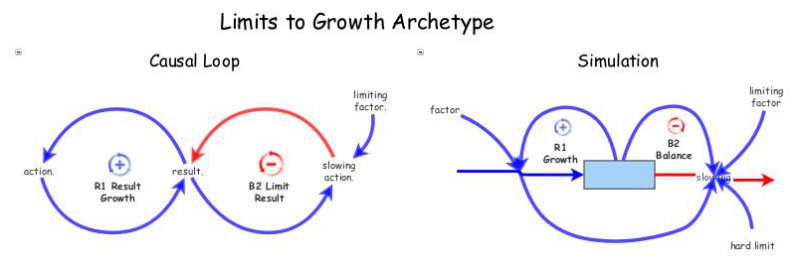
For a writer, this is a foundational principle of creating conflict. Acclaimed fantasy author Brandon Sanderson calls it his "Second Law of Magic," but as he notes, it's really a universal law of storytelling.
To grasp this concept from a writer's perspective, please read selections from Brandon Sanderson's essay, 'Sanderson's Second Law.' He argues that a character's limitations are far more interesting than their powers.
Please read the following parts of the essay: The Law: The introduction explaining the core concept using Superman as an example. Struggle: This subsection explains how limitations force characters to be more clever, making scenes more interesting. Tension: This short part explicitly connects limitations to narrative tension. Limitations vs. Weaknesses vs. Costs: Read the part of this section that defines Limitations and Costs. This provides a practical framework for thinking about what kind of constraint to apply.
As Sanderson explains, limitations force characters to work for their goals and make choices. When a resource is infinite, choices are meaningless. When a resource is scarce, every choice has weight. In your story, the "growth" is the deepening connection between the hinge and her new lover. The "limiting factor" will be a scarce resource that this growth consumes, creating a bottleneck.
2. The Bottleneck in Polyamory: Polysaturation
What are the most potent limiting factors in a relationship, especially a non-monogamous one? The answer is almost always time and emotional energy. Your background as a social researcher gives you a unique insight into the complexities of managing relational resources.
The following article from the blog Poly.Land provides a candid, real-world account of this exact dynamic. The author coins a term for it: "polysaturation."
All Stress Polysaturates You – Work, Home, Love - Poly.Land
This article, 'All Stress Polysaturates You – Work, Home, Love,' offers a powerful case study of how finite personal resources create a bottleneck in polyamorous relationships.
Please read these key sections: Work Stress: Notice how an external factor (a demanding job) directly impacts the author's capacity for relationships. It All Polysaturates You: This section defines the core concept—how stress from all areas of life combines to exhaust a person's bandwidth. Managing Unequal Resources: This is the most crucial part. Focus on the famous polyamory adage, 'Love is infinite. Time and energy are not,' and how unequal access to these resources creates tension.
The article provides the perfect model for our story's next stage. The hinge is the central node in the vee, and therefore, her time and emotional energy are the system's primary limiting factors. Both her husband and her new lover require these resources. The 'Fixes that Backfire' trap you set in the last lesson is already draining her emotional reserves by fueling her husband's insecurity.
Now, we will tighten the screws by making the demand for her resources exceed the supply, forcing a difficult choice.
3. Writing Exercise: Engineering the Bottleneck (35 minutes)
Your task is to design a scenario based on a limiting factor that forces the hinge into a zero-sum choice between her husband and her new lover.
Step 1: Choose Your Limiting Factor (5 mins)
Select the primary resource that is becoming scarce for the hinge. Be specific.
- Time: Is it her demanding career? An external family obligation? The simple fact that there are only 24 hours in a day, and she's trying to maintain the quality of two distinct relationships?
- Emotional Bandwidth: Is the constant emotional labor of managing her husband's growing insecurity (a direct result of our last lesson) leaving her too drained to be present and engaged in her new relationship?
For maximum impact, you can combine them: a stressful work project hits at the exact time her husband's need for reassurance is peaking.
Step 2: Design the Impossible Choice (10 mins)
Now, create a specific situation where two competing, legitimate needs collide, forcing the hinge to choose. The choice must feel impossible, with high stakes on both sides.
Here are two structural examples based on the factors above. Use one as a template or create your own.
-
The Time-Based Choice:
- The Husband's Bid: He plans a special anniversary trip, a "make or break" attempt to reconnect and reaffirm their primacy. It's a direct bid to reinforce the boundaries of their marriage.
- The Lover's Bid: The new lover invites her to a once-in-a-lifetime event (e.g., a family wedding, a major career celebration) that falls on the same weekend. Attending would signify a major step forward in their relationship, making it more 'real'.
- The Dilemma: She literally cannot be in two places at once. Rejecting her husband's trip confirms his worst fears of being replaced. Rejecting her lover's invitation signals that their relationship has a hard ceiling and will always be secondary.
-
The Energy-Based Choice:
- The Husband's Bid: His insecurity (amplified by the 'backfiring fix') boils over into a major emotional crisis. He needs her full, undivided attention and support to feel secure. He might say, "I just need you tonight. No distractions, no texts. Just us."
- The Lover's Bid: The new lover, unaware of the crisis at home, chooses this exact moment to become deeply vulnerable, perhaps revealing a past trauma or a profound fear, and needs her emotional support and presence.
- The Dilemma: She doesn't have the emotional bandwidth to be fully present for two people in crisis simultaneously. Dividing her attention means failing both. Devoting it to one means actively neglecting the other at a moment of critical need.
Step 3: Write the Scene (20 mins)
Write the scene (approx. 400-500 words) where this impossible choice crystallizes. You don't have to show her making the decision yet. The goal of this scene is to present the dilemma in its starkest terms.
- Show, Don't Tell: Start by showing the hinge's state of 'polysaturation.' Is she exhausted, distracted, dropping balls at work or home?
- Layer the Demands: Have the two "bids" for her resources arrive in a way that maximizes pressure. Does one interrupt the other? Do they arrive via text message minutes apart?
- Focus on the Hinge's Internal Reaction: The climax of the scene is the moment she understands she is trapped. Let us see the panic, the frantic calculations, the feeling of being torn in two. End the scene on this moment of crisis, leaving the reader (and the hinge) hanging on the precipice of a painful decision.
This exercise will create a powerful turning point, escalating the story's tension from a general state of unease to a specific, unavoidable conflict.
Conclusion
Today, you've weaponized scarcity by applying the 'Limiting Factor' archetype. You've seen how constraints on resources like time and emotional energy don't weaken a story—they are the very things that give it tension and force characters to reveal themselves.
Key Takeaways:
- A Limiting Factor is a constraint that brings a period of growth to a halt, creating a crisis.
- In relationship narratives, the most effective limiting factors are often finite resources like time and emotional energy ("polysaturation").
- The function of a limiting factor in a plot is to engineer a difficult, zero-sum choice that exposes a character's true priorities and raises the stakes.
In our next lesson, we'll explore 'Accidental Adversaries.' The scenario you just created—where two men are now in direct competition for the hinge's limited resources—is the perfect setup for a dynamic where they begin to undermine each other, even if neither of them is intentionally malicious. The system itself will turn them into rivals.