Introduction
In our last lesson, you constructed a powerful conflict engine using the 'Accidental Adversaries' archetype. You set the husband and the new lover on a path where their reasonable, individual attempts to secure their relationships with the hinge inadvertently sabotage one another. This has created a cycle of escalating misunderstanding and friction.
Today, we will explore the consequences of that dynamic through the lens of our next system trap. This lesson addresses the learning outcome: Apply 'Tragedy of the Commons' to create tension as emotional resources are perceived as finite and competed over.
The 'limiting factor' of the hinge's time and energy, which you previously established, now becomes the central battleground. We will define this finite emotional capacity as a shared, depletable resource—a 'commons'. The adversarial actions of the husband and lover will be framed as the unsustainable overuse of this commons, threatening the stability of the entire relationship system and, most importantly, the well-being of the hinge at its center.
1. Understanding the 'Tragedy of the Commons'
At its core, the 'Tragedy of the Commons' describes a situation where multiple individuals, acting independently in their own self-interest, end up depleting a shared resource, which is to the detriment of all.
To get a quick and clear sense of this dynamic, let's start with a short video.
Tragedy of the Commons │ The Problem with Open Access
The video 'Tragedy of the Commons │ The Problem with Open Access' from This Place offers a concise explanation of the core concept using the classic example of a shared pasture.
Please watch the following parts: 00:00 - 01:30: This section explains how individual herdsmen adding animals for personal gain ultimately degrades the shared pasture for everyone. 01:52 - 03:00: Pay close attention to the conclusion here. The key insight for our story is that the 'tragedy' tends to occur not just when people don't communicate, but when they can't or feel they can't work together—exactly the adversarial situation you've created.
The structure of this system can be visualized. Given your background in statistics and complex systems, this causal loop diagram should provide a clear architectural view of the forces at play.
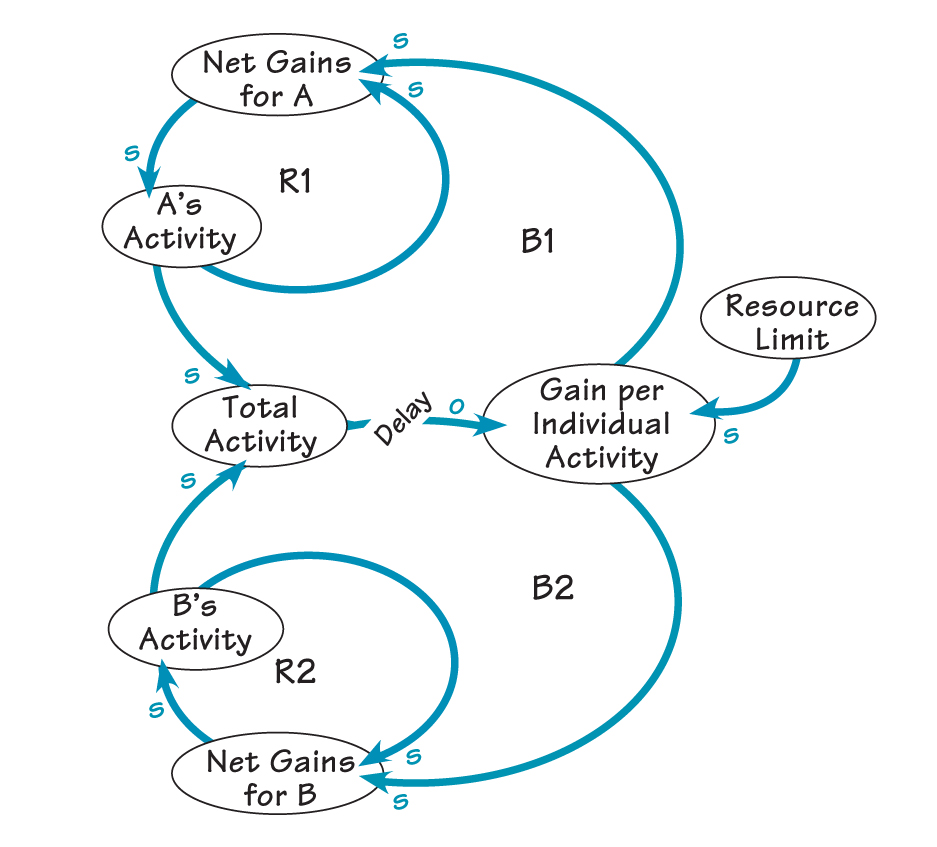
In your story:
- Actor A: The husband.
- Actor B: The new lover.
- A's/B's Activity: Actions taken to secure more time, attention, or reassurance from the hinge.
- The Limited Resource (The Commons): The hinge's emotional energy, time, and psychological well-being.
The crucial first step in applying this archetype is to precisely identify the 'commons'. The following text explores this challenge.
Tragedy of the Commons: All for One and None for All
The article 'Tragedy of the Commons: All for One and None for All' from The Systems Thinker provides a deeper look at the archetype and the importance of defining the shared resource.
Please read the section titled 'Common “Commons”'. Focus on the central point: effective solutions are impossible until everyone agrees on what the shared resource is. In your story, the characters' failure to see the hinge's well-being as the true 'commons' is a primary source of tension.
2. Translating the 'Commons' to Emotional Logistics
Now, let's connect this economic and systems theory directly to the world of your story. The concept of a shared resource being depleted by competition is not just an analogy for polyamorous dynamics; it is a core operational reality.
The following resource is exceptionally useful as it explicitly frames metamour relationships in terms of managing finite emotional resources.
polyamory metamour dynamics emotional logistics
The article 'polyamory metamour dynamics emotional logistics' provides a sophisticated analysis of how time, attention, and 'psychic bandwidth' function as shared, finite assets in a vee relationship.
Please read the following two sections: 'concept': This opening section is critical. It defines the hinge's time, attention, and psychic bandwidth as the "finite assets" and "shared resources" of the relationship constellation. This is your story's 'commons'. 'manifestations of friction and required emotional work': Read the bullet points in this section, especially 'The ‘New Relationship Energy’ (NRE) Buffer' and 'The Comparison Trap'. These are perfect examples of the 'Tragedy of the Commons' in action, where one person's gain is perceived as another's loss, triggering competition and draining the hinge's emotional energy through the need for reassurance and management.
This article gives you the precise vocabulary and scenarios to depict the 'Tragedy of the Commons' in your story. The competition is not for land or fish, but for emotional presence, security, and validation—all of which are drawn from the hinge, the central, limited resource.
3. Writing Exercise: Depicting the Depleted Commons (30 minutes)
Your previous scenes have focused on the perspectives of the husband and the lover, showing how they became 'Accidental Adversaries'. Now, it's time to show the impact of their conflict. You will write a scene from the hinge's point of view as she experiences the depletion of her own emotional resources.
Step 1: Define the Competing Demands (5 mins)
The husband and lover, acting in their own self-interest, are now making escalating demands on the hinge's time and energy to secure their positions.
- Husband's Demand: Building on his fear of being encroached upon, he might insist that the hinge's phone is turned off and left in another room for a few hours every evening so they can have "protected time." His goal is to secure his piece of the 'commons'.
- Lover's Demand: Feeling shut out by the new phone rule and the general tension, he might ask for a "guaranteed" 15-minute video call every night before bed, no matter what, to feel that his connection is still real and valued. His goal is to secure his piece of the 'commons'.
Neither demand is inherently unreasonable, but together, they box the hinge in.
Step 2: Write the Scene from the Hinge's POV (25 mins)
Write a scene (approx. 400-500 words) that shows the hinge trapped between these two demands.
- Show, don't tell the exhaustion. Begin the scene with her feeling the weight of being a logistical and emotional manager. Use internal monologue to show her mental state—is she frazzled, resentful, anxious?
- Illustrate the conflict in action. Depict an evening where she is trying to honor both commitments. Perhaps she's having her "protected time" with her husband, but she's anxiously clock-watching, knowing she has to make the video call soon. The husband senses her distraction, which makes him more insecure and demanding, further draining her.
- The 'Tragedy' materializes. The hinge makes a mistake due to the strain. Maybe she's abrupt with her husband to end the conversation so she can make the call. Or she's late for the call, and her lover is hurt. Or she's so tired during the call that she's emotionally distant.
- End with the depleted resource. The scene should conclude not with a resolution, but with a sense of loss for everyone. The husband feels less secure, the lover feels less connected, and the hinge is left feeling drained and depleted. The 'commons' has been overgrazed, and the quality of the 'pasture' has diminished for all.
Conclusion
In this lesson, you applied the 'Tragedy of the Commons' archetype to transform a simple rivalry into a systemic crisis. By defining the hinge's emotional capacity as a shared, finite resource, you have created a powerful source of tension where the characters' individual pursuits of happiness threaten to destroy the very foundation of their relationships.
Key Takeaways:
- 'Tragedy of the Commons' occurs when individuals acting in their own self-interest deplete a shared resource, leading to a worse outcome for the entire group.
- In your vee relationship story, the 'commons' is the hinge's finite time, attention, and emotional energy ("psychic bandwidth").
- The husband and lover, as 'Accidental Adversaries', each attempt to claim more of this resource, inadvertently draining it and harming the stability of the relationships they are trying to secure.
- Shifting the point of view to the hinge is an effective technique to show the consequences of this dynamic—the depletion and exhaustion of the 'commons'.
This scene you've conceptualized is a crucial crisis point. In our next and final lesson of this module, you will refine and write this scene as the culmination of the 'FLAT' system traps we've explored. You will bring the tension built through 'Fixes that Backfire,' 'Limiting Factor,' 'Accidental Adversaries,' and now 'Tragedy of the Commons' to a head, driving the plot toward a necessary confrontation.