Introduction
Welcome back. In our last two lessons, we explored how system traps create cascading conflicts. First, with 'Drifting Goals', we saw Vera begin to compromise on her marital standards for the sake of short-term peace. This set the stage for 'Success to the Successful', where the new, exciting relationship with Leo started drawing emotional resources away from her marriage, creating a significant power imbalance and leaving Henry feeling sidelined.
This competition for resources—Vera's time, energy, and affection—has created a fertile ground for rivalry. Today, we'll ignite that rivalry using the 'Escalation' archetype. This trap describes a dynamic where two parties, perceiving each other as a threat, get caught in a self-reinforcing loop of action and reaction, with each move provoking a stronger counter-move.
Your goal for this lesson is to write a pivotal scene where this rivalry spiral between Henry and Leo kicks into high gear. This will dramatically increase the story's tension, making the current situation unsustainable and pushing the characters toward a crisis point—a necessary step to make the final resolution of consented intimacy feel both earned and inevitable.
1. Understanding the 'Escalation' Archetype
'Escalation' occurs when one person's actions are seen as a threat by another, prompting a reaction that the first person then also perceives as a threat, leading to a retaliatory spiral. It's an arms race, whether with weapons, price cuts, or, in our case, bids for affection and status.
To understand the mechanics of this trap, please read the following material.
The document 'Systems Archetypes II' provides an excellent breakdown of the 'Escalation' archetype. It details how the dynamic of insecurity and competition creates a reinforcing loop.
Please read the section titled 'USING “ESCALATION” TO CHANGE THE COMPETITIVE GAME' (starts on page 12). As you read, focus on how the actions of one party create 'insecurity' in the other, compelling a reaction. The seven-step process is designed to break the cycle, but for our purposes, you can use it as a recipe for creating one.
The core driver of this archetype is mutual insecurity. Each party is simply trying to maintain its position relative to the other, but in doing so, they collectively create a situation that spirals out of control.
This graph visually captures the accelerating nature of an escalation spiral.
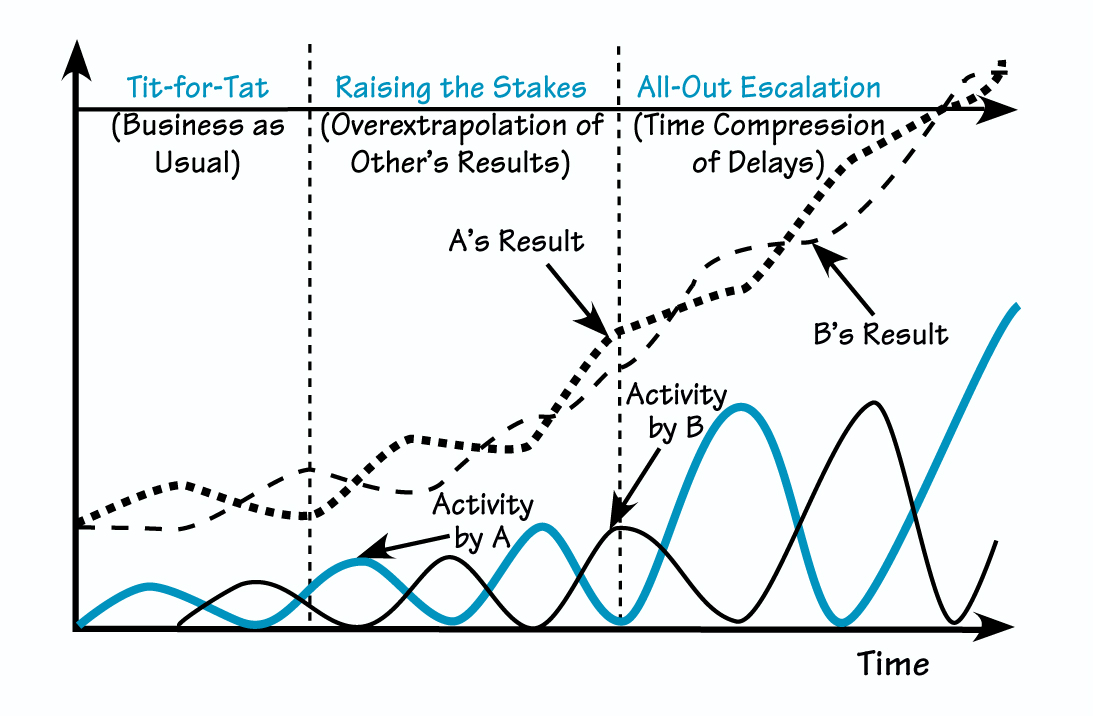
For your story, these phases provide a powerful narrative structure for building conflict over several scenes. Today, we'll focus on triggering the "Raising the Stakes" phase.
2. Mapping 'Escalation' to the Vee Relationship
Your story is perfectly primed for this archetype. The 'Success to the Successful' dynamic has already defined the competitive landscape. Now, we'll make the competition explicit.
- The Players: Henry and Leo.
- The Perceived Threat: Each man feels threatened by the other's claim on Vera's time, intimacy, and status as a partner.
- The Competitive Variable: The central point of competition is demonstrating who has a "better" or "more legitimate" connection to Vera. This can manifest in several ways:
- Shared History vs. Present Passion: Henry can leverage his deep, historical bond, while Leo can leverage the excitement of the new and passionate connection.
- Stability vs. Adventure: Henry represents security and domesticity. Leo represents novelty and romantic escape.
- Public Status vs. Private Intimacy: Henry holds the public title of "husband." Leo can counter this by highlighting the unique, private intimacy he shares with Vera.
The dynamic works like this:
- Action (Henry): Henry makes a move to assert his primary status and connection to Vera.
- Threat Perception (Leo): Leo sees this not as a natural expression of a marriage, but as a competitive move designed to diminish him.
- Reaction (Leo): Leo feels compelled to retaliate with a counter-move that re-establishes his own value and connection, often by "raising the stakes."
- Threat Perception (Henry): Henry now sees Leo's reaction as an aggressive challenge to his role as husband.
- Reaction (Henry): The cycle continues, and the spiral tightens.
Vera is the prize, the audience, and the referee in this contest, a deeply uncomfortable position that will force her toward seeking a definitive resolution.
3. Writing Exercise: Igniting the Spiral (30 minutes)
Your task is to write a pivotal scene where this escalation dynamic is explicitly triggered. This scene should move the conflict from a passive state of imbalance ('Success to the Successful') to an active state of rivalry ('Escalation').
Scenario:
All three characters—Vera, Henry, and Leo—are together in a shared domestic space, like the living room. The evening is underway, and the tension from the power imbalance is already present.
Instructions:
Write a scene that follows the 'Escalation' pattern.
- Set the Stage: Begin with the quiet tension of the imbalanced Vee. Perhaps Vera is giving more of her attention to Leo, a continuation of the previous scene's dynamic. Henry is feeling the chill.
- The First Move (Henry): Have Henry make a subtle but clear move to assert his primacy. This should be an action that only a husband could take, leveraging their shared history.
- Example: He could casually bring up a deeply personal memory only he and Vera share, saying something like, "This reminds me of that little hotel we found in Prague, remember, love?" This creates an exclusive bubble around the two of them.
- Example: He might perform a gesture of familiar domestic intimacy, like walking behind Vera and fixing her collar or kissing the top of her head in a way that feels proprietary.
- Show the Threat (Through Leo's Eyes): Briefly shift the focus to Leo. Show him register Henry's move. He should feel a sting of exclusion, a challenge to his place. The move makes him feel like a guest, not a partner.
- The Counter-Move (Leo): Leo now needs to retaliate by "raising the stakes." His move should shift the battlefield from Henry's strength (history) to his own (passion, novelty).
- Example: In response to the Prague memory, Leo could smile and say to Vera, "Speaking of trips, I was just thinking about that hike last weekend. I've never seen you look as beautiful as you did with the sun in your hair at the summit." He has now created a new, more recent, and more passionately framed exclusive memory.
- Example: After Henry's domestic gesture, Leo could wait for a moment and then take Vera's hand, look her directly in the eyes, and say something intensely personal and forward-looking, like, "I can't wait for our weekend away." This counters stability with future adventure.
- The Impact: End the scene by showing the impact on all three. Henry is now the one who feels challenged and on the back foot. Leo feels he has re-established his position. And Vera is caught squarely in the middle of their escalating rivalry, the air thick with unspoken competition. The problem has just become much more acute.
Conclusion
In this lesson, you've weaponized the 'Escalation' archetype to transform a passive power imbalance into an active, unsustainable rivalry. This is a crucial step in plot construction, as such spirals cannot continue indefinitely. They build pressure until the system either breaks or is forced into a new state.
Key Takeaways:
- 'Escalation' creates a reinforcing loop of action and reaction between competitors, driven by mutual insecurity.
- In the vee story, this manifests as a rivalry between Henry and Leo for status and affection, with each man's move provoking a stronger counter-move from the other.
- This dynamic raises the emotional stakes dramatically, making the situation untenable for all three characters.
- By writing a scene that ignites this spiral, you have created a powerful engine for future conflict and have increased the urgency for the story's final resolution.
Preview of the Next Lesson:
We have now explored several system traps that generate external friction between characters. However, the most compelling conflicts are often internal. In our next module, we will dive into the Decision Paradoxes, starting with the 'Hedgehog's Paradox.' This will allow us to explore the painful internal dilemma Vera now faces: the closer she gets to either partner, the more she risks hurting them—and herself.