Introduction
Welcome back. In our last lesson, we explored the 'Drifting Goals' archetype, where you crafted a scene showing Vera beginning to lower her standards for her marriage. To avoid the exhausting conflict of the 'Escalation' spiral between Henry and Leo, she chose to ignore a "broken window"—a small transgression—effectively trading her long-term vision for short-term peace.
This compromise, however, doesn't resolve tension; it transforms it. Today, we will explore the direct consequence of that drift: the 'Success to the Successful' system trap. This archetype explains how, when two parties compete for a limited resource, the one that gets an early advantage will attract more resources, leading to its own upward spiral of success while the other is starved into a downward spiral.
Our goal is to apply this to your story, creating an imbalance-driven conflict where the new, exciting relationship with Leo begins to thrive at the direct expense of the strained marriage with Henry. This will make Henry's growing anxiety and the escalating friction feel deeply rooted and psychologically inevitable.
1. Understanding the 'Success to the Successful' Archetype
At its core, this archetype describes how initial success becomes a self-fulfilling prophecy. A system is created, intentionally or not, that "bets on the winner."
To start, let's watch a brief overview of this concept.
The 'System Archetypes' video by the Systems Innovation Network provides a concise definition of the 'Success to the Successful' dynamic.
Please watch the section from 04:43 to 05:22. Notice how it describes two activities competing for limited resources and how initial success for one starves the other.
This dynamic is not just about abstract "activities"; it's about how we allocate resources based on perceived success. The following article provides two powerful narrative examples.
Success to the Successful: Self-Fulfilling Prophecies
The article 'Success to the Successful: Self-Fulfilling Prophecies' from The Systems Thinker uses excellent analogies that we can map directly onto your story.
Please read the sections 'Self-Fulfilling Prophecies' and 'Balancing Work and Family'. Pay close attention to the 'Stan and Frank' example and how the manager's resource allocation creates a winner. The 'Work and Family' example is a direct parallel to the choice Vera faces between her two relationships.
As the article illustrates, this isn't necessarily a malicious process. The manager thinks they're making a rational choice by backing Stan. Similarly, a person in the 'Work vs. Family' scenario feels they are responding logically to demands and rewards. The structure itself creates the outcome.
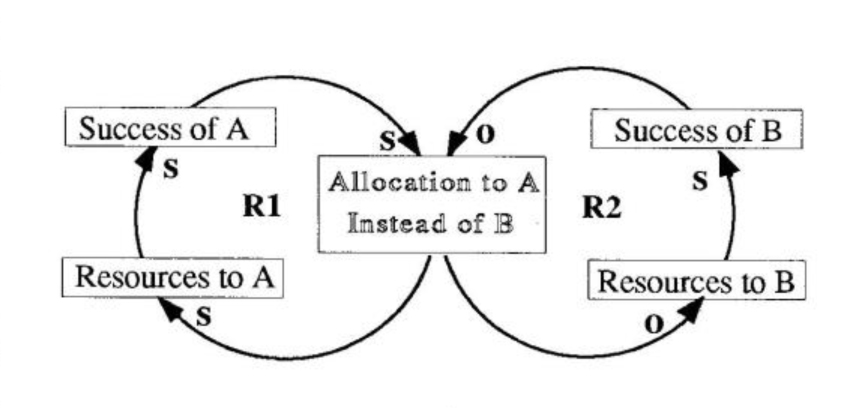
Here is the causal loop diagram for this archetype, which visually represents the two competing feedback loops.
2. Mapping 'Success to the Successful' to the Vee Relationship
Let's translate this diagram into the emotional economy of your story. The 'Drifting Goals' from our last lesson have created the perfect initial conditions for this trap.
-
The Competitors:
- A: The new relationship (Vera & Leo).
- B: The established marriage (Vera & Henry).
-
The Limited Resource: Vera's time, attention, emotional energy, and enthusiasm.
-
The Reinforcing Loops:
- Success Loop (R2 - Leo): The relationship with Leo is new, exciting, and rewarding. When Vera invests her energy here, she receives validation and positive feedback. This feels good, so she is motivated to invest more energy, creating an upward spiral.
- Failure Loop (R1 - Henry): The marriage is now tense and difficult. Because of Vera's 'Drifting Goals', addressing issues is draining. When she invests energy here, she often encounters Henry's anxiety or the underlying conflict, which feels like a punishment. She is therefore motivated to invest less energy, creating a downward spiral.
Henry isn't just imagining things; he is experiencing the systemic starvation of his relationship. The new relationship's success is directly causing the marriage's decline by consuming the resources it needs to survive and repair itself.
3. Power, Options, and Imbalance
Given your background in social research, you know that this resource imbalance is fundamentally about a shift in power dynamics. 'Success to the Successful' creates power imbalances.
Let's explore this idea further through the lens of optionality and commitment, which are core to relational power.
Who has more POWER in a RELATIONSHIP: three easy ways to make the determination
The video 'Who has more POWER in a RELATIONSHIP' by Orion Taraban discusses practical ways to identify power imbalances. This will help you ground the systemic trap in concrete character psychology.
Please watch from 02:50 to 03:39 and from 05:27 to 07:48. Focus on two key ideas: the person who is less committed has more power, and the person with more options has more power. Consider how these apply to Henry, Vera, and Leo.
Applying this to your story:
- Optionality: By definition, Vera has increased her options. Leo, being less entangled, also has more optionality than Henry, whose life is deeply intertwined with the marriage. From Henry's perspective, he has the fewest options, placing him in the least powerful position.
- Commitment: As Vera invests more in the 'successful' new relationship, Henry will perceive her commitment to the marriage as waning. This perceived shift dramatically amplifies his insecurity and the power imbalance.
The 'Success to the Successful' archetype provides the mechanism by which this power shift happens. The growing success of the new relationship gives Vera a rewarding alternative, making her less dependent on the marriage for fulfillment and thus shifting the balance of power away from Henry.
4. Writing Exercise: The Tipping Point (30 minutes)
Your task is to write a scene that dramatizes this imbalance. You will show Vera allocating a key resource to the "successful" relationship (Leo) at the expense of the "struggling" one (Henry), and crucially, you will show the impact this has on Henry.
Scenario:
Vera is at home with Henry. The atmosphere is tinged with the unresolved tension from the previous scenes. Vera is tired or distracted. She then receives a message from Leo, which presents a clear choice for how to spend her immediate time or energy.
Instructions:
Write a scene where this choice plays out, focusing on creating imbalance-driven conflict.
- Establish the 'Failure Loop': Start by showing the low-energy state of the marriage. Henry might be trying to connect, but it's strained. Vera feels the drain of the situation. This is the "downward spiral" of their dynamic.
- Introduce the 'Success Loop': A text, call, or memory of Leo injects a spark of energy and excitement. This is the promise of a positive return on her emotional investment.
- The Resource Allocation: Vera makes a choice. She diverts her attention and energy from Henry to Leo.
- Example: Henry is trying to talk about something important (e.g., their weekend plans, a household issue), but Vera gives him a one-word answer while smiling at a text from Leo. She becomes animated and engaged with her phone, a stark contrast to her listlessness with Henry.
- Example: Henry suggests they watch a movie together, but Vera says she's too tired. A moment later, she gets a call from Leo and her entire demeanor changes—she's energetic, laughing, and agrees to a spontaneous plan with him for later.
- Show the Impact on Henry: This is the most critical part. Let the reader see the effect of this resource diversion through Henry's eyes. He is not just seeing his wife happy; he is seeing the energy that used to be for him now being redirected elsewhere. He should look and feel "sidelined," just as the archetype predicts. Capture his feeling of being in a failing enterprise while witnessing a successful one flourish right in front of him.
- End with Reinforcement: Conclude the scene with Vera's internal state. She might feel a flicker of guilt, but it should be overwhelmed by the positive feeling from her interaction with Leo. This reinforces her decision, locking the archetype's structure more firmly into place.
Conclusion
Today you've weaponized a powerful system trap to create a deeply psychological and realistic conflict. By applying 'Success to the Successful', you've engineered a situation where Vera's rational pursuit of positive emotional returns actively starves her marriage, creating a painful and visible imbalance.
Key Takeaways:
- 'Success to the Successful' creates a self-reinforcing dynamic where resources (like time and emotional energy) are funneled to a "winner," causing the "loser" to decline further.
- In the vee story, this manifests as the new, exciting relationship with Leo thriving at the expense of the tense, strained marriage with Henry.
- This dynamic is driven by a feedback loop: positive experiences with Leo encourage more investment, while negative experiences with Henry discourage it.
- This resource imbalance creates a tangible power shift, leaving Henry in an increasingly insecure and powerless position, which is a potent source of narrative friction.
Preview of the Next Lesson:
The conflict you've just created—where one relationship thrives as the other withers—sets the stage for a new and painful dilemma for Vera. As she tries to navigate this imbalance, she may find that any attempt to get closer to one partner pushes the other away. In our next module, we will begin exploring Decision Paradoxes, starting with the 'Hedgehog's Paradox': the closer you get, the more it hurts.