Introduction
Welcome back. In our last lesson, we ignited a conflict using the 'Escalation' archetype. You wrote a powerful scene where Henry and Leo, no longer able to suppress their anxieties, began a subtle but vicious rivalry. Vera is now caught in the crossfire, and the fragile peace has shattered. This pressure cooker environment is the perfect catalyst for our topic today: the system trap of 'Drifting Goals'.
This archetype explains what happens when a persistent gap between our desired state and our current reality makes us lower our standards over time. Instead of taking corrective action to meet the goal, we bring the goal down to meet reality.
Today's objective is to apply this concept to Vera. We will explore how the relentless pressure from the escalating rivalry causes her to gradually compromise her original values for the vee relationship. This drift won't bring peace; instead, it will generate a new, insidious friction as she slowly loses sight of what she originally wanted, making the eventual resolution feel even more hard-won.
1. The Anatomy of 'Drifting Goals'
The 'Drifting Goals' archetype is fundamentally about the path of least resistance. When faced with a difficult problem, there are two responses: solve the problem or redefine the problem as acceptable.
This is a common pattern in organizations and personal lives. The image below provides a concise summary from a systems thinking perspective.
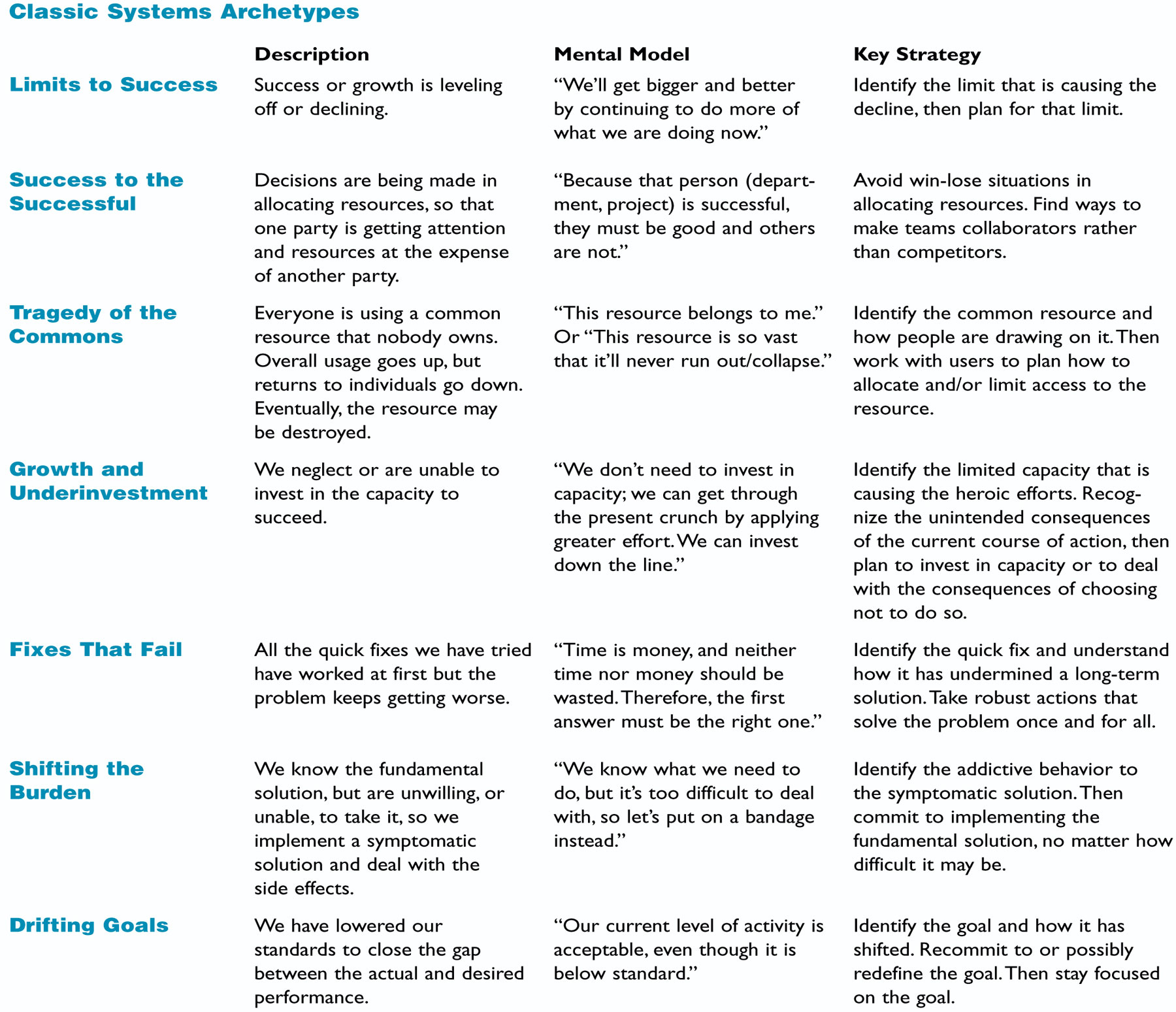
As you can see, the core mental model is, "Our current level of activity is acceptable, even though it is below standard." For Vera, this translates to, "This constant fighting is terrible, but maybe just keeping the peace is a more realistic goal than perfect harmony."
The dynamic is driven by two competing feedback loops, as shown in this causal loop diagram:
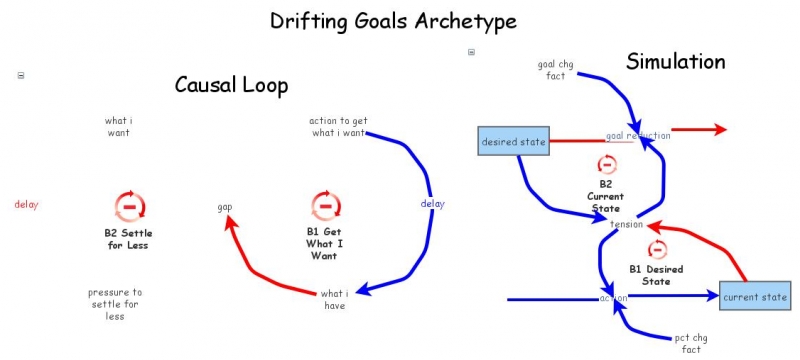
In your story:
- Vera's Goal (What I Want): A healthy, ethical vee relationship built on trust, open communication, and mutual respect.
- The Gap: The current reality of rivalry, passive-aggression, and tension between Henry and Leo.
- Loop B1 (Corrective Action): Vera confronts the men, enforces boundaries, and facilitates difficult conversations to bring the relationship back to her standards. This is hard and creates immediate conflict.
- Loop B2 (Compromising Action): Vera avoids confrontation, placates the men, and tells herself that her original goals were naive. This is easier in the short term but erodes the foundation of the relationship.
Today, we're focusing on what happens when Vera chooses Loop B2.
2. Drifting Goals as a 'Fall Arc'
From a storytelling perspective, a character experiencing 'Drifting Goals' is on a Fall Arc. Their moral or ethical standards are in decline, not through a single evil choice, but through a series of small, seemingly justifiable compromises.
The following resource provides an excellent framework for plotting this kind of character journey.
Writing a Fall Arc: How to Show a Character's Moral Decline
The article 'Writing a Fall Arc' by K.M. Weiland explains how a character's refusal to face a difficult truth can lead them down a path of moral decline. This perfectly maps onto the 'Drifting Goals' archetype.
Please read the article from the beginning down to the section 'The “Worse Lie” in a Fall Arc'. Focus on how a character starts with a 'Lie' (a limited perspective), rejects a 'Truth' (the hard choice), and slides into a 'Worse Lie' (the compromised goal).
Let's apply this structure to Vera:
- The Original Lie: Vera's initial belief might be, "I am skilled enough to manage everyone's feelings and ensure this transition is perfectly smooth." This is a limited perspective, not a malicious one.
- The Catalyst: The 'Escalation' spiral between Henry and Leo. This shatters her belief that she can manage everything perfectly.
- The Moment of Truth: Vera realizes that to maintain her original vision, she must enforce painful boundaries and risk one or both relationships collapsing.
- Rejection of Truth & Embracing the Worse Lie: Unwilling to risk that collapse, she chooses the path of least resistance. The 'Worse Lie' she begins to believe is, "My primary role is to be a peacemaker. My original ideals of perfect openness and honesty are less important than just stopping the fighting."
This shift—from upholding a principle to simply managing a conflict—is the essence of her drifting goal.
3. The 'Broken Windows' Analogy
A powerful real-world analogy for 'Drifting Goals' is the "Broken Windows Theory." It posits that visible signs of disorder, like a single broken window left unrepaired, encourage further disorder and crime.
This concept applies directly to personal boundaries and relationship standards.
The Broken Windows Theory Applied to Boundaries & Self-Esteem
The article 'The Broken Windows Theory Applied to Boundaries & Self-Esteem' by Natalie Lue offers a fantastic metaphor for how 'Drifting Goals' works in relationships.
Please read from the beginning of the article down to the paragraph that ends, '...where you let one thing slide, more follows.' Pay attention to how every unaddressed boundary crossing is a 'broken window' that signals acceptance of lower standards.
Each time Vera fails to address a transgression from Henry or Leo to avoid a fight, she's leaving a 'broken window' in the structure of her relationship.
- Henry makes a sarcastic comment about Leo's presence? A small broken window.
- Leo subtly tries to exclude Henry from a conversation? Another broken window.
By not "repairing" these windows—by not enforcing her original standards—Vera is subconsciously signaling that this new, lower-standard behavior is acceptable. The pressure from the 'Escalation' dynamic makes it feel easier to ignore the windows than to fix them, causing her goals to drift. The extensive comments section in that article provides a rich source of authentic voices describing this exact experience, which can be valuable for capturing Vera's internal state.
4. Writing Exercise: The First Crack (25 minutes)
Now, let's write the scene where Vera's goals visibly begin to drift. This should show her consciously choosing the compromising loop (B2) over the corrective loop (B1).
Scenario:
Following the initial 'Escalation' scene, the tension between Henry and Leo is high. One of them (you choose who) commits another subtle act of rivalry in front of Vera. This could be a possessive gesture, a passive-aggressive remark, or an attempt to claim her attention in a way that excludes the other.
Instructions:
Write a scene that demonstrates Vera's goals beginning to drift under this pressure.
- Re-establish the Ideal: Start with a brief moment of Vera's internal thought, reminding the reader of her original vision for the vee (e.g., "This was supposed to be about honesty and joy, not... this."). This clarifies her starting goal.
- The 'Broken Window': One of the men acts out. Make the action a clear violation of her original principles but subtle enough that she could ignore it.
- The Crossroads (Internal Conflict): Show Vera's internal debate. She recognizes the transgression and knows she should address it (Corrective Loop B1). But she also weighs the immediate, exhausting conflict that will follow. She feels the pull to just smooth it over (Compromising Loop B2).
- The Drift: Vera makes her choice. Instead of confronting the behavior, she placates, changes the subject, or rationalizes it away. Show her actively choosing to "settle for less" to avoid an immediate fight.
- The Aftermath: End the scene with Vera's internal reaction to her own compromise. She might feel a fleeting sense of relief, but it should be immediately followed by a pang of unease, guilt, or self-betrayal. She has just traded a piece of her long-term vision for a moment of short-term peace. This creates the friction your story needs.
Conclusion
In this lesson, you've layered a new, more subtle form of tension onto your story using the 'Drifting Goals' archetype. By putting Vera under pressure, you've forced her to a critical juncture where she begins compromising her own values to manage the conflict between Henry and Leo.
Key Takeaways:
- 'Drifting Goals' is a system trap where the path of least resistance leads to lowering one's standards instead of solving the underlying problem.
- The 'Broken Windows Theory' provides a powerful metaphor for how small, unaddressed boundary violations accumulate, signaling that lower standards are acceptable.
- Narratively, 'Drifting Goals' can be structured as a 'Fall Arc', where a character's series of small compromises leads to a gradual moral or ethical decline.
- This creates friction by putting the character in conflict not just with others, but with her own original principles.
Preview of the Next Lesson:
Vera's drifting goals will have consequences. As the standards for her marriage begin to erode in the name of "peacemaking," the new relationship with Leo might appear more successful and rewarding by comparison. In our next lesson, we will explore the 'Success to the Successful' archetype. You will design a scenario where the new relationship's growth starves the original marriage of resources (time, energy, emotional investment), creating a dangerous imbalance that will pour fuel on the fire of Henry's and Leo's rivalry.