Introduction
Welcome back. In our last lesson, you applied the 'Shifting the Burden' archetype to establish a fragile and unsustainable dynamic. By casting Vera as the reluctant mediator between her husband, Henry, and her new lover, Leo, you've created a system dependent on a single point of failure. This "quick fix" provides temporary peace but prevents Henry and Leo from developing the skills to manage their relationship directly.
This dependency creates the perfect conditions for our next system trap: 'Growth and Underinvestment.' With Vera absorbing the immediate friction, Henry is shielded from the acute need to confront his own insecurities. The demands of the growing vee relationship continue to mount, while his own emotional capacity to handle them stagnates. This is the underinvestment.
Today, you will use this archetype to build a powerful, simmering tension. You will show Henry neglecting his own emotional needs, not out of malice, but as a predictable response to a system that allows him to. This will create a "ticking time bomb" in your narrative, making the eventual crisis feel both inevitable and deeply personal.
1. The 'Growth and Underinvestment' Archetype in Relationships
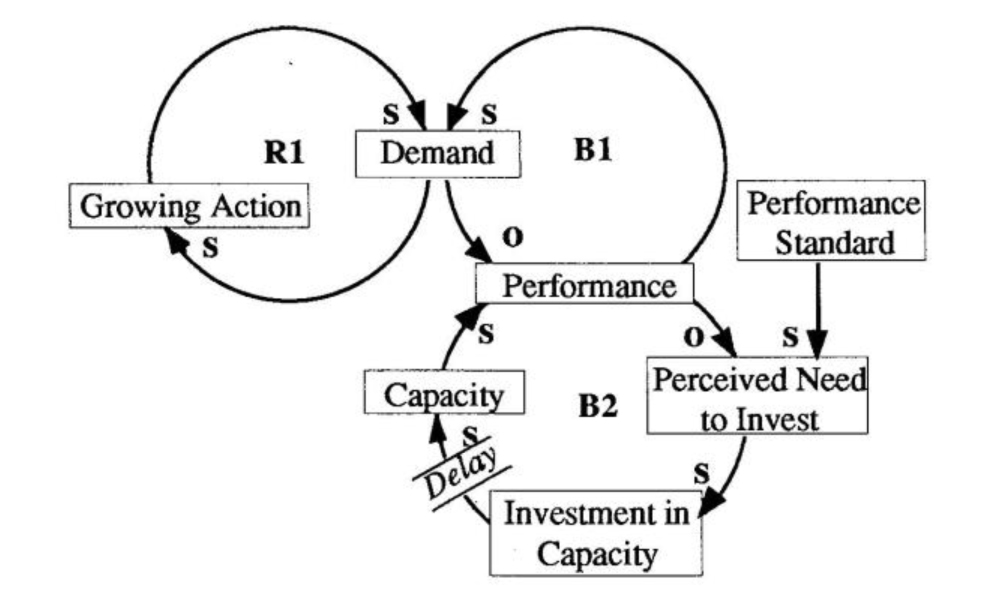
In a business context, this archetype describes a company that fails to invest in necessary capacity (like staff or equipment) to meet growing demand, leading to a decline in performance and, eventually, a crisis. We can map this directly onto the emotional landscape of your story.
To ground our understanding, let's start with the formal definition from a key text in systems thinking.
[PDF] Systems Archetypes III: Understanding Patterns of Behavior and Delay
The document 'Systems Archetypes III' provides a detailed explanation of the 'Growth and Underinvestment' structure. We will focus on its core mechanics and then translate them into the emotional stakes of your characters.
Please read the section titled '“GROWTH AND UNDERINVESTMENT”: THE ROLE OF RELATIVE DELAY.' Focus on understanding the three loops: the growth engine (R1), the limiting factor (B2), and the investment loop (B3). Then, skim the following section, 'THE DYNAMICS OF GROWTH AND UNDERINVESTMENT,' paying close attention to the 'Behavior over Time' graph and the description of the downward spiral.
As you've just read, the core of this trap is making investment decisions based on falling performance, which is often too late. Let's translate this into Henry's internal world:
- Growth Engine (Demand): The developing relationship between Vera and Leo. As they become closer, it places increasing "demand" on the system for emotional maturity, security, and communication.
- Capacity: Henry's emotional capacity. This is his ability to manage jealousy, feel secure in his marriage, and adapt to the new dynamic.
- Limiting Factor: Henry's insecurity. As the "demand" grows, his insecurity puts a brake on the healthy evolution of the three-person dynamic. Performance (e.g., marital harmony, his own well-being) begins to suffer.
- Investment: The difficult emotional labor Henry needs to perform to increase his "capacity." This includes introspection, vulnerable communication with Vera, processing his fears, and actively seeking to understand and adapt to the new situation.
- Underinvestment: Because Vera is currently acting as a buffer ('Shifting the Burden'), the "performance standard" for Henry feels artificially stable. He doesn't experience the full, immediate consequences of the growing V-relationship, so the perceived need to do the hard emotional "investment" work is low. He avoids the discomfort, and his capacity stagnates.
This creates a dangerous gap between the growing demands of the relationship structure and Henry's static ability to cope, as illustrated below.
2. The Psychology of Avoidance
How do we portray this "emotional underinvestment" in a character? Henry isn't just sitting idle; he is actively (if subconsciously) suppressing his feelings to avoid the discomfort of the "investment." This avoidance is a character trait you can show through specific behaviors.
How to Write Characters Who Ignore Their Feelings
This article, 'How to Write Characters Who Ignore Their Feelings,' provides an excellent checklist of behaviors, interactions, and internal attitudes that perfectly describe a character like Henry in this stage of the story.
Please review the bulleted lists under the headings 'Behaviour' and 'Negative story outcomes.' These lists provide a rich palette of actions and consequences for a character who is actively neglecting their emotional well-being.
The "negative story outcomes" mentioned in the article—relationship deterioration, breakdown from stress, emotional barriers—are precisely the crisis you are building toward. This emotional neglect can be visualized as its own repeating cycle, which fuels the larger system trap.

3. Writing Exercise: The Unaddressed Fear (25 minutes)
Your task is to write a scene that puts this dynamic into action. You will show the "demand" on the system increasing and Henry consciously choosing to "underinvest," ratcheting up the tension for the reader.
Scenario:
A few weeks have passed since Vera became the mediator. Her relationship with Leo has naturally deepened. They are now planning their first overnight trip together—a significant step up from previous dates. This is a major new "demand" on Henry's emotional capacity.
Instructions:
Write a scene where Vera tells Henry about the trip, and his reaction clearly demonstrates his emotional underinvestment.
- The Information (Vera's part): Vera brings up the overnight trip. She does so carefully, perhaps trying to reassure him, showing how her role as mediator has forced her to become more strategic in her communication.
- The Underinvestment (Henry's part): This is the core of the scene. Show Henry actively avoiding the emotional core of the issue. Instead of expressing his fear or asking for reassurance (the "investment"), he deflects. Use the behaviors from the article you just read:
- Does he focus on logic and facts? ("What hotel will you be at? Send me the address. What time will you be back?")
- Does he appear stoic or unfazed, saying "It's fine, have a good time," while his body language (a clenched jaw, turning away, staring intently at a screen) shows the opposite?
- Does he immerse himself in work or a hobby as a distraction, changing the subject abruptly?
- The Consequence (Vera's POV): End with a brief internal reflection from Vera. She's not fooled. She feels his unexpressed fear like a cold spot in the room. The immediate conflict is avoided, but she understands that the problem hasn't been solved; it has been buried. This gives her (and the reader) a sense of dread, the knowledge that this suppressed emotion will inevitably surface later, and likely in a more destructive form.
This scene should leave the reader feeling the weight of what is not being said. It's the literary equivalent of the 'Behavior over Time' graph showing capacity flatlining while demand shoots upward. A crisis is now a matter of when, not if.
Conclusion
In this lesson, you have weaponized a character's internal avoidance as a major driver of plot tension using the 'Growth and Underinvestment' archetype.
Key Takeaways:
- 'Growth and Underinvestment' is a powerful model for plotting the consequences of emotional neglect in a relationship.
- The gap between growing "demand" (relationship complexity) and stagnant "capacity" (a character's emotional maturity) is a potent source of narrative tension.
- By showing a character's avoidance behaviors—focusing on facts, stoicism, distraction—you can make the abstract concept of "underinvestment" concrete and compelling.
- This trap builds on the previous lesson's 'Shifting the Burden,' showing how enabling a character's avoidance can lead to a more significant, delayed crisis.
Preview of the Next Lesson:
The pressure you've built inside Henry cannot be contained forever. The crisis is imminent. In our next lesson, we will use the 'Escalation' archetype. You will see how Henry's suppressed insecurity finally boils over, but instead of leading to a productive conversation, it will trigger a competitive, tit-for-tat rivalry between him and Leo, pushing the entire system one step closer to the breaking point.