Hello! Welcome back to our module on "Designing Narrative-Driven Campaigns."
In our last lesson, we defined a 'continuous narrative' as the thread that connects all brand touchpoints—ads, emails, website visits—into a single, cohesive story for the customer. We established that instead of creating isolated marketing moments, our goal is to build an evolving saga.
Today, we move from the "what" to the "how." Our learning outcome is to outline a multi-stage campaign that uses a narrative arc to guide the customer journey. We'll take the classic story structures you know from literature and map them directly onto a marketing campaign, creating a blueprint for a narrative-driven experience.
1. Merging the Story Arc with the Customer Journey
The fundamental idea is simple yet powerful: a customer's path from discovering a brand to becoming a loyal advocate follows a natural narrative structure. It has a beginning (a problem), a middle (a search for a solution), and an end (a transformation).
Your job as a brand storyteller is to align your campaign with this inherent story. The "marketing funnel," a classic concept from your business background, provides the stages. The narrative arc provides the emotional momentum.
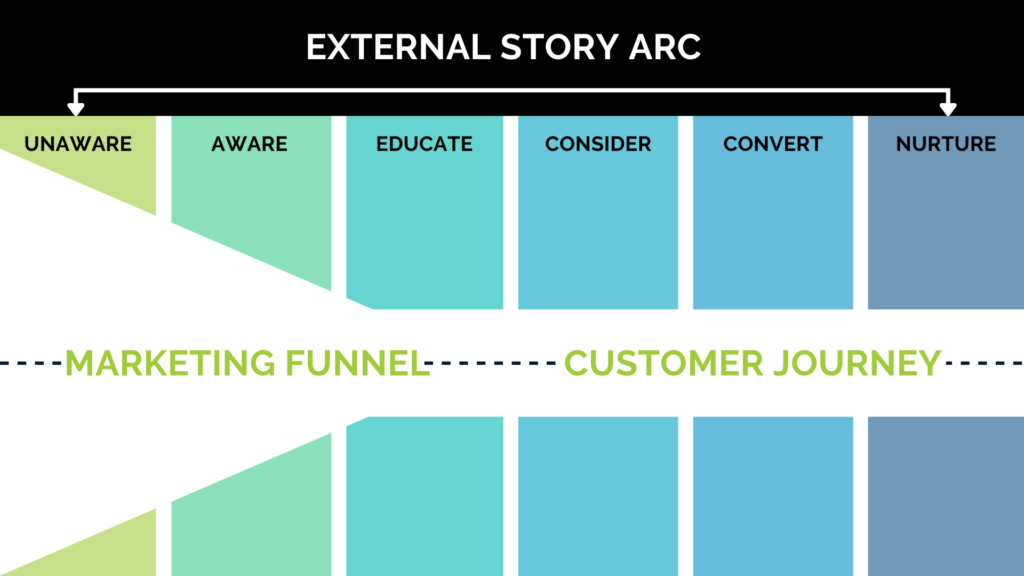
To begin, let's refresh our understanding of the marketing funnel's stages.
How to Build a Marketing Funnel that Actually Works for your Business
This video from HubSpot Marketing, 'How to Build a Marketing Funnel that Actually Works,' clearly breaks down the standard customer journey into four key stages. This will be the scaffold for our narrative.
Please watch from 00:33 to 01:26. As you watch, note the four stages and the customer's mindset in each: Awareness: They have a problem and are looking for solutions. Interest: They become engaged with a potential solution. Consideration: They actively compare your product with alternatives. Decision: They are qualified and ready to purchase.
These stages form the timeline of our campaign. Now, let's infuse them with the principles of storytelling.
2. The Customer Journey as a Three-Act Structure
We can map these marketing stages directly onto the three-act structure we've previously discussed. This turns a transactional process into a transformational story.
Marketing Storytelling: How to Craft Stories That Sell And Build Your Brand
This clip from marketing expert Adam Erhart simplifies the Hero's Journey into a beginning, middle, and end, and explicitly applies it to telling stories for a business. It's a perfect bridge between narrative theory and marketing practice.
Watch from 11:32 to 13:46. Pay close attention to how he connects the three parts of a story to the customer's experience: The Beginning: Where the customer is now (their pains and problems). The Middle: How your business acts as a guide or mentor. The End: How the customer's life is better after your help (their transformation).
By combining the marketing funnel with this three-act view, we get a clear blueprint:
-
Act I: The Setup (Awareness)
- The customer exists in their "ordinary world," but they have a problem or an unfulfilled desire. This is the inciting incident—the moment they realize something needs to change and begin their search. Your campaign's first stage makes them aware that you understand their problem.
-
Act II: The Confrontation (Interest & Consideration)
- The customer enters the "special world" of solutions. They explore, learn, and face obstacles (confusing options, high prices, untrustworthy brands). This is the rising action. Your campaign guides them, building trust and demonstrating value, positioning your brand as the mentor or the tool they need to succeed.
-
Act III: The Resolution (Decision & Beyond)
- The customer makes a choice. The purchase is the climax of this initial journey. Afterward, the resolution and denouement occur as they use the product and experience the promised transformation. Your campaign's final stages confirm they made the right choice and celebrate their success.
3. How to Outline Your Narrative Campaign
Now, let's turn this into a step-by-step process. Structuring your campaign like a story ensures it has emotional momentum and a satisfying payoff.
Use Story Arcs to Build Campaigns That Convert
The article 'Use Story Arcs to Build Campaigns That Convert' by Mailchimp provides an excellent, actionable guide for this process. We'll focus on the section that details how to build the arc.
Please read the sections 'How to build a story arc into your next campaign' and 'Common mistakes to avoid when using story arcs.' As you read, focus on the core steps: Identify the central conflict (the customer's pain point). Create a relatable protagonist (your customer). Structure with rising tension (guiding them through consideration). Deliver a climax/resolution (the purchase and its aftermath).
This framework gives you a clear method. Instead of just thinking "What should our next ad say?", you ask, "What is the next plot point in our customer's story?"
4. A Multi-Stage Campaign Blueprint
Let's synthesize these ideas into a detailed blueprint. We'll expand the four-stage funnel to include post-purchase stages, as a good story doesn't end the moment the conflict is resolved. The Woden agency's article, "How Your Story Unlocks an Efficient Customer Journey," offers a sophisticated model for this, which we'll adapt here.
Here is a five-stage blueprint for your campaign outline:
| Stage | Narrative Purpose (The Story's Job) | Customer's Mindset (The Hero's Feeling) | Example Touchpoints |
|---|---|---|---|
| 1. Awareness | Introduce the Conflict. Frame a problem your customer feels but may not have articulated. Establish the "cost of inaction." | "Something isn't right. I'm frustrated/stuck." | Social media ads, blog posts defining the problem, educational videos, podcast interviews. |
| 2. Consideration | Introduce the Mentor. Show empathy for the hero's struggle and position the brand as the wise guide with a plan. | "I see there are solutions. Which one is right for me? Who can I trust?" | How-to guides, webinars, detailed case studies, free downloads (checklists, e-books). |
| 3. Evaluation | Assert Credibility & Raise the Stakes. Prove why your solution is the unique key to success. Contrast the future with your brand vs. the future without it. | "This brand seems to understand me. Is their solution really the best? What's the risk if I don't choose them?" | Comparison pages, customer testimonials, product demos, detailed proposals, free trials. |
| 4. Decision (Climax) | The Call to Adventure. This is the moment of commitment. Make it a clear, simple, and empowering step to take. | "I'm ready to make a change. I'm choosing this path." | A clear Call-to-Action (CTA) on a sales page, a special offer, a simple checkout process. |
| 5. Nurture & Evangelism (Resolution) | Show the Transformation. Reinforce the value delivered and celebrate the customer's success, turning them into an advocate who shares their story. | "I made the right choice! My life is better. Others should know about this." | Onboarding emails, customer success stories, referral programs, community forums, requests for reviews. |
This blueprint gives you a powerful tool. For any campaign, you can now map out the story you will tell at each stage, ensuring a continuous narrative from first glance to final advocacy.
Test your understanding!
Let's use our brand, "The Storysmith's Guild," to put this into practice. Imagine the Guild is launching a high-ticket online course called "The Founder's Folio," designed to help startup founders craft a compelling brand origin story.
Using the five-stage blueprint above, briefly outline a multi-stage campaign. For each stage, describe:
- Narrative Goal: What is the key message or story beat for this stage?
- Example Touchpoint: Name one specific piece of content for that stage.
Show answer
Here's a possible outline for the "The Founder's Folio" campaign:
-
Stage 1: Awareness
- Narrative Goal: Introduce the conflict that most founders have a great product but struggle to connect with investors and customers because their story is "just a list of features."
- Example Touchpoint: A LinkedIn article titled "Your Pitch Deck is Missing Its Most Important Slide: The Story."
-
Stage 2: Consideration
- Narrative Goal: Position the Guild as the mentor. Show empathy for the founder's journey and introduce the idea that storytelling is a learnable skill, not just innate talent.
- Example Touchpoint: A free downloadable PDF: "The 5-Sentence Story Framework for Your Next Investor Pitch."
-
Stage 3: Evaluation
- Narrative Goal: Assert credibility by showing success. Highlight how the "Founder's Folio" is a unique, structured system, not just generic advice.
- Example Touchpoint: A video testimonial from a beta-tester founder who used the course to successfully close a funding round.
-
Stage 4: Decision (Climax)
- Narrative Goal: Call them to the adventure of transforming their business through story. Create a sense of opportunity.
- Example Touchpoint: A sales page for "The Founder's Folio" with a clear "Enroll Now" CTA and a limited-time bonus (e.g., a one-on-one "story audit" session).
-
Stage 5: Nurture & Evangelism
- Narrative Goal: Celebrate their progress. Reinforce their new identity as a "storyteller-founder."
- Example Touchpoint: An exclusive "Founder's Circle" in the Guild's community for course graduates to share their new brand stories and get feedback.
Conclusion
Today, we've built a bridge between the art of narrative and the science of marketing. By treating a campaign not as a checklist of tasks but as a story to be told, you create a more human, engaging, and effective experience for your audience.
Key Takeaways:
- A customer's journey from awareness to advocacy naturally follows a narrative arc.
- You can outline a multi-stage campaign by mapping story elements (setup, rising action, climax, resolution) onto marketing funnel stages (awareness, consideration, decision).
- This approach ensures each touchpoint serves a narrative purpose, guiding the customer through a cohesive story where they are the hero and your brand is the trusted guide.
- A comprehensive campaign narrative includes post-purchase stages, turning satisfied customers into powerful advocates.
Preview of the Next Lesson:
We now have a high-level map for our narrative campaign. But what does a single point on that map look like? In our next lesson, we will zoom in and "Develop a key story beat for one touchpoint (e.g., an email, a social post) within the outlined campaign." We'll go from architect to craftsman, writing the actual content for one chapter of our story.