Hello! Welcome to the first lesson in our module on one of the most powerful storytelling frameworks ever identified: The Hero's Journey.
In our last lesson, we constructed a brand narrative using the StoryBrand framework. You learned how to position the customer as a hero facing a problem and the brand as a guide offering a plan for success. This problem-solution structure is incredibly effective, and you may have noticed it feels familiar and intuitive.
There's a reason for that. Frameworks like StoryBrand are modern adaptations of a much older, universal story pattern. Today, we'll explore that foundational pattern. Your learning goal for this lesson is to outline the key stages of the Hero's Journey, from the 'Ordinary World' to the 'Return with the Elixir'.
Given your background in literature and history, you may be familiar with the work of mythologist Joseph Campbell, who studied myths from across the world and discovered they often shared a fundamental structure he called the "monomyth." We will be working with a popular 12-stage adaptation of this structure, developed by Christopher Vogler, which has become a cornerstone of modern storytelling in film and, increasingly, in branding.
1. The Blueprint of Transformation
At its core, the Hero's Journey is a map of transformation. It describes a character who goes on an adventure, wins a victory in a decisive crisis, and comes home changed or transformed. This structure is typically divided into three main parts: The Departure, The Initiation, and The Return.
To help you visualize this path, here is a common depiction of the 12 stages arranged in a circle:
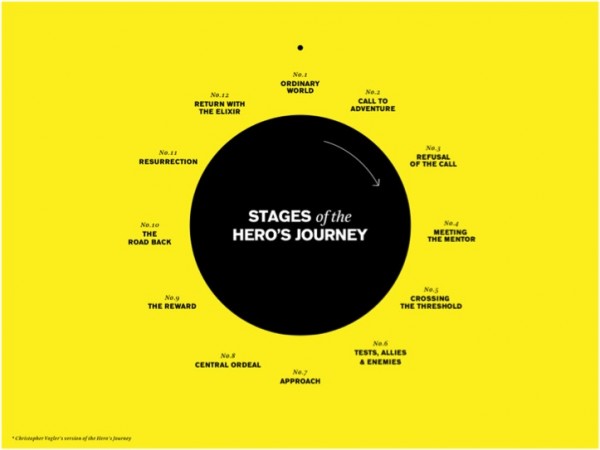
This cycle is the blueprint we'll be exploring today. It's the underlying architecture for countless stories you know, from ancient myths and epics to modern blockbusters like Star Wars and The Lord of the Rings.
2. The 12 Stages Explained by the Expert
There is no better way to learn this framework than from the person who adapted it for modern storytellers. We are going to watch a detailed explanation from Christopher Vogler himself. He will walk us through each of the 12 stages he outlined in his influential guide for Hollywood screenwriters.
I recommend having a notepad handy to jot down the name of each stage and a key idea associated with it.
12 Stages Of The Hero's Journey - Christopher Vogler
This video from Film Courage features Christopher Vogler giving a masterclass on his 12-stage model of the Hero's Journey. As you watch, pay attention to how each stage builds upon the last, creating a chain of cause and effect that drives the hero's transformation.
Please watch the entire video (approximately 22 minutes). I've broken down the key sections below so you know what to look for.
As you've just seen, the journey is a comprehensive arc. Let's briefly consolidate those 12 stages into their three main acts.
Act I: The Departure (Stages 1-5)
This act is about leaving the known world behind.
- The Ordinary World: We meet the hero in their normal life, establishing who they are before the adventure. For a brand, this is your customer's status quo.
- The Call to Adventure: The hero is presented with a problem, challenge, or opportunity. This is the customer realizing they have a need or a desire.
- Refusal of the Call: The hero is hesitant or fearful to begin the journey. This is the customer's doubt, inertia, or fear of change.
- Meeting the Mentor: The hero encounters a wise figure who gives them training, advice, or a tool for the journey. This is where your brand enters as the guide, offering expertise and reassurance.
- Crossing the Threshold: The hero fully commits and enters the "special world" of the adventure. This is the customer making their first purchase or signing up for your service.
Act II: The Initiation (Stages 6-9)
This is where the hero faces trials and undergoes their primary transformation.
- Tests, Allies, and Enemies: The hero learns the rules of the new world, builds relationships, and faces initial challenges. This is the customer learning to use your product, finding a community, and overcoming initial obstacles.
- Approach to the Inmost Cave: The hero and their allies prepare for the biggest challenge. This is the customer preparing to use your product/service to tackle their main problem.
- The Ordeal: The hero faces their greatest fear or a "death and rebirth" moment. They hit rock bottom and are transformed by the experience. This is the climactic moment where the customer overcomes their biggest challenge using your solution.
- The Reward (Seizing the Sword): The hero takes possession of the treasure they've won: an object, knowledge, or insight. This is the customer achieving their goal and gaining the tangible and intangible benefits.
Act III: The Return (Stages 10-12)
The final act involves bringing the reward back to the ordinary world.
- The Road Back: The hero begins the journey home, but faces one last challenge or pursuit. This is about integrating the solution into their life and ensuring the change sticks.
- The Resurrection: The hero is tested one last time and uses everything they've learned to succeed. This is the final climax. This is the customer's ultimate transformation, proving they have become the person they wanted to be.
- Return with the Elixir: The hero returns to their ordinary world with the "elixir" (the treasure or knowledge) to share with and improve their community. This is the customer becoming an advocate, sharing their success story, and inspiring others.
Test your understanding!
In the previous lesson, we saw that StoryBrand positions the brand as the "guide." In the Hero's Journey, which stage most directly corresponds to the guide's introduction?
Show answer
Stage 4: Meeting the Mentor. This is the point where a character with experience and wisdom (the mentor/guide) appears to equip the hero for the journey ahead.
3. A Quick Reference Guide
The 12 stages can be a lot to remember. It's helpful to have a concise list you can refer back to. The following resource provides exactly that.
Exploring the 12 Stages of the Hero’s Journey
The guide 'Exploring the 12 Stages of the Hero’s Journey' from ScreenCraft provides a clear and simple breakdown. It's a useful document to bookmark for future reference.
Please read the numbered list of the 12 stages in the section 'The Hero’s Journey Breakdown' (it appears on page 4 of the PDF). This will reinforce the names and definitions of each stage.
This framework is not a rigid formula but a flexible model. As Vogler mentions, stages can be shuffled, combined, or even omitted to create different effects. What remains constant is the core idea of a transformative journey.
Conclusion
In this lesson, you have explored the foundational narrative structure of the Hero's Journey. We've moved beyond the simple problem-solution dynamic to see the richer, more detailed archetypal pattern that underpins it.
Key Takeaways:
- The Hero's Journey is a 12-stage narrative pattern outlining a hero's transformative adventure.
- The journey is divided into three main acts: The Departure, The Initiation, and The Return.
- The 12 stages are: The Ordinary World, Call to Adventure, Refusal of the Call, Meeting the Mentor, Crossing the Threshold, Tests, Allies, and Enemies, Approach to the Inmost Cave, The Ordeal, The Reward, The Road Back, The Resurrection, and Return with the Elixir.
- In a branding context, the customer is the hero, and the brand often plays the role of the mentor.
Preview of the Next Lesson:
A hero doesn't complete their journey alone. As you saw in the list of stages, they meet allies, enemies, and mentors. In our next lesson, we will focus specifically on these crucial roles. You will learn to identify the roles of mentor, ally, and threshold guardian in the Hero's Journey and understand their function in driving the story forward.