Hello! Welcome to the final lesson in our module on conflict, tension, and stakes.
In our last session, we analyzed how the problem-solution dynamic in marketing works as a classic conflict-resolution structure. We established that the most effective brand stories cast the customer as the hero and the brand as a helpful guide.
Today, we transition from analysis to creation. Your goal for this lesson is to construct a brand narrative that positions a product or service as the key to resolving a central conflict. We will use a concrete, step-by-step framework that is one of the most widely used and effective in modern branding. By the end of this hour, you will have a practical template for building compelling brand stories from the ground up.
1. The Foundation: Start with the Customer's Conflict
As we've discussed, every great story—and every great brand narrative—begins with a conflict. Before you can position your product as a solution, you must deeply understand the problem your customer is facing. This means defining their desire and the obstacle standing in their way.
Let's reinforce this core principle with a clear, practical guide.
What Is a Brand Story? | HBS Online
The article 'What Is a Brand Story?' from Harvard Business School Online neatly summarizes the first steps of building a narrative. It emphasizes that the story isn't about you; it's about your customer.
Please read the first two steps in the 'How to Create a Brand Story' section: '1. Pinpoint the Conflict' and '2. Position Your Customer as the Hero'. This reading will solidify the crucial mindset that the customer is the protagonist of the story you are telling.
This idea of positioning the brand as a "guide" rather than the "hero" is a powerful shift. It changes the dynamic from a sales pitch ("Look how great we are") to a story of empowerment ("We can help you succeed").
Marketing expert Donald Miller is a leading proponent of this philosophy. He explains why this distinction is so critical for connecting with an audience.
How to clarify your message so people listen | Donald Miller | TEDxNashville
In this segment from his TEDx talk, Donald Miller explains the psychological reasons why positioning your brand as the hero is a mistake and why the 'guide' is the most powerful role you can play in your customer's story.
Please watch from 10:23 to 12:25. Listen for his two key reasons why you should never be the hero. This concept is the foundation of the framework we're about to use.
2. A Practical Framework for Construction: StoryBrand
Now that we've cemented the core principle, let's get to the 'how'. We will use the StoryBrand 7-Part Framework (SB7), a tool designed specifically to construct the kind of narrative we've been discussing. It translates the elements of a good story into a blueprint for marketing messages.
Here is a visual overview of the framework's flow:
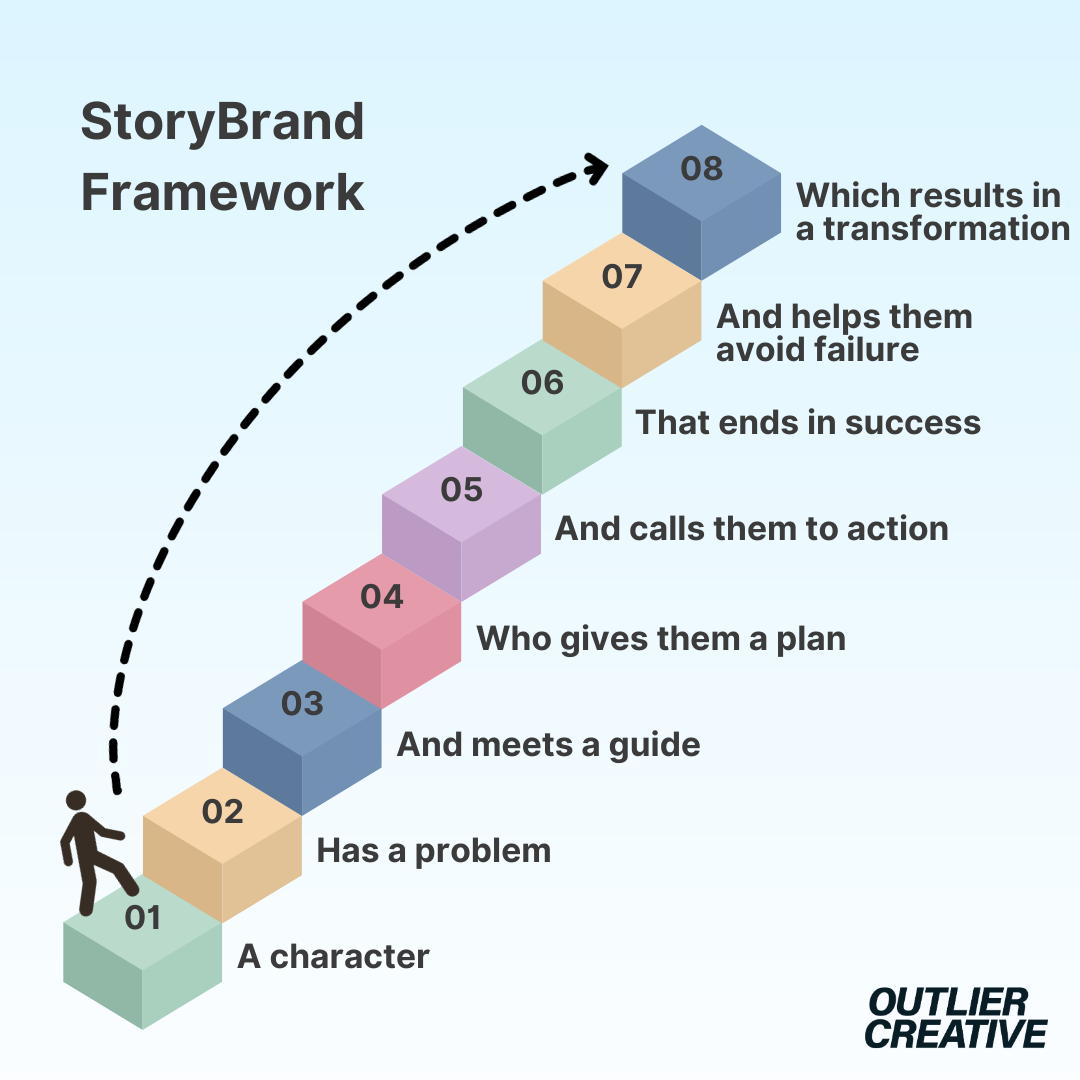
We will now walk through the key parts of this framework to build our narrative.
Step 1: Define the Character and their Problem (The Conflict)
As the HBS article stated, the story starts by defining what your character (the customer) wants and what problem is preventing them from getting it. The SB7 framework encourages you to think about this problem on three levels to create a more resonant conflict.
The StoryBrand Framework: A Complete Step-by-Step Guide
Let's use the detailed guide 'The StoryBrand Framework: A Complete Step-by-Step Guide' to explore these foundational elements.
Please read 'Principle 1: Who does your customer want to become?' and 'Principle 2: What are your customer's external, internal, and philosophical problems?'. Pay close attention to the distinction between the three levels of problems; this is how you connect a product feature (solving an external problem) to a deeper emotional need (solving an internal problem).
Step 2: Introduce the Guide and the Plan (The Resolution)
Once the conflict is clear, the brand enters as the guide. The guide doesn't just show up; they demonstrate empathy ("We understand your problem") and authority ("We have the expertise to solve it"). Then, they provide a simple plan, which is how you position your product or service as the key to resolving the conflict. The plan removes confusion and gives the hero a clear path forward.
The StoryBrand Framework: A Complete Step-by-Step Guide
Now, let's look at how the brand enters the story to provide the resolution.
Continuing with the same article, read 'Principle 3: Be the Guide, Not the Hero' and 'Principle 4: Give your clients an easy step-by-step to move forward'. Note how the 'Plan' is the bridge between the customer's problem and your solution.
Step 3: Clarify the Stakes (Success and Failure)
As we learned in previous lessons, a story without stakes is boring. The audience needs to know what can be won or lost. In brand storytelling, this means painting a clear picture of success (life after your product) and reminding them of the consequences of failure (life if they don't solve their problem).
The StoryBrand Framework: A Complete Step-by-Step Guide
Finally, we need to make it clear what's at stake. This is what compels the hero to act.
Read the sections 'Principle 6: Have you identified what is at stake?' and 'Principle 7: Have you helped your hero imagine what success looks like?'. This part of the framework provides the emotional motivation for the narrative.
Test your understanding!
Why is it more effective to offer the customer a simple, 3-step "plan" instead of just describing your product's features?
Show answer
A plan simplifies the path to a solution. While features describe what a product does, a plan shows the customer how they can solve their problem with your help. It removes confusion and fear, making it feel easy and achievable for the customer to take action and engage with your brand. It turns the abstract idea of a solution into a concrete, actionable journey.
3. Application: Constructing Your Narrative
Now, let's put this all together. We will construct a brand narrative for a fictional company using the SB7 framework as our guide.
Scenario:
A company called "Artisan Sites" offers web design services. Their target customers are talented artisans (e.g., potters, jewelers, woodworkers) who struggle to sell their products online.
Your task is to build the core narrative that positions Artisan Sites as the solution to this conflict. I'll walk you through it.
Our Narrative Construction
1. A Character...
- The hero is a talented artisan.
2. ...Who Wants Something.
- They want to run a successful online business that showcases the quality of their craft and provides them with a stable income.
3. ...Has a Problem.
- External: Their current website is either non-existent or unprofessional. It's confusing to use and doesn't generate sales.
- Internal: They feel overwhelmed by technology, frustrated that their passion isn't translating to income, and fearful that their business might fail.
- Philosophical: It's plain wrong that incredible talent should be held back by technical hurdles.
4. ...And Meets a Guide.
- The guide is Artisan Sites.
- Empathy: "We understand how much passion goes into every piece you create. It’s frustrating when your online presence doesn't reflect that beauty."
- Authority: "We have helped over 200 artisans launch beautiful online stores and double their sales in the first year."
5. ...Who Gives Them a Plan.
- This is how Artisan Sites' service becomes the resolution.
- Schedule a Free Consultation: We'll get to know your craft and your brand vision.
- We Build Your Store: Our team designs and builds a stunning, easy-to-manage website for you.
- Launch & Grow: You start selling with confidence while we provide ongoing support.
6. ...And Calls Them to Action.
- Direct Call to Action: "Schedule Your Free Consultation."
7. ...That Helps Them Avoid Failure...
- Continuing to struggle with a failing website, feeling their passion drain away, and ultimately having to give up their dream of running their own business.
8. ...And Ends in Success.
- A thriving online business where they can proudly share their work with the world. They feel confident and in control, with more time to focus on what they love—creating.
This completed outline is a powerful brand narrative. It's not a list of web design features; it's a story about an artisan's transformation, with Artisan Sites positioned as the essential guide that makes it possible. You can see how this narrative could be used to write website copy, create an advertisement, or structure a sales conversation.
Conclusion
Today you moved from theory to practice by constructing a brand narrative from scratch. By using a structured framework like StoryBrand, you can systematically apply classic storytelling principles to create marketing messages that are clear, compelling, and human.
Key Takeaways:
- A powerful brand narrative positions the customer as the hero and the brand as the guide.
- The conflict is built around the customer's external, internal, and philosophical problems.
- The resolution is provided through the guide's empathy, authority, and a clear plan. Your product or service is the core of this plan.
- Clearly defined stakes (success vs. failure) provide the emotional motivation for the customer to act.
Preview of the Next Lesson:
This lesson concludes our module on conflict. We are now ready to explore one of the most enduring and influential storytelling frameworks in history: The Hero's Journey. You will see how the problem-solution structure we've mastered is a simplified version of this epic model. In our next lesson, we will begin this new module by outlining the key stages of the Hero's Journey, from the 'Ordinary World' to the 'Return with the Elixir'.