Hello! Welcome back to our course.
In our last lesson, we focused on Act I, "The Setup." We learned that its main purpose is to establish the hero's ordinary world, build empathy, and introduce an inciting incident—a problem that disrupts the status quo and forces the hero to act. For your work in branding, this means vividly portraying your customer's world and the challenge that leads them to seek a solution.
Today, we move into the heart of the narrative. The inciting incident has thrown a challenge at our hero. Now what? They can't go back to their old life, so they must move forward. This journey forward is Act II. Our goal for this lesson is to explain the function of Act II (The Confrontation), including rising action and the midpoint. This is the longest and often most complex part of a story, where the main character is truly tested.
The Shape of the Journey
If Act I is the climb up the roller coaster's first hill, Act II is the thrilling, turbulent, and unpredictable part of the ride that follows. It's where the tension you've built begins to escalate dramatically.
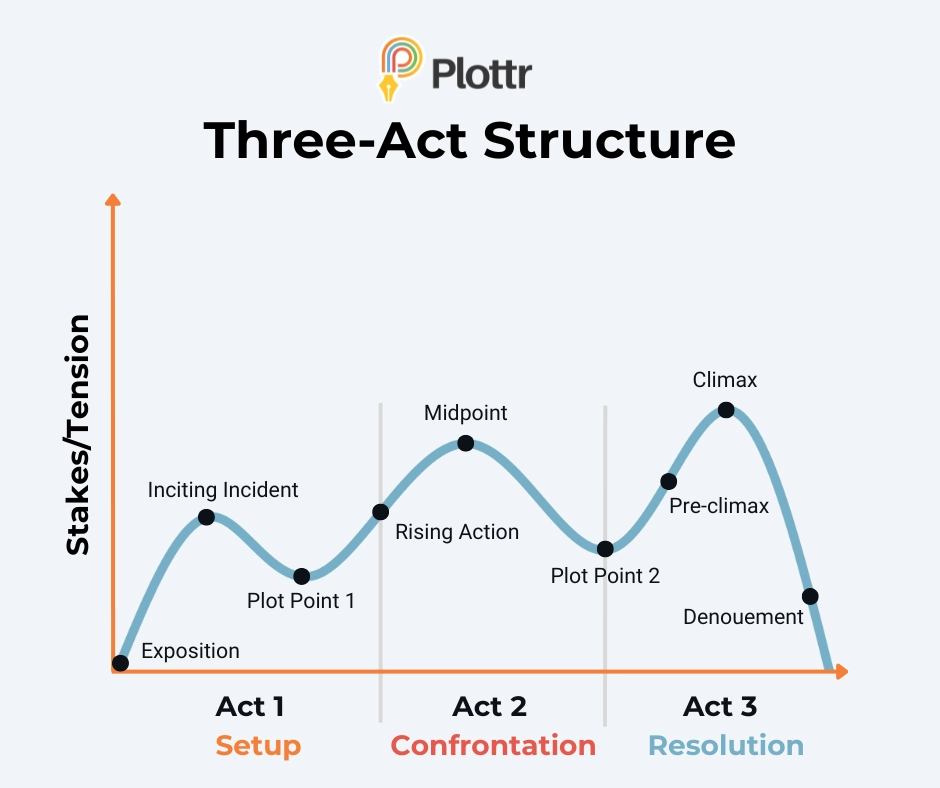
What is Act II: The Confrontation?
Act II is the second and longest part of the three-act structure. It begins after the hero commits to their journey at the end of Act I and ends just before the story's final showdown. Its primary function is to develop the central conflict through a series of escalating challenges. It's often called "The Confrontation" because this is where the hero directly confronts the obstacles that stand between them and their goal.
How the 3 Act Structure Works (With Examples)
The video 'How the 3 Act Structure Works' offers a sharp and effective definition of Act II. The presenter calls it the 'meat of your film.'
Please watch from 01:39 to 02:20. Pay close attention to the description of the character being in 'unfamiliar territory' and the act being 'full of complications, rising tension, and conflict.'
As the video explains, this is where the character is tested. For your purposes, this is where the customer (the hero), having decided to solve their problem, embarks on a journey to find the right solution.
The Engine of Act II: Rising Action
The journey through Act II isn't a straight line. It’s a series of escalating events known as the rising action. The hero tries to solve their problem, but each attempt is met with new and more difficult complications. These challenges aren't just random events; they serve to raise the stakes and increase the narrative tension, making the audience wonder, "What will happen next?"
Writing With the Three Act Structure
The article 'Writing With the Three Act Structure' from Writers.com provides an excellent literary definition of rising action and its role within Act II.
Read the first two paragraphs in the section 'Act 2: The Story’s “What Then?”'. Focus on the definition of Rising Action as the part where 'tension ratchets up with the story’s escalating conflict.'
This sequence of "pushes and pulls, of forwards and backs" is what makes a story engaging. The hero might achieve a small victory, only to face a larger setback. This is where character growth happens, as the hero must learn and adapt to overcome these mounting challenges.
The Turning Point: The Midpoint
Roughly halfway through Act II, a significant event often occurs: the midpoint. This isn't just another obstacle; it's a major turning point that often changes the game entirely. The midpoint can be:
- A major revelation or plot twist.
- An event that raises the stakes dramatically.
- A moment where the hero moves from reacting to events to proactively driving the action.
- A "point of no return" where the hero's commitment is sealed.
The midpoint fundamentally alters the hero's understanding of their journey and what they must do to succeed.
How the 3 Act Structure Works (With Examples)
Let's return to the 'How the 3 Act Structure Works' video for a clear example of a midpoint from a classic film.
Watch the segment from 02:53 to 03:17. The presenter explains the midpoint in The Matrix, where Neo visits the Oracle. Notice how her revelation is a 'huge blow' that changes how he approaches the rest of his journey.
To see this in a more traditional narrative, let's look at the example of Titanic.
Writing With the Three Act Structure
The 'Writing With the Three Act Structure' article provides a great breakdown of Titanic using the three-act structure.
Read the bullet points for Act 2 under the 'Example: Titanic' heading. Identify the Rising Action (ship hits iceberg), the Midpoint (Cal frames Jack), and the Response (Rose saves Jack). See how the midpoint escalates the conflict from 'forbidden love' to 'life or death'.
In this example, the midpoint isn't the iceberg—that's part of the rising action. The midpoint is the moment Cal frames Jack. This personal, malicious act raises the stakes beyond the external danger of the sinking ship, forcing Rose to make a definitive choice between her old life and her new love.
Test your understanding!
In The Wizard of Oz, Dorothy's journey along the Yellow Brick Road with her companions is the rising action. What event serves as the midpoint, revealing that the journey is much harder than they thought?
Show answer
The midpoint is when the group finally reaches the Emerald City, only to be told by the Wizard that he will not grant their wishes until they bring him the Wicked Witch of the West's broomstick. This transforms their goal from a simple journey into a dangerous quest, raising the stakes significantly.
Act II in Brand Storytelling
This is where the theory becomes a powerful tool for your branding and marketing. In your stories, the customer is the hero. Act II represents their journey from recognizing a problem to finding a successful resolution with your brand's help.
Here, your brand plays the role of the mentor or guide, providing the hero with the tools, knowledge, and encouragement they need to navigate the rising action.
Content Marketing Storytelling: Three-Act Structure |…
The article 'Content Marketing Storytelling' is written specifically for marketers and explains the function of Act II in building a relationship with your audience.
Read the entire section 'Act Two: Building Engagement and Loyalty.' Notice how it frames Act II not just as conflict, but as an opportunity to deliver value, demonstrate expertise, and build trust.
As the article suggests, the "rising action" in your content strategy could be:
- A blog series that tackles different aspects of a customer's problem.
- Video tutorials that help them overcome specific challenges.
- Case studies that show how others have succeeded, providing a glimpse of a possible future.
- Customer testimonials that build confidence and counter doubt.
Each piece of content is a step on the hero's journey, helping them navigate the obstacles and building their relationship with your brand.
Let's watch one final clip that shows this "journey" aspect of Act II in the context of a non-profit's story.
Three-Act Structure | Storytelling for Commercial & Non-Profit FIlms
The 'Three-Act Structure' video we viewed in the last lesson contains a powerful example of a non-profit story about a woman needing eye surgery. It perfectly illustrates the 'rollercoaster' of Act II.
Watch the clip from 06:22 to 07:12. The storyteller describes the woman's journey: she decides to get surgery (Plot Point 1), the surgery goes wrong (a major obstacle in the rising action), and then she discovers the non-profit's solution. This up-and-down journey is the essence of Act II.
Practice Application
Let's continue with the meal-kit delivery service example from our last lesson. Our hero is a busy professional who, after a frustrating week of unhealthy takeout (the inciting incident), has decided to find a better way to eat well at home (Plot Point 1, the end of Act I).
How could we map their journey through Act II? Think about the rising action and a potential midpoint.
- Hero: The busy professional.
- Goal: Eat delicious, healthy, home-cooked meals without stress.
- Rising Action (The Obstacles): What challenges might they face on this journey before fully committing to the meal-kit service?
- They try searching for recipes online but get overwhelmed.
- They go to the grocery store with a list but can't find a key ingredient.
- They attempt a complex recipe one night, and it takes two hours and makes a huge mess. They feel discouraged.
- Midpoint (The Turning Point): What could be the midpoint that solidifies their need for a simpler solution?
Possible answer: A friend who uses the meal-kit service invites them over for dinner. Our hero is amazed to see their friend prepare a gourmet meal in 30 minutes with no stress. This real-world demonstration is the revelation—the midpoint—that shows them there is a better way. They move from simply "looking for a solution" to "wanting that specific solution."
Conclusion
Today we've navigated the longest and most challenging part of the narrative arc. Act II is where the promises of Act I are tested, and where the story truly earns its emotional payoff.
Key Takeaways:
- Act II (The Confrontation) is the heart of the story, where the hero actively tries to solve the problem introduced in Act I.
- Rising Action is a series of escalating challenges and obstacles that build tension and develop the character. In branding, this is your opportunity to guide the customer with valuable content.
- The Midpoint is a crucial turning point in Act II that raises the stakes, provides a key revelation, and solidifies the hero's commitment to their goal.
In our next lesson, we will arrive at our destination: Act III, The Resolution. We'll explore how to bring the story to a satisfying climax and conclusion, demonstrating the ultimate success your customer can achieve with your brand as their guide.