Hello! Welcome to the first lesson in our second module, "The Three-Act Structure in Branding."
In our last lesson, we wrapped up our exploration of narrative foundations by outlining a brand origin story. We established the crucial idea that in brand storytelling, the customer is the hero and the brand acts as their trusted guide. The origin story you created serves to build the credibility and empathy of that guide.
Today, we're going to zoom in on the very beginning of the customer's journey. Our goal is to describe the purpose and characteristics of Act I (The Setup), including the inciting incident. Act I is where you hook your audience by grounding them in a relatable world and presenting a problem that demands a solution. Mastering this first act is the key to making your audience care enough to follow the rest of the story.
The Three-Act Structure: A Visual Overview
For centuries, from Aristotle to modern screenwriting, stories have been built on a fundamental three-part structure: a beginning, a middle, and an end. In storytelling terms, we call these Act I, Act II, and Act III.
This structure creates a narrative arc, a journey of rising and falling tension that keeps an audience engaged. Think of it like a roller coaster.
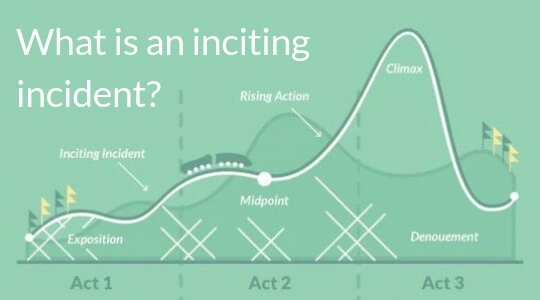
Today, we are focusing on that initial, crucial climb up the hill: Act I, The Setup.
What is Act I: The Setup?
The purpose of Act I is to establish the "ordinary world" of your story. It's the "before" picture. Before the adventure begins, before the problem escalates, who is our hero and what is their life like? A well-crafted setup doesn't just list facts; it makes the audience connect with and root for the main character.
What is storytelling in marketing? Structure & best practice
To start, let's get a clear, concise definition of the first act's role. The article 'What is storytelling in marketing?' provides a great overview.
Please read the paragraph beginning 'In the first act, you establish the normal world...'. It clearly outlines the three primary jobs of Act I.
As the article notes, Act I is where you:
- Establish the normal world.
- Introduce the protagonist and other main characters.
- Present the inciting incident that sparks the central conflict.
The most important function of this setup is to create empathy. We need to understand the hero's world so we can feel for them when it's turned upside down.
Three-Act Structure | Storytelling for Commercial & Non-Profit FIlms
The video 'Three-Act Structure' explains this concept of 'audience empathy' beautifully. It shows how skilled storytellers make you care about a character long before the main action kicks off.
Watch the segment from 00:25 to 02:14. Pay attention to how the storyteller creates a connection with the main character by showing his situation and making us feel 'poor guy.'
Key Characteristics of Act I
To build this empathetic connection, the setup focuses on two core character elements: motivation and obstacles.
- Motivation: What does the hero want? This desire drives their actions throughout the story. It can be a grand ambition or a simple, relatable need.
- Obstacle: What is standing in the hero's way? A story without an obstacle is just a statement of fact, not a narrative. The obstacle creates the initial tension.
Marketing Storytelling: How To Craft A Story Brand (That Sells)
The video 'Marketing Storytelling: How To Craft A Story Brand' uses the blockbuster film Avatar to illustrate these two key components of Act I. Even if you haven't seen the film, the explanation is very clear.
Watch the segment from 03:16 to 08:42. Notice how the speaker distinguishes the hero's internal motivation ('I just want something to fight for') from the external obstacles he faces.
The Spark: The Inciting Incident
The "ordinary world" is stable, but a story requires change. The inciting incident is the event that shatters that stability. It's the catalyst that disrupts the hero's life and launches them on their journey. There is no turning back.
Your background in literature has likely exposed you to many famous inciting incidents:
- In The Lord of the Rings, it's Gandalf's visit to the Shire and his discovery of the One Ring's nature, forcing Frodo to leave his home.
- In Harry Potter, it's Hagrid's arrival with the letter from Hogwarts, revealing Harry's true identity and changing his life forever.
Story structure lessons you can use on your brand
This concept is a cornerstone of narrative theory. The article 'Story structure lessons you can use on your brand' provides a sharp definition and more classic examples.
Read the subsection titled 'The inciting incident.' It clearly defines this crucial story beat and links it, along with the hero and their problem, to the opening act.
The inciting incident is the point where the hero can no longer remain passive. They are called to action.
Test your understanding!
In the movie The Matrix, what is the inciting incident that forces the protagonist, Neo, out of his ordinary life as a computer programmer?
Show answer
The inciting incident is when Morpheus offers Neo a choice between the red pill (to learn the truth about the Matrix) and the blue pill (to return to his old life). Neo's decision to take the red pill is the moment his life irrevocably changes, launching him into the main conflict of the story.
Act I in Brand Storytelling
Now, let's translate this to your goal: branding. Remembering that the customer is the hero, Act I is not about your company's history. It's about the customer's "ordinary world" before they found your brand.
- The Hero: Your target customer.
- The Ordinary World: Their daily life, including the frustrations and unaddressed problems related to what you sell.
- The Motivation: What they desire (e.g., more time, less stress, a sense of belonging, a healthier lifestyle).
- The Obstacle: What prevents them from achieving that desire (e.g., lack of knowledge, limited budget, inconvenient options).
- The Inciting Incident: The moment the customer decides they can't continue with the status quo. It's the trigger that makes them search for a solution.
This is where your brand will eventually enter the story as the guide in Act II. But first, you must set the stage effectively.
Marketing Storytelling: How To Craft A Story Brand (That Sells)
Let's return to the 'Marketing Storytelling' video. The speaker does an excellent job of applying the principles of Act I directly to business and marketing.
Watch from 20:07 to 26:15. Notice the crucial shift: 'You are not the hero of this story.' The speaker explains how a customer's motivation and obstacle become the core of your messaging on a website or in a sales call.
The video makes a vital point: for high-pain problems ("I need more leads or my business will fail"), you can lead with the obstacle. For luxury or desire-based products (like an iPhone), you lead with the motivation.
Let's look at some simple, concrete examples of how this "opening act" works for different businesses.
Story structure lessons you can use on your brand
The article 'Story structure lessons you can use on your brand' offers several clear, simple examples of what a brand story's opening act looks like.
Read the section 'Example brand story opening acts.' See how each tiny story for the cafe, lawyer, and hotel quickly establishes a hero, their problem (obstacle), and an inciting incident.
Practice Application
Let's outline Act I for a customer-hero of a meal-kit delivery service (like Blue Apron or HelloFresh).
- Hero: A young professional who values health and good food.
- Ordinary World: Works long hours, often feels too tired to cook, resorts to expensive and unhealthy takeout, feels a bit guilty about it.
- Motivation: To eat delicious, home-cooked, healthy meals without the stress of meal planning and grocery shopping.
- Obstacle: Lack of time and energy.
- Inciting Incident: Can you think of one? What might be the "last straw" that sends this hero searching for a solution?
Possible answers: They see a charge for a week's worth of takeout on their credit card bill and are shocked. Or, a friend posts a photo of a beautiful meal they cooked at home, making the hero feel envious. Or, they simply feel sluggish and unhealthy after a week of bad food and decide 'enough is enough'.
This setup perfectly positions the hero to meet a guide (the meal-kit service) who has a plan to solve their problem.
Conclusion
Today we dissected the first and perhaps most critical part of any story. By establishing a relatable world and a clear problem, Act I earns your audience's attention and emotional investment.
Key Takeaways:
- Act I (The Setup) establishes the hero's "ordinary world" to build audience empathy. It introduces the hero's core motivation and the obstacles they face.
- The Inciting Incident is the catalytic event that disrupts the hero's world, creates a point of no return, and launches the story's main conflict.
- In branding, Act I is about the customer's world. Your marketing should reflect their motivations and acknowledge their obstacles, setting the stage for your brand to enter as the solution.
In our next lesson, we'll continue our journey up the narrative roller coaster into Act II: The Confrontation. We will explore how to build on the foundation of Act I with rising action and navigate the midpoint, where the hero fully commits to their journey.