Hello! Welcome to the final lesson in our module on the three-act structure.
In our previous lessons, we journeyed through Act I, where we set up the hero's world and introduced an inciting incident, and Act II, where the hero faced rising action and a pivotal midpoint. They have been tested, they have struggled, and they have grown. Now, they stand at the threshold of the story's conclusion, ready for the final confrontation.
This brings us to the third and final act. Today's lesson will focus on exactly that, as we work to describe the components of Act III (The Resolution), including the climax and denouement. This is where the narrative tension you've carefully built pays off, providing your audience with a powerful and satisfying conclusion that reinforces your brand's ultimate message.
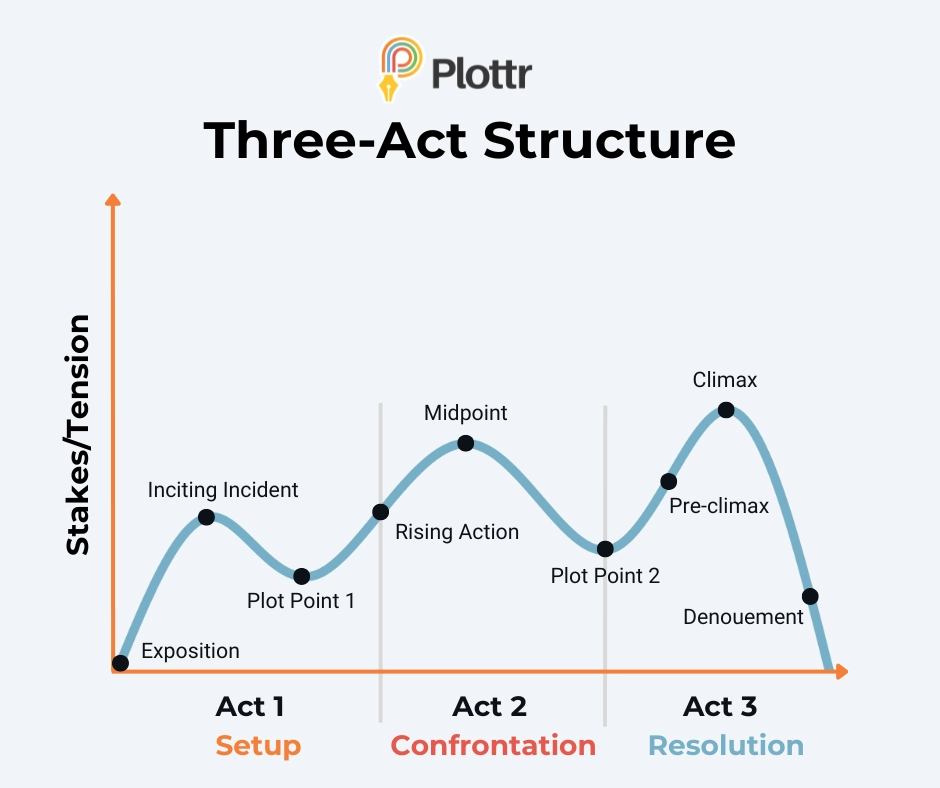
Let's look at our familiar narrative map one last time to situate ourselves.
What is Act III: The Resolution?
Act III is the destination of your story's journey. It's the final quarter of the narrative where the central conflict comes to a head, all the subplots and character arcs converge, and the story's central questions are answered. Its purpose is to deliver a conclusion that feels both earned and inevitable, leaving a lasting impression on the audience.
Act 3: How to Write a Showstopping Ending
To begin, let's get a broad overview of Act III's purpose from the video 'Act 3: How to Write a Showstopping Ending.' It explains why this final act is so crucial for leaving a lasting impression.
Watch the segment from 00:08 to 01:19. Focus on the idea that Act III is where you 'bring it all together' and how a weak ending can undermine the entire story.
As the video highlights, this is where everything you've set up pays off. In branding, this means demonstrating decisively how your product or service delivers on its promise.
The Key Moments of Act III
Act III isn't just one long ending; it has its own distinct beats that guide the audience through the story's final moments.
The Three-Act Structure: How to Write the Oldest Story ...
Act III can be broken down into a few key moments. The article 'The Three-Act Structure' from Scribophile provides a clear, step-by-step guide to these components.
Read the subsections under 'Act III': 'Pre-climax (or false climax)', 'Climax', and 'Resolution'. Pay attention to the definitions and the role each part plays in bringing the story to a close.
Based on this reading, we can identify two primary components, often preceded by a "darkest hour" moment:
-
The Climax: This is the "showstopper," the peak of the story's conflict and tension. It's the final, direct confrontation where the protagonist faces the antagonistic force. The central narrative question (Will the hero succeed?) is definitively answered. Everything has been leading to this moment.
-
The Denouement (or Resolution): This French term literally means "the untying." It's the period immediately following the climax where the dust settles. Here, you tie up loose ends, show the consequences of the climax, and reveal the protagonist's "new normal." It provides a sense of closure and emotional release for the audience.
Deep Dive: The Climax and Its Stakes
A truly great climax resolves more than just the external plot. It provides a meaningful resolution by addressing the different layers of what's at stake for the hero.
A powerful climax resolves more than just the plot; it resolves the story's core meaning. The video 'How to Write a Great Ending' introduces a brilliant framework for this, using three levels of stakes.
Watch from 02:37 to 05:03. Focus on the definitions of external, internal, and philosophical stakes. Think about how a great ending must provide a resolution for all three.
As the video explains, a satisfying climax resolves all three levels of conflict:
- External Stakes: Will the hero achieve their tangible goal? (e.g., Will the customer solve their business problem?)
- Internal Stakes: How will the hero's key relationships and emotional state be resolved? (e.g., Will the customer regain their confidence?)
- Philosophical Stakes: Which core value or belief will win out? (e.g., Will collaboration triumph over isolation? Will innovation win over tradition?)
The "philosophical stakes" are especially crucial for branding, as this is where your brand's core values are proven through action. The climax is made even more powerful when it comes as a reversal—snatching victory from the jaws of defeat. This is often achieved by putting the hero through a pre-climax "dark night of the soul," where all hope seems lost, making the eventual triumph that much more elating.
Test your understanding!
Your background in literature will make this a familiar example. Let's apply the three-stakes framework to the climax of Jane Austen's Pride and Prejudice, as outlined in the Scribophile article you read earlier (LINK). The climax is Darcy's second proposal.
Can you identify the resolution of the external, internal, and philosophical stakes in this moment?
Show answer
- External Stakes: The Bennet family's financial security and social standing. By accepting Darcy, Elizabeth secures a future for herself and helps solidify her family's position. This is resolved.
- Internal Stakes: Elizabeth's relationship with Darcy, and her own self-perception. She has overcome her prejudice, and he his pride. Their emotional and relational conflict is resolved with their union.
- Philosophical Stakes: The conflict between "pride and prejudice" (or appearance vs. reality, class snobbery vs. individual merit). Their marriage, based on genuine understanding and respect rather than social convention, represents the triumph of merit and love over superficiality.
Deep Dive: The Denouement and Its Purpose
The story doesn't end the second the climax is over. The denouement is essential for providing what Aristotle called catharsis—an emotional release and purification for the audience. We need to see the results of the hero's transformation.
Act 3: How to Write a Showstopping Ending
Let's return to the 'Act 3' video from Reedsy. It offers a great explanation of what the final part of the story should accomplish on a character level.
Watch from 01:19 to 02:22. The video emphasizes showing the protagonist making choices that reflect their change and the convergence of their internal and external conflicts. This is the core function of the denouement.
The denouement is your chance to show the audience the "happily ever after"—not necessarily in a fairytale sense, but in the sense of a new, improved reality. This is where you deliver on the emotional promises of the story.
Act III in Brand Storytelling
In a brand story, your customer is the hero. Act III is where you prove that your brand is the key to their successful transformation.
What is storytelling in marketing? Structure & best practice
The article from CMO Alliance, 'What is storytelling in marketing?', connects this classic structure directly to branding.
Read the section 'Structuring your marketing stories around the three acts,' focusing on the definition of 'The Resolution' and the John Lewis holiday ad example. Notice how the ads work because they build tension that makes the resolution feel cathartic.
Let's apply this to a brand narrative:
- The Climax: The customer uses your product or service at the most critical moment. This is the ultimate test. Does it work? Does it solve the core problem? For a software company, this might be the moment the user presents their project, created with the software, to a skeptical board—and wins them over.
- The Denouement: You show the customer's transformed life. They are no longer struggling with the problem from Act I. They are more successful, confident, or fulfilled. This is where you showcase the ultimate benefit and value of your brand. The software user from the climax is now seen leading the new project, their career advanced and their stress gone.
Practice Application
Let's revisit the meal-kit delivery service story.
- Hero: The busy professional.
- Act I: Frustrated with unhealthy takeout, they decide to find a better way to eat.
- Act II: They try cooking, but it's time-consuming and stressful. They see a friend easily make a gourmet meal with the service (the midpoint). They sign up for a trial.
Now, let's outline Act III.
- Pre-Climax (The "Darkest Hour"): What's the final test?
- Possible answer: They have to host an impromptu, important dinner for their boss. They are terrified it will be a disaster like their previous cooking attempts. All their anxieties about cooking and failure come rushing back.
- Climax: How does the brand help them succeed?
- Possible answer: They use the meal-kit. The ingredients are all there, the instructions are clear. In 45 minutes, they prepare an impressive, delicious meal. Their boss is amazed. The central conflict—their inability to cook well under pressure—is resolved.
- Denouement: What is their "new normal"?
- Possible answer: We see a montage of them a few weeks later: effortlessly cooking meals, enjoying dinner with friends, feeling healthier and more in control. They are no longer the stressed professional from Act I; they are a confident home chef. The brand's promise of "delicious, stress-free meals" is fully realized.
Conclusion
Today we've completed our exploration of the three-act structure by dissecting its most critical part: the resolution. A powerful Act III is what makes a story memorable and meaningful.
Key Takeaways:
- Act III provides resolution by bringing the story's central conflict to a head and showing the aftermath.
- The Climax is the peak of tension where the hero faces their final challenge, and the external, internal, and philosophical stakes are resolved.
- The Denouement (or Resolution) is the "untying" of the knot, showing the character's new reality and providing emotional catharsis for the audience.
- In branding, Act III is where you prove your value and showcase the customer's ultimate transformation, solidifying your brand's message.
In our next lesson, we will put all this theory into practice. We will take what we've learned about Acts I, II, and III and use it to analyze a complete brand advertisement or campaign from start to finish.