Hello! Welcome back.
In our last lesson, we explored how a founder's story uses a positive character arc to reveal a brand's "why," forging an authentic connection with the audience. We saw how a journey from a "Painful Gap" to a "Happy Current Moment" can define a brand's entire purpose.
Today, we're going to apply those same principles of character transformation to what is arguably the most powerful tool in your branding arsenal: the customer success story. Our learning outcome is to outline a customer success story that follows a clear character arc of transformation. Instead of the founder, the customer will now take center stage as the protagonist of our narrative.
1. The Golden Rule: The Customer is the Hero
Before we build the story, we must establish its most important rule: your brand is not the hero. The customer is.
This is a fundamental shift in perspective for many marketers. Brands often want to talk about their features, their history, and their greatness. But in a compelling story, the audience connects with a hero who has a problem they need to solve. Your brand's role is not to be that hero, but to be the wise and trusted guide who helps the hero win the day. Think of your brand as Yoda to the customer's Luke Skywalker.
The StoryBrand Framework, developed by Donald Miller, is built on this very principle. It leverages the timeless structure of the hero's journey for marketing. Let's look at the core components.
The StoryBrand 7-Part Framework: Your Complete Guide ...
The article 'The StoryBrand 7-Part Framework' clearly lays out the roles in a brand narrative. Understanding these roles is the first step to crafting a customer-centric story.
Please read the first half of the article, from the beginning down to the end of section '3. And Meets a Guide.' Focus on these key ideas: The customer is the Character (Hero). They have a Problem (with external, internal, and philosophical layers). Your business is the Guide. The story must focus on what the Hero wants.
By positioning the customer as the hero, you invite your audience to see themselves in the story. The narrative is no longer about your brand's achievements; it's about the customer's transformation, which your brand helps make possible.
2. The Anatomy of Transformation: A Three-Act Structure
A character arc, as we've learned, is a journey of change. In a customer success story, this journey can be effectively structured into three simple acts: Before, During, and After. This mirrors the classic beginning, middle, and end of any good story.
This structure charts the hero's emotional journey from a state of struggle to a state of success, much like the famous "Cinderella" story arc.
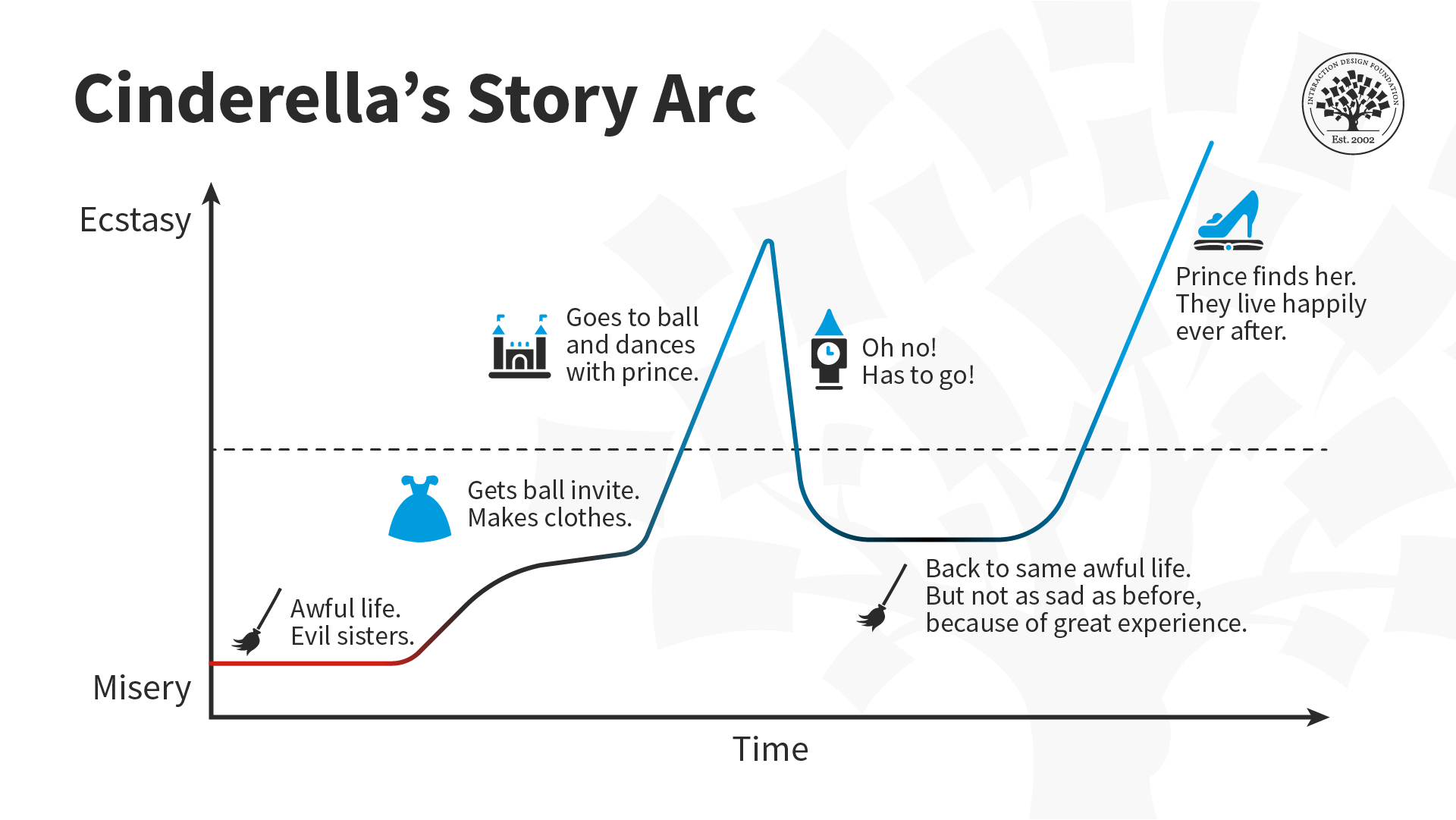
Let's break down each act.
Act I: The "Before" State — The World of Struggle
This is the setup. You need to paint a vivid picture of the customer's world before your brand entered the scene. The goal is to make the audience relate to the hero's problem.
- The Situation: Who is our hero? Make them relatable. What does their normal day look like?
- The Pain: This is the core of Act I. As we saw in the StoryBrand resource, a good story defines the problem on multiple levels:
- External Problem: The practical, surface-level issue. (e.g., "I can't get my team to collaborate effectively on projects.")
- Internal Problem: How the external problem makes the hero feel. (e.g., "I feel frustrated, overwhelmed, and like a failure as a manager.")
- Philosophical Problem: The larger "why" this is wrong. (e.g., "A team's great ideas shouldn't be wasted because of bad tools.")
Establishing this deep-seated pain creates the tension that will drive the rest of the story.
Act II: The "During" State — The Journey of Change
With the problem established, the hero now begins their journey toward a solution. This is the rising action. This is where your brand enters as the Guide.
To understand how to frame this journey, let's watch a short video that explains the structure of a customer story.
Telling A Story | Customer Success Skills Ep. #3 | Winning By Design
The video 'Telling A Story' from Winning by Design offers a direct, practical framework for customer success narratives. It reinforces the idea of the customer as the hero.
Please watch from the beginning to 05:17. Pay close attention to the simple 'Situation -> Pain -> Impact' structure and, most importantly, the explanation of how your company acts as the 'Yoda' (the guide) to the customer's 'Luke Skywalker' (the hero).
As the video explains, the journey involves the hero facing their challenges. Your story shouldn't gloss over this. Real projects are often messy. Showing the struggle and how the customer used your solution to navigate it makes the final success more earned and believable. The brand provides the plan and the tools, but it's the hero who takes the action and completes the journey.
Act III: The "After" State — The Transformation
This is the resolution. The hero has overcome their problem and now lives in a new, better reality. Your job is to show, not just tell, what this transformation looks like.
- The Impact (Success): What changed? You should capture this in two ways:
- Rational Results: The measurable, quantifiable wins. (e.g., "Project completion time was reduced by 30%.")
- Emotional Results: How the hero feels now. (e.g., "I feel confident, in control, and proud of my team's work.")
- The Character Transformation: This is the heart of the story. The hero has transformed from someone who was [frustrated, stuck, insecure] to someone who is now [confident, free, empowered].
A powerful way to think about this entire three-act structure is through a simple story formula.
How to Master Brand Storytelling (Steal This Story System)
Let's watch this segment from 'How to Master Brand Storytelling' to see a simple yet profound narrative pattern that encapsulates the hero's entire transformation.
Please watch the segment from 02:21 to 05:11 and again from 09:44 to 11:46. Focus on the 'Once upon a time... until finally' structure. Also, note the concept of 'temporal compression'—the art of showing significant change in a short amount of time.
This "Once upon a time... until finally" structure perfectly contains the Before, During, and After. It takes us from the old world to the new, showing a clear and satisfying transformation.
3. Your Turn: Outline a Customer Transformation
Now it's time to put these pieces together. Your task is to use a structured outline to map out a customer success story. A good outline is the blueprint that ensures your final story has a strong narrative arc.
Scenario:
A freelance writer named Alex is overwhelmed. They use a combination of spreadsheets, sticky notes, and a cluttered email inbox to manage their projects, deadlines, and client communication. They often miss deadlines, spend hours on admin instead of writing, and feel unprofessional. One day, after losing a potential client due to their disorganization, Alex decides they need a change and discovers "ScribeZen," a project management tool designed for freelancers.
Use the template below to outline Alex's customer success story.
Test your understanding!
Task: Fill out the following outline for Alex's story.
Customer Success Story Outline
-
The Hero: Alex, a talented freelance writer.
-
Act I: The "Before" — The World of Chaos
- Situation: Describe Alex's daily work life.
- The Problem (The Pain):
- External: What is the practical problem Alex faces?
- Internal: How does this make Alex feel?
- Philosophical: Why is this situation fundamentally wrong?
-
Act II: The "During" — The Path to Order
- The Inciting Incident: What event triggers the search for a solution?
- Meeting the Guide: How does Alex find ScribeZen?
- The Path Forward: What key actions does Alex take using ScribeZen to get organized?
-
Act III: The "After" — The World of Control
- The New Reality (The Impact):
- Rational: What are the measurable results?
- Emotional: How does Alex feel now?
- Character Transformation Summary: Alex transformed from a _______ writer to a _______ professional.
- The New Reality (The Impact):
Show answer
Here is a sample outline. Your version might differ, and that's perfectly fine!
Customer Success Story Outline
-
The Hero: Alex, a talented freelance writer with great ideas but a chaotic workflow.
-
Act I: The "Before" — The World of Chaos
- Situation: Alex’s desk is covered in sticky notes. Their email inbox has hundreds of unread messages, and they toggle between three different spreadsheets to track projects, invoices, and client details.
- The Problem (The Pain):
- External: Juggling administrative tasks is taking up more time than actual writing. Deadlines are missed, and client communication is inconsistent.
- Internal: Alex feels overwhelmed, stressed, and embarrassed by their lack of organization. They suffer from imposter syndrome, feeling like a "fraud" rather than a professional.
- Philosophical: Talented creators shouldn't be held back by administrative chaos. Their energy should be spent on creating, not managing spreadsheets.
-
Act II: The "During" — The Path to Order
- The Inciting Incident: Alex loses a high-paying client because they missed a crucial follow-up email that got buried in their inbox. This is the final straw.
- Meeting the Guide: Frustrated, Alex searches online for "project management for writers" and discovers the ScribeZen website, which speaks directly to their pain points.
- The Path Forward: Alex signs up for a trial. They use ScribeZen's templates to import all their clients and projects. They set up automated reminders for deadlines and invoicing. For the first time, they see all their work in one clean dashboard.
-
Act III: The "After" — The World of Control
- The New Reality (The Impact):
- Rational: Alex has reduced their weekly administrative time by 8 hours. They haven't missed a deadline in three months and have increased their income by 25% by taking on more work.
- Emotional: Alex feels confident, in control, and professional. They are proud to send clients a link to their ScribeZen portal. The stress is gone, replaced by a calm focus on their writing.
- Character Transformation Summary: Alex transformed from an overwhelmed and disorganized writer to a confident and professional creative entrepreneur.
- The New Reality (The Impact):
Conclusion
Today you've learned how to structure a customer success story not as a dry case study, but as a compelling narrative of human transformation. By making the customer the hero and your brand the trusted guide, you create a story that resonates on an emotional level and powerfully demonstrates your value.
Key Takeaways:
- The Customer is the Hero: Your brand is the guide that helps them succeed.
- The Three-Act Structure: Frame your story in three parts: Before (the problem), During (the journey), and After (the transformation).
- Focus on Transformation: The story's power comes from the clear change in the hero, from a state of struggle to a state of success, both rationally and emotionally.
Preview of the Next Lesson:
Now that you've mastered the art of outlining a narrative arc, we'll move on to the next logical step: writing. In the next lesson, you will draft a short employee or customer story that humanizes the brand by showcasing its values in action. We will focus on bringing the outline to life with vivid language and detail.