Hello! Let's continue our exploration of deep inelastic scattering and the structure of the proton.
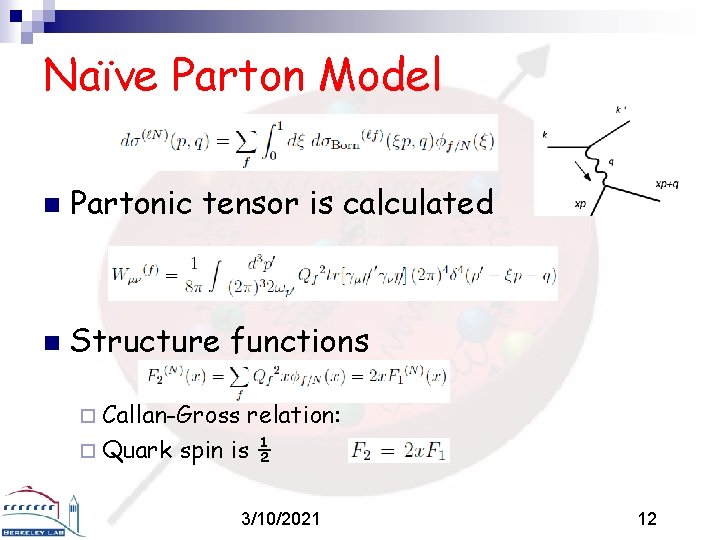
In our last lesson, we established the naive parton model, which provides a powerful physical picture of the proton as a collection of quasi-free, point-like constituents called partons. By treating electron-proton scattering as an incoherent sum of elastic electron-parton collisions, we derived a concrete expression for the structure function in terms of the parton distribution functions (PDFs): . This formula gave a direct physical meaning to and beautifully explained the experimental observation of Bjorken scaling.
Today, we will complete that picture by deriving the other structure function, . You will see that in the parton model, and are not independent. They are linked by the Callan-Gross relation, a simple but profound equation whose experimental verification provided one of the most decisive pieces of evidence that the partons within the proton are indeed the spin-1/2 quarks of the Standard Model.
Our learning goal for this lesson is to derive the Callan-Gross relation and explain its interpretation as evidence for spin-1/2 partons (quarks).
1. Connecting and
Let's begin by recalling the general form of the differential cross-section for electron-proton scattering in the lab frame, expressed in terms of the two structure functions and :
In the Bjorken limit ( with fixed), we define the scaling structure functions:
Note that different texts may use slightly different definitions for , but they all lead to the same final relation.
The parton model's core assumption is that this scattering is just elastic scattering off a single parton. The beauty of this is that we already know the cross-section for elastic scattering off a point-like spin-1/2 fermion, such as a muon. The formula is very similar, and by comparing the two, we can deduce the relationship between and .
For elastic scattering of an electron off a point particle of mass , the structure functions are not arbitrary functions but are fixed by kinematics. Specifically, they must contain a delta function that enforces the elastic condition, . This condition translates to . The structure functions for a point-like fermion are:
The factor of in arises from the magnetic moment interaction of a Dirac fermion.
Now, let's apply this to the parton model. We treat the scattering as elastic scattering off a quark of mass carrying a momentum fraction of the proton's momentum, so its momentum is . In the infinite momentum frame, the effective mass of this parton is , where is the proton mass.
The derivation is now straightforward.
Chapter 9 Proton structure in QCD
This section from the lecture notes 'Proton structure in QCD' provides a concise derivation of the Callan-Gross relation by directly comparing the structure functions for a point particle to the scaling functions in the parton model.
Please read section 9.3.3, 'Callan-Gross relation'. Follow the argument that starts by relating F₁ and F₂ to W₁ and W₂, then uses the known relationship between W₁ and W₂ for elastic scattering on a point particle to arrive at the final result.
Let's walk through the key steps from the text.
- From the definitions of and , we can form the ratio:
- In the parton model, we substitute the point-like structure functions, treating the parton of mass as the target:
- Combine these and substitute (the crucial result from our last lesson):
- Recognizing that the term in parenthesis is just the definition of Bjorken-, we get:
Rearranging this gives the celebrated Callan-Gross relation:
This is a remarkable prediction. It states that the two structure functions, which in principle could be completely independent, are in fact locked together by a simple scaling factor. This prediction is not a general property of QFT; it is a specific consequence of the assumption that the charged constituents of the proton are spin-1/2 particles.
2. The Physical Interpretation: Spin-1/2 vs. Spin-0 Partons
Why is this relation so specific to spin-1/2? The answer lies in how particles of different spin interact with the electromagnetic field, which is mediated by the virtual photon in DIS.
A full QED calculation of the partonic tensor, , for both a spin-1/2 fermion and a hypothetical spin-0 scalar reveals the difference.
- For a spin-1/2 quark (a Dirac fermion), the interaction vertex is . The calculation yields both a "charge" term (related to ) and a "magnetic" term (related to ), leading to the Callan-Gross relation.
- For a hypothetical spin-0 quark (a scalar boson), the interaction vertex would be of the form . A calculation shows that this leads to , and therefore .
The Callan-Gross relation is thus a unique signature of scattering from point-like, spin-1/2 constituents. The fact that is non-zero implies that the partons have a magnetic moment, and the specific relation to indicates that this magnetic moment is precisely the one expected for a fundamental Dirac fermion ().
Test your understanding!
What would the Callan-Gross relation predict for the ratio , where and are the absorption cross-sections for longitudinally and transversely polarized virtual photons, respectively? The cross-sections are related to the structure functions by:
What does your result for R imply about how spin-1/2 quarks interact with virtual photons in the high-energy limit?
Show answer
Substituting the Callan-Gross relation, , into the expression for :
Therefore, the ratio .
This implies that in the parton model, spin-1/2 quarks can only absorb transversely polarized virtual photons, not longitudinal ones. This is a helicity conservation argument. In the high-energy (massless) limit, a spin-1/2 quark's helicity is conserved. A transverse photon carries helicity , while a longitudinal photon carries helicity 0. A quark can absorb a transverse photon and flip its direction of motion while conserving helicity. To absorb a helicity-0 longitudinal photon, it would have to flip its helicity (e.g., from right-handed to left-handed), which is forbidden for a massless fermion.
Introduction to the Parton Model and Pertrubative QCD
These lecture notes by George Sterman offer a slightly more formal derivation and provide excellent physical intuition, including the contrast with scalar quarks and the connection to photon polarizations.
Please read the sections titled 'Structure functions in the Parton Model: The Callan-Gross Relation' and 'Structure Functions and Photon Polarizations' (up to the discussion of neutrinos). Note Exercise 3, which points out that the relation is different for scalar quarks, and the derivation showing that the Callan-Gross relation implies the longitudinal structure function (F_long) is zero.
3. Experimental Verification
The Callan-Gross relation is a sharp, testable prediction. Shortly after it was proposed, experiments at the Stanford Linear Accelerator Center (SLAC) put it to the test. They performed DIS experiments over a wide range of kinematics and painstakingly extracted and from the angular dependence of the cross-section.
The result was a triumph for the quark-parton model.
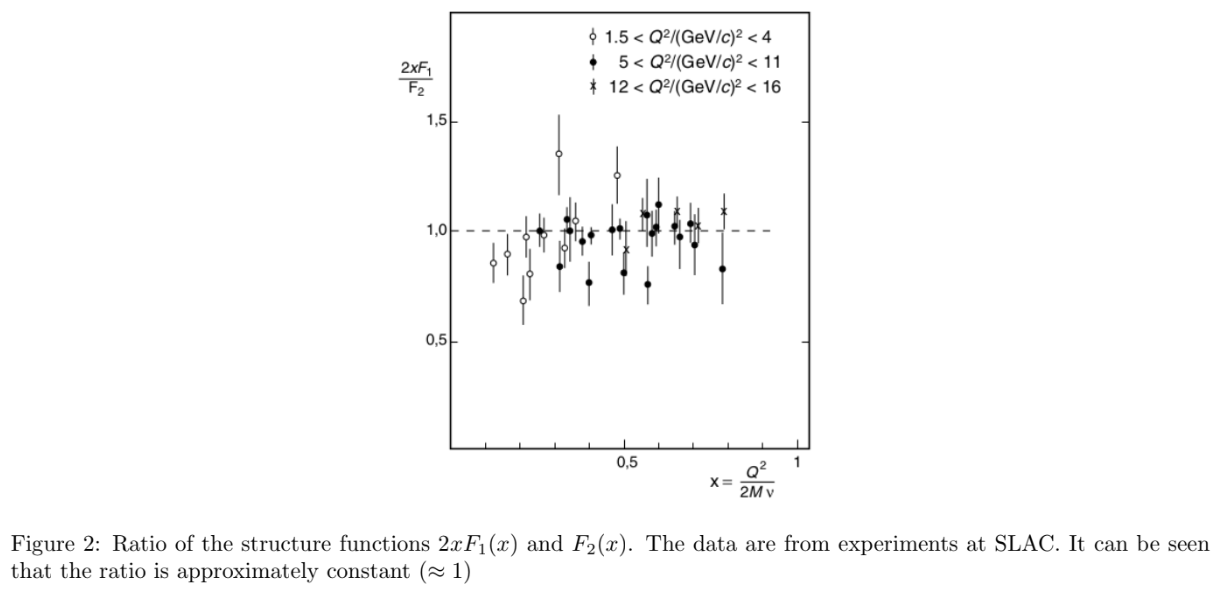
As the plot clearly shows, the measured ratio is very close to 1, across a range of and values. This confirmed that the charged partons inside the proton behave exactly like spin-1/2 Dirac fermions. It was powerful, direct evidence that the abstract "partons" of Feynman's model were in fact the same physical entities as the "quarks" from Gell-Mann's classification of hadrons.
In modern experiments, small deviations from the Callan-Gross relation are observed. The ratio is small, but not exactly zero. These deviations are well-understood within the framework of full QCD as arising from the transverse momentum of quarks and from interactions involving gluon exchange. Far from invalidating the model, these corrections provide further, more subtle tests of the theory of strong interactions.
Conclusion
This lesson marks a crucial point in our journey. We have moved from the general parameterization of our ignorance (the initial definition of and ) to a predictive physical model that was confirmed by experiment.
Key Takeaways:
- The naive parton model, which treats DIS as elastic scattering off free constituents, predicts a specific relationship between the two structure functions: . This is the Callan-Gross relation.
- This relation is a direct consequence of the assumption that the partons are spin-1/2 Dirac fermions. The term arises from the magnetic interaction, which would be absent () for hypothetical spin-0 partons.
- The prediction implies that in the high-energy limit, quarks can only absorb transversely polarized virtual photons ().
- Experimental data from SLAC showed remarkable agreement with the Callan-Gross relation, providing definitive evidence that the proton's charged constituents have spin-1/2 and cementing the identification of partons with quarks.
Preview of the Next Lesson:
The naive parton model is a spectacular success, but it leaves some deep questions unanswered. If quarks are quasi-free inside the proton, why have we never observed a free quark in isolation? The model also treats the PDFs as static inputs; the full theory of QCD should describe their origin and evolution. In the next lesson, we will begin to address these points by discussing quark confinement, the factorization theorem in QCD, and the Callan-Gross-Llewellyn Smith sum rule, bridging the gap between our simple model and the complete theory of the strong force.