Hello! In our last lesson, we saw the incredible success of the naive parton model. By assuming the proton's constituents were quasi-free, spin-1/2 particles, we derived the Callan-Gross relation, which was then spectacularly confirmed by experiment. This cemented the identification of Feynman's partons with Gell-Mann's quarks.
However, this success leaves us with a profound paradox. If quarks behave as nearly free particles when probed at high energies inside a proton, why have decades of experiments failed to observe a single free quark in isolation? This puzzle points to a fundamental, non-perturbative feature of the strong force.
Today, we will address this paradox by exploring the concept of quark confinement. We will see how this phenomenon is inextricably linked to the behavior of Quantum Chromodynamics (QCD) in the low-energy, long-distance regime, where the theory becomes strongly coupled.
Our learning goal is to describe the concept of quark confinement and its relation to the strong-coupling regime of QCD.
1. The Phenomenon of Confinement
The experimental reality is stark: only color-singlet (color-neutral) combinations of quarks are ever observed in nature. These are:
- Baryons: Three-quark states (), like the proton and neutron.
- Mesons: Quark-antiquark states (), like the pion and kaon.
Individual quarks, or the gluons that bind them, which carry color charge, have never been isolated. This observation is the essence of confinement. To describe this mathematically, physicists developed a phenomenological model for the potential energy between a static quark and antiquark:
This potential has two distinct parts:
- A Coulomb-like term (): This dominates at short distances (). It's very similar to the Coulomb potential in QED, and it explains why quarks behave as quasi-free particles when they are close together. The factor is a color factor for a pair in a singlet state.
- A linear term (): This term dominates at long distances (). Here, is the string tension, with an experimentally determined value of about , which corresponds to a force of about 160,000 Newtons!
The linear term is the key to confinement. It implies that the energy required to separate a quark-antiquark pair grows linearly and indefinitely with distance. Pulling them apart would require an infinite amount of energy.
In reality, before you can pull the quarks infinitely far apart, something else happens. The energy stored in the "string" between them becomes so large that it is energetically favorable to create a new quark-antiquark pair from the vacuum. The original string breaks, and the new quarks pair up with the old ones, resulting in two separate mesons instead of two free quarks. This process is known as hadronization and is the reason why high-energy particle collisions produce sprays of hadrons (called "jets") rather than free quarks.
2. The Cause: Strong Coupling and Asymptotic Freedom
Why does the QCD potential have this strange long-distance behavior, so different from the familiar potentials of gravity or electromagnetism? The answer lies in how the strength of the interaction, governed by the coupling constant , changes with distance or energy scale.

In QED, vacuum polarization from virtual electron-positron pairs screens the electric charge, making the effective charge smaller at larger distances. In QCD, the opposite happens. The gluons, unlike photons, carry color charge themselves and can self-interact. This leads to an "anti-screening" effect.
This behavior is described by the QCD beta function, which dictates how the coupling (where ) runs with the energy scale .
To understand the origin of confinement, we first need to understand how the QCD coupling changes with energy. This section from David Tong's lecture notes on Gauge Theory explains the concept of the running coupling, asymptotic freedom, and the emergence of a fundamental energy scale in QCD, \Lambda_{QCD}.
Please read Section 2.4, 'The Flow to Strong Coupling', and Section 2.4.1, 'Anti-Screening and Paramagnetism'. Focus on how the negative sign of the beta function leads to asymptotic freedom at high energies and strong coupling at low energies. Pay attention to the concept of \Lambda_{QCD} and the condensed matter analogy for anti-screening.
As you read, the key takeaways are:
- Asymptotic Freedom: At high energies () or short distances, the QCD coupling becomes very small. Quarks and gluons interact weakly, which explains the success of the parton model.
- Strong Coupling: At low energies () or long distances, the coupling becomes large. Perturbation theory breaks down completely. This is the regime where confinement occurs.
- Dimensional Transmutation: Classical Yang-Mills theory has no inherent energy scale. Quantum effects (the running of the coupling) generate a physical energy scale, MeV. This scale governs the masses of hadrons and the string tension .
3. The Physical Picture: Chromoelectric Flux Tubes
We now have the ingredients: at large distances, the strong force is... well, strong. But how does this strong self-interaction of gluons lead to a linear potential?
The prevailing physical picture is that the QCD vacuum acts as a complex medium that cannot tolerate chromoelectric fields.
- In QED, the electric field lines from a charge spread out into space. The field strength decreases as , which integrates to the familiar potential.
- In QCD, the gluon self-interactions squeeze the chromoelectric flux into a narrow, string-like tube connecting a quark and an antiquark.
The energy density within this flux tube is roughly constant. Therefore, the total energy stored in the tube is directly proportional to its length, . This is the physical origin of the linear confining potential.
Prof. Leonard Susskind "The Mechanism of Quark Confinement"
Professor Leonard Susskind provides a superb physical explanation of this flux tube mechanism. He discusses how the idea of confinement evolved and explains the core concept of the QCD vacuum being a medium that repels chromoelectric fields.
Please watch from 13:40 to 21:10. First, he explains how the 1+1 dimensional Schwinger model provides a solvable example of confinement via flux lines. Then, he generalizes this to 4D QCD, introducing the crucial idea that 'nature abhors a chromoelectric field', leading to the formation of flux tubes.
A powerful analogy for this phenomenon comes from the physics of superconductivity, which you've studied in your condensed matter courses.
The formation of QCD flux tubes is often described as a 'dual superconductor' effect. David Tong's notes provide a clear explanation of this analogy.
Read Section 2.5.1, 'The Confining Force', and Section 2.5.2, 'An Analogy: Flux Lines in a Superconductor'. Focus on how magnetic monopoles would be confined inside a regular superconductor by magnetic flux tubes (Abrikosov vortices) and then understand the dual picture for QCD: the vacuum acts like a medium that confines chromo-electric charges via electric flux tubes.
4. Quantifying Confinement: The Wilson Loop
The flux tube picture is intuitive, but is there a more formal, quantitative criterion for confinement? The answer is yes, and it is provided by the Wilson loop.
Imagine creating a quark-antiquark pair from the vacuum at some point in spacetime, moving them apart to a distance , letting them propagate for a time , and then having them annihilate. The path of the quark and antiquark traces out a rectangular loop in spacetime with area .
The expectation value of the Wilson loop, , is related to the energy of this static quark-antiquark configuration, :
We can now distinguish between different behaviors of the potential:
- Deconfinement (e.g., QED): If the potential is Coulomb-like, the expectation value follows a perimeter law: , where the exponent depends on the perimeter of the loop.
- Confinement: If the potential is linear, , then the expectation value follows an area law: The energy depends on the area of the spacetime loop. This area law is the definitive signal of confinement.
Because confinement is a strong-coupling phenomenon, proving the area law from first principles is extremely difficult. However, it can be demonstrated using a powerful numerical approach called Lattice QCD, where spacetime is discretized into a grid.
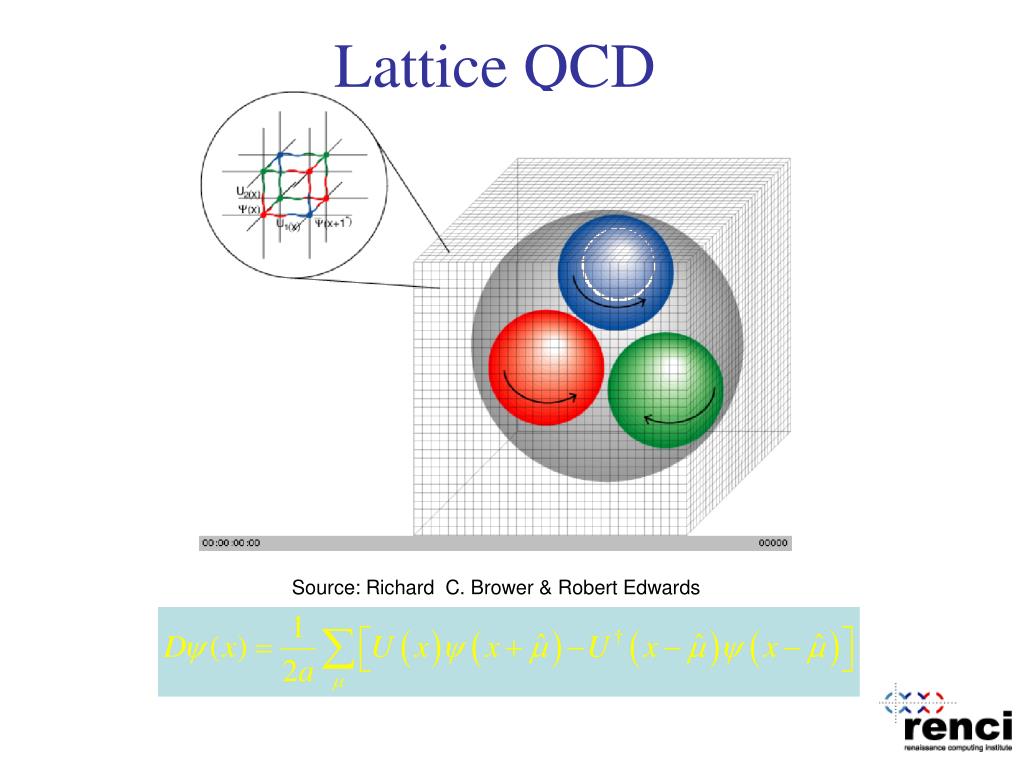
Lattice QCD simulations robustly show that pure Yang-Mills theory (QCD without quarks) exhibits an area law for the Wilson loop, thus confirming that the theory is confining. Other non-perturbative analytical methods, such as the Hamiltonian approach in Coulomb gauge you have encountered in your research reading, also aim to demonstrate this confinement analytically. For instance, the paper by Szczepaniak and Swanson concludes that their self-consistent method naturally leads to the "emergence of the confinement phenomenon" and produces a static potential that matches lattice data well.
Test your understanding!
Consider a hypothetical world where the string tension is much smaller, say , but the quark masses are the same. How would the phenomenon of hadronization and the appearance of jets in particle colliders change? Would it be "easier" or "harder" to see "quasi-free" quarks over larger distances?
Show answer
If were much smaller, the energy stored in the flux tube per unit length would be lower. String breaking occurs when the energy in the string, , is sufficient to produce a new quark-antiquark pair, i.e., , where is the mass of the lightest quarks.
With a smaller , the string would have to be stretched to a much greater length before it has enough energy to break. Therefore, it would be "easier" to see quarks behaving as distinct entities over larger distances within a hadron. In a collider, the resulting jets would be much narrower, as the produced quarks could travel further before the confining force dictates their hadronization into a spray of particles.
Conclusion
Today we have demystified one of the most fundamental and unique aspects of the strong force. What appeared as a paradox—the simultaneous freedom of quarks inside hadrons and their imprisonment within them—is resolved by understanding the scale-dependent nature of the QCD coupling.
Key Takeaways:
- Confinement is the experimental fact that only color-singlet states (baryons and mesons) are observed as free particles, while colored quarks and gluons are not.
- This is caused by the strong-coupling regime of QCD at long distances. While QCD is weakly coupled at short distances (asymptotic freedom), the coupling grows as quarks are pulled apart.
- The physical picture of confinement involves the formation of chromo-electric flux tubes between color charges. The constant energy density of these tubes leads to a potential energy that grows linearly with distance, .
- The formal criterion for confinement is the area law for the expectation value of the Wilson loop, which has been confirmed by Lattice QCD simulations.
Preview of the Next Lesson:
Now that we understand that quarks are fundamentally confined, the success of the naive parton model seems even more remarkable. How can we justify treating a high-energy collision as a simple scattering off a single quark, when that quark is part of a complex, strongly-interacting, confined system? The answer lies in the factorization theorem of QCD, which provides the rigorous theoretical foundation for this separation of scales. In our next lesson, we will explore this crucial theorem and its application to calculating hadronic cross-sections.