Welcome back. In our last lesson, we outlined the principles and the multi-step process of conducting a systematic review, appreciating it as a rigorous method for synthesizing evidence in Ayurveda. We discussed how to formulate a PICO question and the importance of a comprehensive search.
Today, we transition from the "what" and "why" to the "how." This lesson is designed to help you master a critical, practical skill in research. We will directly address the learning outcome: Design a search strategy and data extraction form for a Dravyaguna-related research question. These two documents are the architectural blueprints for any systematic review. A well-designed search strategy ensures you find all the relevant evidence, while a well-designed data extraction form ensures you collect the right information from that evidence in a structured, unbiased way.
1. Designing a Systematic Search Strategy
The goal of a search strategy is to create a net that is wide enough to catch all relevant studies but fine enough to exclude most of the irrelevant ones. Your strategy must be transparent, logical, and reproducible, so another researcher could run the same search and get the same results.
Let's use a research question that aligns with your interest in metabolic disorders:
"What is the evidence for the efficacy of Guggulu (Commiphora wightii) in managing Medoroga (obesity and/or dyslipidemia)?"
To build a search strategy for this question, we follow a systematic process.
Step 1: Deconstruct the Question into Concepts (PICO)
First, we break down our question into its core concepts. For a search strategy, we primarily focus on the Population (P) and Intervention (I).
- Population (P): Medoroga, Obesity, Dyslipidemia
- Intervention (I): Guggulu, Commiphora wightii
Step 2: Brainstorm Keywords for Each Concept
This is where your BAMS knowledge is indispensable. For each concept, we need to list all possible search terms, including Ayurvedic terminology, biomedical equivalents, synonyms, and different English spellings.
- Population (P) Keywords:
- Ayurvedic terms:
Medoroga,Sthaulya,Medovriddhi - Biomedical terms:
Obesity,Overweight,Hyperlipidemia,Dyslipidemia,Hypercholesterolemia,"Metabolic Syndrome"
- Ayurvedic terms:
- Intervention (I) Keywords:
- Dravya name & synonyms:
Guggulu,Guggul,Guggulipid,Guggulsterone - Botanical name:
"Commiphora wightii","Commiphora mukul"(an older botanical name)
- Dravya name & synonyms:
Note: Using quotation marks (" ") around multi-word phrases tells the database to search for that exact phrase.
The paper "Literature searches on Ayurveda: An update" (resource_id: [LINK](https://rcastoragev2.blob.core.windows.net/dbde123bc9785e7ce4248d87db438ac2/PMC4895749.pdf)), which we looked at in the last lesson, provides an excellent example of this process in its Table 1 for the topic of Psoriasis. Notice how the authors list Ayurvedic terms, biomedical terms, and multiple botanical names. This is the level of detail required for a comprehensive search.
Step 3: Combine Keywords with Boolean Operators
Next, we connect our keywords using Boolean operators (AND, OR).
ORis used to combine synonyms within a single concept. It broadens the search.Obesity OR Overweight OR Hyperlipidemia OR Dyslipidemia OR Medoroga OR Sthaulya
ANDis used to combine different concepts. It narrows the search to find articles that contain both concepts.(Guggulu OR "Commiphora wightii")AND(Obesity OR Hyperlipidemia)
The following video provides a clear, practical demonstration of how to structure your keywords and combine them using these operators.
Systematic Review Search Strategy | How to plan and present your search terms
This video, 'Systematic Review Search Strategy', clearly explains how to organize keywords into concepts and use Boolean operators to build a search string.
Please watch from 02:21 to 07:08. The video presents two real-life examples. Pay close attention to how the reviewers group their keywords into categories (concepts) and plan to connect them with 'OR' within categories and 'AND' between categories. This visual representation of the logic is very helpful.
Putting it all together, a final search string for a database like PubMed might look like this:
("Commiphora wightii" OR "Commiphora mukul" OR Guggulu OR Guggul OR Guggulipid) AND (Obesity OR Overweight OR Hyperlipidemia OR Dyslipidemia OR Medoroga OR Sthaulya)
Step 4: Select Databases and Document the Search
As we learned previously, no single database is sufficient for Ayurvedic research. You must plan to search multiple sources:
- Ayurvedic Databases: AYUSH Research Portal, DHARA, ABIM.
- Biomedical Databases: PubMed, Cochrane Library, DOAJ.
- Grey Literature: Thesis databases (e.g., Shodhganga), clinical trial registries (e.g., CTRI).
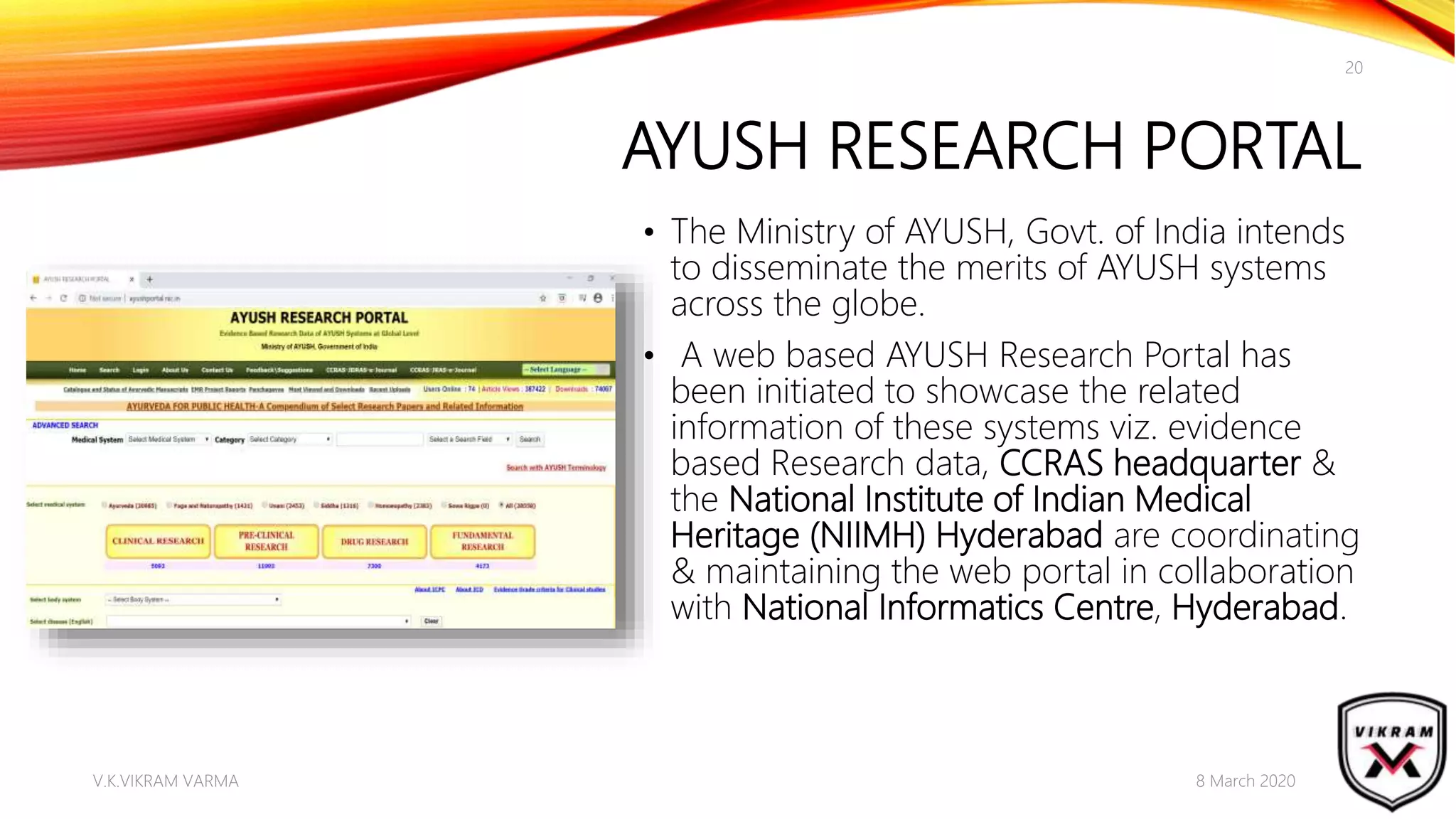
For each database you search, you must meticulously record:
- The name of the database.
- The exact search string used (it may need slight modification for each database's syntax).
- The date of the search.
- The number of results found.
This documentation is essential for the reproducibility and transparency of your review, as emphasized in the LINK video you just watched.
2. Designing a Data Extraction Form
Once you have screened your search results and have your final list of included studies, you need to extract the relevant information from each one. A standardized data extraction form is crucial for this. It acts as a template to ensure you collect the same information from every study, minimizing bias and making the final synthesis much easier.
Let's continue with our Guggulu and Medoroga example. What information would we need to pull from each clinical trial?
Core Components of a Data Extraction Form
A good form is a mix of general study information and details specific to your PICO question. The resource "A protocol for systematic reviews of Ayurveda treatments" (resource_id: [LINK](https://pmc.ncbi.nlm.nih.gov/articles/PMC3059450/)) provides an excellent, Ayurveda-specific template.
A protocol for systematic reviews of Ayurveda treatments
This paper provides a template for an 'Integrated data extraction form' (IDE) specifically designed for Ayurvedic interventions. It is an invaluable guide for creating your own form.
First, read the brief paragraph under the heading 'Data extraction' (section 3). Then, carefully study 'Table 2. Integrated data extraction form' (section 5). Notice how it includes fields for both Ayurvedic concepts (like intervention type - Shamana/Shodhana, Prakriti) and standard modern research components (study design, outcome measures).
Drawing from the principles in that table and general best practices, our form for the Guggulu review should include fields for:
-
General Information:
- Study ID (e.g., "Sharma 2018")
- Title, Author, Year of Publication
- Study Design (e.g., RCT, quasi-experimental, case series)
- Funding Source
-
Population Details (P):
- Total participants (N), and number in each group
- Inclusion/Exclusion criteria
- Baseline characteristics (age, gender, BMI, lipid profile)
- Ayurvedic diagnosis criteria (if any)
- Deha Prakriti distribution (if reported)
-
Intervention Details (I):
- Drug Name: Guggulu
- Formulation Details: Part used (e.g., resin), dosage form (Vati, Churna), whether it was Shodhita (purified).
- Standardization: Was the drug standardized to active constituents like guggulsterones? (This is a key quality marker).
- Dosage & Frequency: e.g., 500mg, thrice daily.
- Duration of treatment: e.g., 12 weeks.
- Anupana (Adjuvant): e.g., warm water, honey.
-
Comparison Details (C):
- Type of control (e.g., Placebo, standard allopathic drug, another Ayurvedic drug).
- Details of the comparison intervention (dose, duration, etc.).
-
Outcome Details (O):
- Primary/Secondary Outcomes: As defined by the study authors.
- Anthropometric Measures: Weight change (kg), BMI reduction, waist circumference.
- Biochemical Measures: Change in LDL, HDL, Total Cholesterol, Triglycerides.
- Ayurvedic Measures: Symptomatic relief in Medoroga symptoms (if measured).
- Adverse Events: Any reported side effects.
-
Results & Quality:
- Key Findings: Summary of results for each outcome (e.g., mean difference, p-value).
- Risk of Bias Assessment: Notes on the study's quality (e.g., randomization method, blinding).

Test your understanding!
Imagine you are designing a data extraction form for a systematic review on the use of Amalaki (Emblica officinalis) for Amlapitta (hyperacidity/GERD). In the "Intervention Details" section of your form, what specific fields related to the Dravya (Amalaki) would you include?
Show answer
For the "Intervention Details" on Amalaki, you would want to include fields for:
- Part Used: Fresh fruit, dried fruit, seed.
- Dosage Form: Swarasa (fresh juice), Churna (powder), Avaleha (linctus, e.g., in Chyawanprash), Vati (tablet).
- Standardization: If it's an extract, is it standardized to a certain percentage of tannins or Vitamin C?
- Samskara (Processing): Was the Amalaki processed in any specific way (e.g., bhavana with its own juice)?
- Dose, Frequency, and Duration: The exact regimen used.
- Anupana: The adjuvant used, if any (e.g., with honey, ghee, or water).
Conclusion
Today we have built the essential toolkit for a systematic review. By moving from a research question to a detailed, reproducible search strategy and a structured data extraction form, you have laid the foundation for high-quality evidence synthesis.
Key Takeaways:
- A search strategy is built by breaking a PICO question into concepts, brainstorming extensive keywords (both Ayurvedic and modern), and combining them logically with Boolean operators.
- Searching for Ayurvedic evidence requires using multiple databases, including specialized portals like AYUSH and biomedical databases like PubMed.
- A data extraction form is a pre-defined template used to systematically collect key information on the Population, Intervention, Comparison, Outcomes, and study design from each included paper.
- Designing an Ayurveda-specific form means including fields for concepts like Prakriti, dosage form (kalpana), processing (samskara), and adjuvants (anupana).
Preview of the Next Lesson:
We have now learned how to find studies and how to prepare to extract data from them. But not all studies are created equal. How do we judge the quality and reliability of the evidence we find? In our next lesson, we will begin to answer that question by focusing on the learning outcome: "Explain the principles of randomization and blinding for minimizing bias in clinical research." These two concepts are cornerstones of high-quality clinical trials and are critical for assessing the validity of the research you will be reviewing.