Hello! Welcome to our next lesson.
In our previous session, we established the critical importance of standardizing the drug for a clinical trial. We saw how a Certificate of Analysis, backed by pharmacognosy and advanced chemistry, ensures that an Ayurvedic intervention is safe, potent, and reproducible.
But what about the other side of the equation—the patient? In Ayurveda, a successful treatment (Samprapti Vighatana) depends just as much on understanding the patient's internal state as it does on the quality of the medicine. The concepts of Agni (metabolic fire) and Ama (metabolic toxins) are central to this understanding, especially in the metabolic disorders you are focusing on.
For decades, assessing Agni and Ama has relied on clinical signs and patient-reported symptoms—valuable, but subjective. To truly integrate Ayurveda with modern medicine and conduct robust research, we need objective, measurable parameters. This brings us to today's learning outcome: to evaluate biomarkers for assessing Agni function and Ama in metabolic disorders. This lesson is a direct bridge between classical pathophysiology and modern laboratory science, a cornerstone of your goal to build an evidence-based integrative practice.
The Need for Objective Measurement
Agnimandya (impaired metabolic function) is considered the root cause (moolam) of most diseases. This impaired Agni leads to the formation of Ama, a state of accumulated metabolic waste that clogs channels (Srotas) and initiates disease.
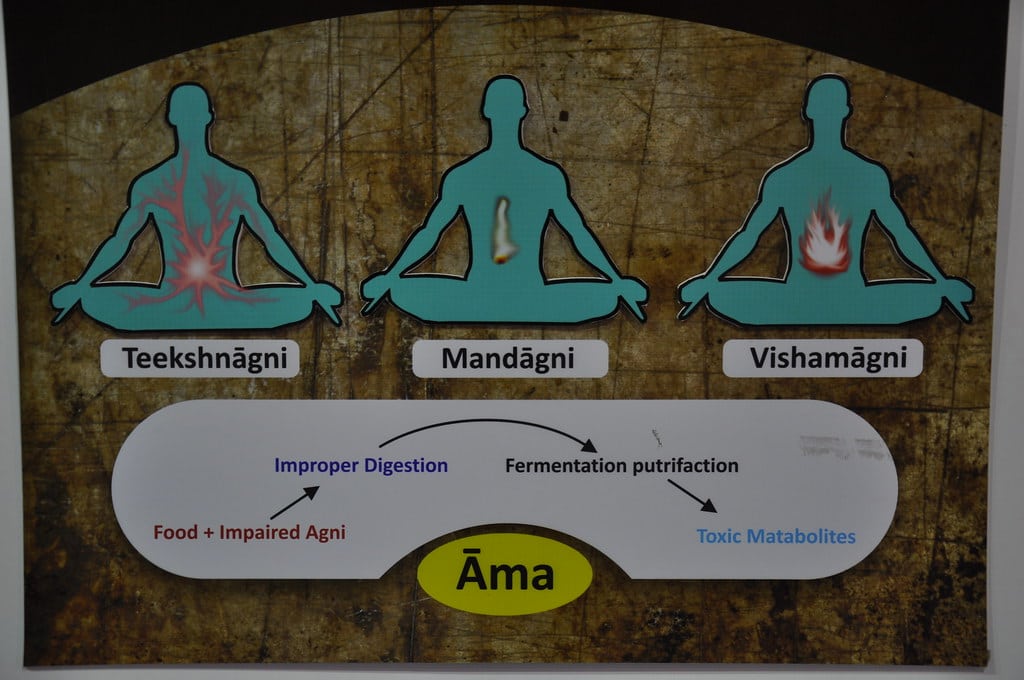
While a skilled practitioner can infer the state of Agni and Ama through methods like Nadi Pariksha (pulse diagnosis), observing the tongue, and detailed questioning, these methods present challenges for modern clinical research and scalable practice:
- Subjectivity: The interpretation can vary between practitioners.
- Lack of Quantification: It's difficult to measure the degree of
Agnimandyaor the amount ofAma, making it hard to track treatment progress objectively.
To address this, researchers are working to correlate these classical concepts with modern physiological biomarkers. Let's start by exploring the framework for this integration.
Webinar on Concept of Agni with special reference to gastrointestinal physiology and Prakriti
The webinar 'Concept of Agni' by the National Institute of Ayurveda, Jaipur, provides an excellent perspective on why we need to build these bridges. It discusses the lacunae in our current understanding and the necessity of incorporating modern physiological knowledge.
Please watch two short segments from this video: 22:12 - 25:06: This section discusses the importance of integrating modern physiology (like that from Guyton's textbook) with Ayurvedic wisdom. 59:05 - 1:00:44: This part highlights the need for dynamic, objective tools for Agni assessment beyond subjective reporting.
As the speaker emphasizes, the goal is not to replace Ayurvedic principles but to enrich them with modern tools to create a more precise and evidence-based approach. We will now evaluate specific biomarkers that research has begun to link with Agni and Ama.
1. Evaluating Biomarkers for Agni Function
The strength of Agni (Agnibala) is traditionally classified into four states: Sama (balanced), Manda (weak), Tikshna (intense), and Vishama (irregular). Recent research has shown that these functional states can be correlated with standard metabolic panels, particularly the lipid profile.
Let's examine a key study that developed and validated a self-assessment tool for Agnibala and then correlated the results with serum lipid parameters in 300 healthy volunteers.
Development, Validation, and Verification of a Self- ...
The paper 'Development, Validation, and Verification of a Self-Assessment Tool to Estimate Agnibala' provides direct evidence linking Agni states to measurable lipid biomarkers.
Please read the section 'Verification of the Tool for Its Clinical Utility' and pay close attention to Table 4. Focus on which specific lipid parameters showed statistically significant differences between the different Agnibala groups.
The results from this study give us our first set of concrete biomarkers:
- Total Cholesterol: The study found a statistically significant difference between the
Mandagnigroup (mean: 192.83 mg/dL) and theTikshnagnigroup (mean: 222.53 mg/dL). This suggests thatTikshnagnimay represent a hyper-metabolic state associated with higher cholesterol turnover, whileMandagnireflects a hypo-metabolic state. - LDL/HDL Ratio & Cholesterol Ratio: Significant differences were observed between the
Vishamagni(irregular) andSamagni(regular) groups. This is a fascinating finding. It implies that the regularity and balance ofAgni(Samagni) are crucial for efficient lipid transport and metabolism, and that the unpredictability ofVishamagniis reflected in less favorable lipid ratios.
In addition to lipid profiles, we can assess Agni function at the tissue level (Dhatvagni) by looking at protein metabolism.
Original Research Paper Ayurveda
The research paper 'Ojas-Agni-Prana Triad Correlating with Physiological Biomarkers' explains how Agni's function is reflected in the body's anabolic and catabolic balance, which can be measured with a standard liver function test.
Please read the subsection 'Concept of Tejas (Agni) and Metabolic Biomarkers'. Focus on the discussion around the Albumin/Globulin (A/G) ratio and its connection to Samagni and Mandagni.
From this, we can derive another critical biomarker:
- Albumin/Globulin (A/G) Ratio:
- Samagni (Balanced Agni): A balanced state of
Agniensures properDhatu Poshana(tissue nourishment), leading to a healthy balance between protein synthesis (anabolism) and breakdown (catabolism). This is reflected in a normal A/G ratio. - Mandagni / Dhatwagnimandya (Weak Agni): Impaired
Agni, especially at the tissue level, can lead to decreased protein synthesis in the liver. This results in hypoalbuminemia (low albumin) and consequently a low A/G ratio. This is a powerful link, as hypoalbuminemia is a known marker for poor nutritional status and systemic disease.
- Samagni (Balanced Agni): A balanced state of
Test your understanding!
A 45-year-old patient with a new diagnosis of metabolic syndrome comes to you for an integrative consultation. Their lab report shows:
- Total Cholesterol: 230 mg/dL
- LDL/HDL Ratio: 4.5
- Serum Albumin: 3.2 g/dL (Normal: 3.5-5.5 g/dL)
- Serum Globulin: 3.0 g/dL (Normal: 2.0-3.5 g/dL)
Based on the biomarkers we've just discussed, what would be your initial assessment of this patient's Jatharagni and Dhatvagni status? Justify your answer.
Show answer
Based on the biomarkers:
- Jatharagni: The elevated total cholesterol and high LDL/HDL ratio could suggest a state of
Tikshnagni(hyper-metabolism leading to high cholesterol) or, more likely in metabolic syndrome, a dysfunctionalAgnithat has aspects of bothTikshnagni(overactive in some pathways like lipid synthesis) andMandagni(sluggish in clearing metabolites). The high ratio specifically points away from a balancedSamagni. - Dhatvagni: The low serum albumin indicates hypoalbuminemia, and the resulting A/G ratio is low (3.2 / 3.0 = 1.06). This strongly suggests a state of
Dhatwagnimandya, where the tissue-level metabolic fire is weak, leading to impaired protein synthesis in the liver.
2. Evaluating Biomarkers for Ama
Ama is not just "indigestion." As your BAMS background taught you, it's a systemic problem of incompletely metabolized substances that can trigger disease. Let's clarify this crucial concept before diving into its biomarkers.
Assessment of Ama, Dosha & Sthana : Re examining Classical methods of Clinical Diagnosis
Dr. Rammanohar, in his lecture 'Assessment of Ama, Dosha & Sthana,' provides a precise definition of Ama, distinguishing it from simple Ajirna (indigestion) and placing its formation at the systemic level.
Please watch the segment from 54:20 to 58:19. Note the key distinction he makes: Ajirna is a delay in digestion, while Ama is a failure of transformation, occurring at the level of Rasa Dhatu.
This "failure of transformation" means the body sees Ama as a foreign, toxic substance. The body's response to this is central to identifying biomarkers for Ama. Modern science has a name for this response: chronic low-grade inflammation.
Inflammatory Markers
The paper on the "Ojas-Agni-Prana triad" (LINK) explicitly connects Agnimandya and Ama to pro-inflammatory biomarkers. The chain of events is:Agnimandya ➞ Formation of Ama ➞ Ama acts as an endogenous toxin/antigen ➞ Triggers an immune response and chronic inflammation.
This process is reflected in elevated levels of:
- C-Reactive Protein (CRP): A highly sensitive marker of systemic inflammation.
- Tumor Necrosis Factor-alpha (TNF-α): A key pro-inflammatory cytokine deeply involved in the pathophysiology of insulin resistance.
- Interleukins (e.g., IL-6): Signaling molecules that promote the inflammatory cascade.
These are the very same markers implicated in modern medicine's understanding of "meta-inflammation"—the low-grade inflammation that drives metabolic syndrome, type 2 diabetes, and atherosclerosis. This provides a robust, evidence-based bridge between the concept of Ama and the pathophysiology of metabolic disorders.
Oxidative Stress Markers
The inflammatory state triggered by Ama also leads to significant oxidative stress. The same paper (LINK, section 2 on "Pathological Effect") links this to the depletion of Ojas (the essence of immunity and vitality). This gives us another set of biomarkers, which are more common in research but crucial for understanding the mechanism:
- Markers of Cellular Damage:
- Malondialdehyde (MDA): An indicator of lipid peroxidation (damage to cell membranes).
- 8-hydroxy-2'deoxyguanosine (8-OHdG): A marker for oxidative damage to DNA.
- Markers of Depleted Antioxidant Defenses:
- Reduced levels of enzymes like Superoxide Dismutase (SOD) and Glutathione Peroxidase (GPx).
The presence of Ama, therefore, can be evaluated by a panel that shows increased inflammation and increased oxidative damage, reflecting a body struggling with a load of metabolic toxins.
Conclusion
Translating classical concepts into objective measures is fundamental to integrative medicine. We can no longer think of Agni and Ama as purely abstract. By leveraging standard and advanced laboratory tests, we can create a more precise, personalized, and evidence-based Ayurvedic practice.
Key Takeaways:
- Assessing
Agnifunction:Agnibala(strength of digestive fire) can be correlated with serum lipid profiles.Tikshnagnimay be associated with higher total cholesterol, whileVishamagniis linked to poorer lipid ratios compared toSamagni.Dhatvagni(tissue metabolism) can be evaluated using the Albumin/Globulin (A/G) ratio, with a low ratio suggestingDhatwagnimandya.
- Assessing
Ama:Amaacts as an endogenous toxin that triggers chronic low-grade inflammation. It can be measured through inflammatory biomarkers like CRP, TNF-α, and IL-6.- The presence of
Amaalso leads to systemic oxidative stress, which can be quantified by oxidative stress markers like MDA and reduced SOD levels.
- Integrated Approach: These biomarkers do not replace classical clinical assessment but rather complement it, providing an objective layer to confirm diagnosis, monitor treatment efficacy, and conduct high-quality research.
Preview of the Next Lesson:
We have now learned to evaluate biomarkers for a patient's dynamic pathological state (Vikriti), as expressed through Agni and Ama. This raises a deeper question: can we also find objective markers for a person's fundamental constitution, their Deha-Prakriti? In our next lesson, we will explore this exciting frontier: "Evaluate biomarkers used to correlate Deha-Prakriti with genomic and metabolomic profiles." This will take us from assessing the current state of imbalance to understanding the patient's baseline constitutional blueprint.