Hello! Welcome back to our journey into Ayurvedic research design.
In our last lesson, we successfully outlined a hypothetical Randomized Controlled Trial (RCT) for Nishamalaki Churna in managing Type 2 Diabetes. A critical detail in our protocol was the use of a "standardized" formulation. This single word carries immense weight and is the cornerstone of credible clinical research. But what does it truly mean to standardize an herbal drug? How can we be sure that the first dose given in a trial is pharmacologically equivalent to the last?
This lesson addresses that very question. Our learning outcome is to describe the standardization methods for herbal drugs required for clinical trial protocols. Answering this is fundamental to bridging the gap between classical Ayurvedic pharmacy and the rigorous demands of modern science. For your goals of integrating Ayurveda with evidence-based medicine, mastering this topic is non-negotiable.
1. The Challenge of Consistency in Herbal Medicine
Unlike single-molecule allopathic drugs, herbal medicines are inherently complex. A single plant like Haridra contains hundreds of phytochemicals. The concentration of these compounds can vary significantly based on:
- Geographical source and soil conditions
- Season of harvest
- Genetic strain of the plant
- Post-harvest processing and storage
When you combine multiple herbs into a formulation like Nishamalaki, this complexity multiplies. Classical Ayurvedic texts provided guidelines for preparation, but these were often for individual physicians, not for producing thousands of identical batches for a multi-center clinical trial. Without a robust system of standardization, any clinical trial result, whether positive or negative, is uninterpretable and cannot be reproduced.
To begin, let's look at a comprehensive overview of the different facets of herbal drug standardization.
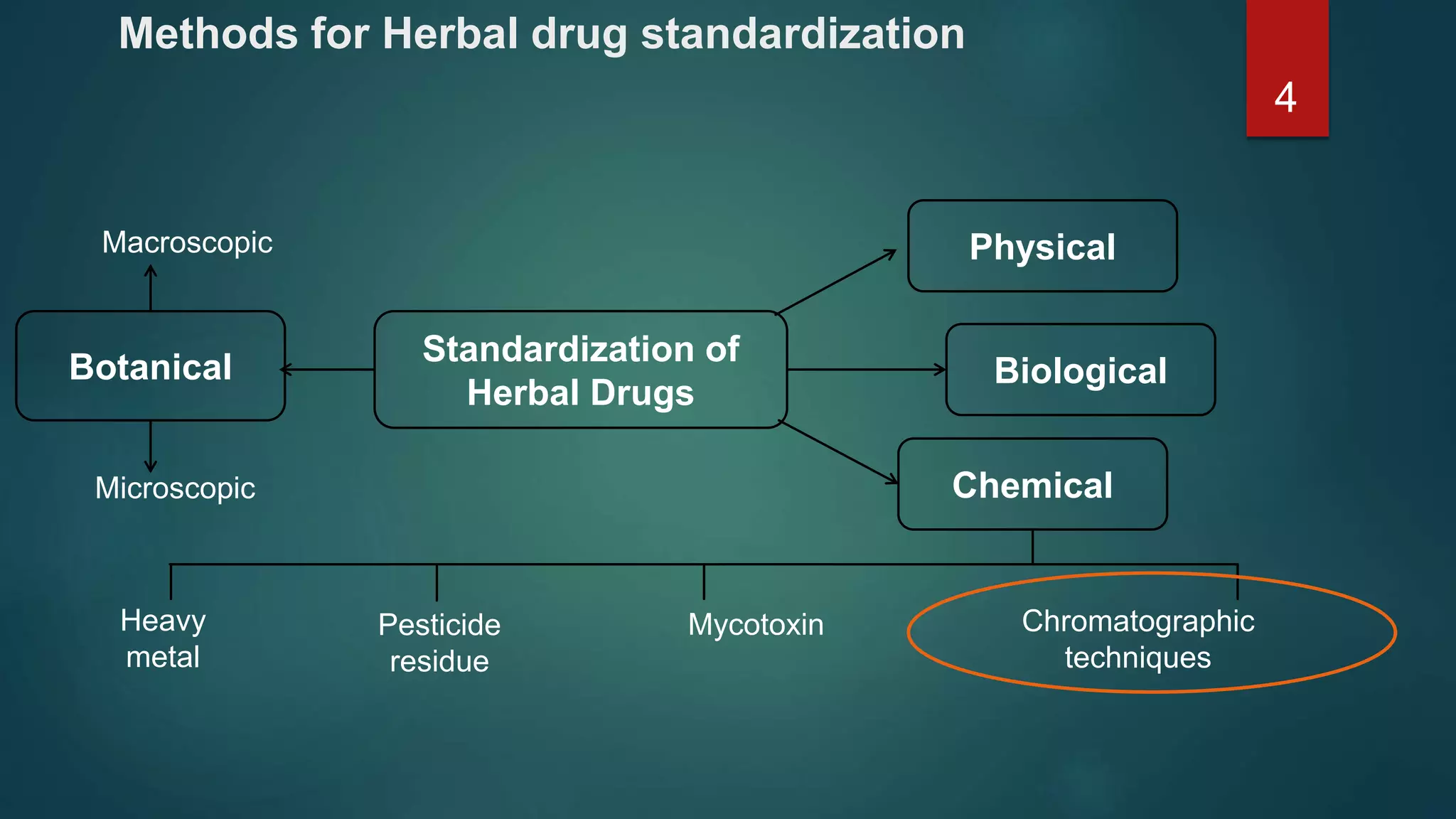
This chart shows that standardization isn't a single action but a comprehensive quality assurance system. We can organize this system into a logical, three-step framework.
To understand this framework and its importance, let's explore a foundational article on the topic.
Review on Standardization of Ayurvedic Medicine
The article 'Review on Standardization of Ayurvedic Medicine' provides an excellent structure for understanding this process. It lays out the challenges and the main approaches used to ensure quality and consistency.
Please read the 'BACKGROUND' section and the section titled '4. APPROACHES TO STANDARDIZATION'. Focus on: The reasons why standardization has become a major challenge for Ayurvedic medicine. The three broad categories of quality control approaches.
As the article highlights, we can break down the process into three critical stages:
- Standardization of Raw Materials
- Standardization of the Manufacturing Process
- Standardization of the Finished Product
Let's examine each of these in detail.
2. Stage 1: Standardization of Raw Materials
Everything starts with the quality of your initial ingredients (dravyas). If you start with the wrong plant or a poor-quality one, no amount of processing can fix it. This stage involves two key activities: Authentication and Quality/Purity Assessment.
Authentication: Is it the right plant?
- Macroscopic and Organoleptic Analysis: This is the classical Dravyaguna approach—using your senses to identify the plant part based on its shape, size, color, texture, odor, and taste (Rasa).
- Microscopic Analysis: This involves examining the powdered drug under a microscope to identify characteristic cellular structures, such as trichomes, stomata, starch grains, or calcium oxalate crystals. This provides a scientific confirmation of the plant's identity.
Quality and Purity Assessment: Is it a good and safe plant?
- Foreign Matter: Checking for and quantifying any contaminants like sand, soil, stones, or parts of other plants.
- Ash Values: Measuring total ash gives an idea of the total inorganic material. Acid-insoluble ash is more specific for silica (sand and soil). High values suggest contamination.
- Contaminant Testing: This is a critical safety step for any drug used in a human trial. This includes:
- Heavy Metals: Testing for arsenic, lead, mercury, and cadmium.
- Pesticide Residues: Ensuring levels are below permissible limits.
- Microbial Load & Mycotoxins: Testing for the presence of harmful bacteria, fungi, and their toxic byproducts (e.g., aflatoxins).
To ensure this initial quality, modern herbal industries are increasingly adopting Good Agricultural and Collection Practices (GACP). This framework, promoted by the WHO, provides guidelines on everything from selecting seeds and cultivation sites to proper harvesting and drying, minimizing variability and contamination from the very beginning.
3. Stage 2: Standardization of the Manufacturing Process
Once you have authenticated, high-quality raw materials, you must ensure the process of turning them into the final formulation is consistent. This is governed by Good Manufacturing Practices (GMP), a set of regulations that ensures products are consistently produced and controlled according to quality standards.
For our hypothetical Nishamalaki Churna, process standardization would involve controlling variables like:
- The precise ratio of Haridra and Amalaki.
- The fineness of the powder (particle size), which affects absorption.
- The equipment and duration used for mixing to ensure homogeneity.
If we were making a more complex formulation like an Asava, the parameters to control would be even more extensive, including fermentation time, temperature, and the type of vessel used, as these all impact the final chemical profile of the product.
4. Stage 3: Standardization of the Finished Product
This is the final checkpoint. Here, we test the finished drug to confirm it meets all specifications before it is packaged and sent to the clinical trial sites. This involves physicochemical tests and, most importantly, phytochemical profiling.
Physicochemical Parameters
These are general quality metrics, many of which you saw in the table from the "Review on Standardization" article. They include:
- pH
- Loss on drying (moisture content)
- Specific gravity (for liquids)
- Disintegration time (for tablets/capsules)
Phytochemical Profiling: The Chemical "Fingerprint"
This is the heart of modern herbal standardization. Since it's often impossible to identify a single "active ingredient," the goal is to create a characteristic chemical fingerprint of the formulation. This fingerprint confirms the identity of the herbs and ensures the relative concentrations of key compounds are consistent from batch to batch.
Challenges and guidelines for clinical trial of herbal drugs
The article 'Challenges and guidelines for clinical trial of herbal drugs' briefly touches upon the modern analytical techniques used for this purpose. It reinforces why these methods are essential for registration and quality control.
Please read the section titled 'QUALITY CONTROL OF HERBAL PRODUCTS'. Focus on the mention of sophisticated techniques like HPLC and GC-MS and their role in identifying and quantifying constituents.
The primary tools for this are chromatographic techniques:
- High-Performance Thin-Layer Chromatography (HPTLC): A relatively quick and visually intuitive method that separates the compounds on a plate, creating a distinct banding pattern. This serves as a qualitative fingerprint for identity.
- High-Performance Liquid Chromatography (HPLC): This is the gold standard for both qualitative and quantitative analysis. An HPLC chromatogram is a graph showing a series of peaks, where each peak corresponds to a different chemical compound. The overall pattern is the fingerprint.
Crucially, HPLC allows us to quantify marker compounds. A marker compound is a specific chemical in the plant that is chosen as a proxy for quality. It could be:
- A known active constituent (e.g., curcuminoids in Haridra).
- A known characteristic constituent of the plant, even if its activity isn't fully known (e.g., gallic acid in Amalaki).
For our Nishamalaki Churna, the manufacturer would use HPLC to ensure that every batch contains, for example, not less than 4% total curcuminoids and not less than 5% tannins. This quantitative value is what truly guarantees potency and consistency.
All of this information is compiled into a Certificate of Analysis (CoA), a document that accompanies each batch of the investigational drug, certifying that it has passed all standardization tests.
Test your understanding!
Imagine you are the lead investigator for the hypothetical RCT on Nishamalaki Churna from our last lesson. The drug manufacturer sends you the Certificate of Analysis (CoA) for the first batch.
Based on what you've learned today, list four critical parameters you would look for on that CoA to ensure the drug is suitable for your clinical trial.
Show answer
An ideal answer would include checks from each stage of standardization:
- Identity/Authentication: A statement confirming the identity of Curcuma longa and Phyllanthus emblica via macroscopic/microscopic analysis and/or HPTLC fingerprint.
- Purity (Safety): Test results showing that heavy metals (Lead, Mercury, etc.) and microbial counts are below the acceptable limits.
- Potency (Quantification): An HPLC-based assay result confirming the percentage of key marker compounds, e.g., "Total Curcuminoids: Not less than 4%" and/or "Tannins: Not less than 5%".
- Physicochemical Properties: A basic parameter like "Loss on drying" (moisture content) to ensure stability and prevent microbial growth.
Conclusion
Standardization is not about reducing a vibrant herb to a single molecule. It's about ensuring that the complex therapeutic entity described in the classical texts can be delivered to patients and research subjects in a safe, reliable, and reproducible form.
Key Takeaways:
- Standardization is a three-stage process: ensuring the quality of raw materials, consistency of the manufacturing process, and validation of the finished product.
- It combines classical pharmacognosy (macroscopic/microscopic analysis) with modern analytical chemistry.
- Safety is paramount, requiring rigorous testing for contaminants like heavy metals, pesticides, and microbes.
- Chromatographic fingerprinting (HPTLC, HPLC) and quantification of marker compounds are the cornerstones of modern herbal standardization, ensuring batch-to-batch consistency in potency.
- The Certificate of Analysis (CoA) is the official document that guarantees a drug's quality for a clinical trial.
Preview of the Next Lesson:
We've now discussed how to design a trial and how to standardize the drug used in it. But what about the patient? In Ayurveda, the state of the patient's Agni and the presence of Ama are critical to both pathogenesis and treatment response. How do we measure these concepts objectively?
In our next lesson, we will tackle this by exploring the topic: "Evaluate biomarkers for assessing Agni function and Ama in metabolic disorders." This will take us another step forward in building a robust bridge between Ayurvedic principles and modern biomedical research.