Hello! Welcome to our lesson.
In our last session, we explored how to objectify the dynamic states of imbalance, Vikriti, by evaluating biomarkers for Agni (metabolism) and Ama (metabolic toxins). We saw that lipid profiles can reflect Agnibala, while inflammatory markers like CRP can quantify the systemic effects of Ama.
Today, we shift our focus from the dynamic state of Vikriti to the static, constitutional foundation of an individual: Deha-Prakriti. While Vikriti tells us what is wrong now, Prakriti tells us what an individual's inherent tendencies and susceptibilities are. For centuries, Prakriti assessment has been phenotypic—based on observing physical, physiological, and psychological traits. But can we find its signature in our very biology?
This brings us to our learning outcome: to evaluate biomarkers used to correlate Deha-Prakriti with genomic and metabolomic profiles. We will journey to the cutting edge of research where Ayurveda's holistic classification meets modern molecular biology. This is the heart of building the evidence-based, integrative practice you aim for, moving Ayurveda into the realm of predictive and personalized medicine.
From Ancient Phenotype to Modern Genotype: The Birth of Ayurgenomics
The idea that the three Doshas—Vata, Pitta, and Kapha—which define our Prakriti might have a basis in our genetic makeup is a revolutionary one. This hypothesis has given rise to a new trans-disciplinary field: Ayurgenomics.
Ayurgenomics seeks to correlate the phenotypic classification of Prakriti with objective, measurable molecular data from genomics, transcriptomics, proteomics, and metabolomics. It doesn't try to "prove" Ayurveda, but rather to use Ayurveda's powerful system of classification to better understand human biological variation.
Let's begin with two high-level perspectives on this integration.
Evidence-Based Ayurveda: How Ancient Medicine Meets Modern Science | Prof Bhushan Patwardhan
First, let's watch a brief clip from a talk by Prof. Bhushan Patwardhan, a pioneer in this field. He directly introduces the concept of Ayurgenomics and how it emerged from scientific inquiry into Prakriti.
Please watch the following segments: 00:22 - 01:02: Introduction to Ayurgenomics as a discipline. 21:42 - 22:12: A specific example of a genome-wide study that identified a gene (PGM1) associated with Pitta Prakriti.
Evidence-Based Ayurveda: How Ancient Wisdom + Modern Biology Revolutionizes Healthcare-Prof. Shankar
Next, Prof. Shankar provides a powerful conceptual framework. He explains that Ayurveda and modern biology are like two different windows looking at the same garden—the phenomenon of biological change. Ayurgenomics is the effort to combine these views for a more complete picture.
Please watch these two clips: 02:44 - 18:18: This longer section explains the core concept: Ayurveda offers a 'whole system' view, while biology offers a 'molecular' view. Understanding this distinction is crucial. Focus on the analogy of the eastern and western windows. 19:28 - 23:11: This part directly discusses Ayurgenomics and how Prakriti provides a framework to classify populations based on their genotype, a major challenge in modern genetics.
These perspectives establish a clear rationale: Prakriti provides a sophisticated, time-tested system for phenotyping (classifying observable traits) that can bring order to the vast complexity of genomic data. The "Ayurgenomics Approach" integrates these two worlds, as shown below.

Unlocking the Code: Genomic Biomarkers of Prakriti
Research in Ayurgenomics has started to reveal specific genetic markers that correlate with the three primary Prakriti types. These findings provide the first level of objective biological evidence for the Prakriti concept.
Let's dive into a review article that synthesizes many of these findings.
REVIEW ON PRAKRITI-BASED PERSONALIZED MEDICINE
The paper 'REVIEW ON PRAKRITI-BASED PERSONALIZED MEDICINE' provides a superb overview of the genomic basis of Prakriti. It details specific genetic variations linked to each Dosha type.
Please read the sections titled 'Genetic Correlations with Prakriti' and 'Transcriptomic and Proteomic Profiles'. Pay close attention to the specific genes mentioned for each Prakriti type (e.g., HLA variations, CYP genes, FTO, LEPR, IL-6, TNF-α).
Based on this and other research, we can summarize the key genomic correlates. These often involve Single Nucleotide Polymorphisms (SNPs), which are variations at a single position in a DNA sequence among individuals.
Key Genetic Associations:
-
Vata Prakriti: Associated with movement, the nervous system, and catabolism.
- Neurological & Stress Response: Variations in genes like
DRD4(dopamine receptor) andADRB2(beta-2 adrenergic receptor) align with the heightened neurological sensitivity and reactivity seen in Vata types. - Drug Metabolism: Polymorphisms in
CYP2C19(a key liver enzyme) are observed, potentially explaining variability in drug responses. - Circadian Rhythms: Variants in the
CLOCKgene may relate to the irregular sleep and digestive patterns common in Vata.
- Neurological & Stress Response: Variations in genes like
-
Pitta Prakriti: Associated with metabolism, transformation, and inflammation.
- Inflammation: Over-expression or variants of genes for pro-inflammatory cytokines like
IL-6(Interleukin-6) andTNF-α(Tumor Necrosis Factor-alpha) correlate with the Pitta tendency towards inflammatory conditions. - Metabolism: The
PGM1gene, involved in glucose metabolism, has been strongly associated with Pitta. Variants inCYP2C19related to rapid drug metabolism are also linked to the 'Tikshna Agni' of Pitta.
- Inflammation: Over-expression or variants of genes for pro-inflammatory cytokines like
-
Kapha Prakriti: Associated with structure, stability, and anabolism.
- Metabolism and Obesity: Gene variants associated with obesity and metabolic syndrome are more common in Kapha types. These include
FTO(fat mass and obesity-associated gene),LEPR(leptin receptor),FABP2, andAPOE(involved in lipid metabolism). - Immunity: Certain
HLA(Human Leukocyte Antigen) gene profiles suggest a tendency towards increased innate immune tolerance. - Drug Metabolism: Variants in
CYP2C19associated with slow drug metabolism align with the 'Manda Agni' of Kapha.
- Metabolism and Obesity: Gene variants associated with obesity and metabolic syndrome are more common in Kapha types. These include
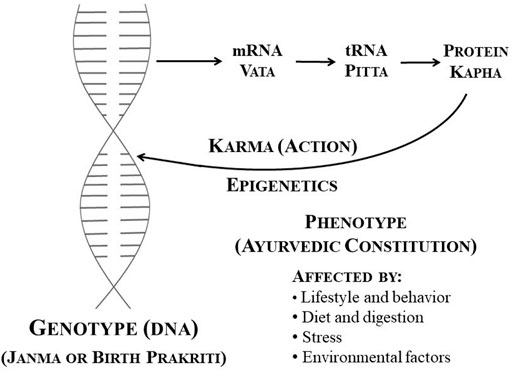
The image below conceptually links the fixed genetic blueprint (Janma Prakriti) with the expressed constitution, which is also influenced by epigenetic factors and lifestyle.
The Metabolic Signature: Metabolomic Profiles of Prakriti
While genomics reveals our constitutional blueprint, metabolomics provides a real-time snapshot of our physiological activity. It measures the levels of small-molecule metabolites (like sugars, lipids, amino acids) in our body. Studies have shown that different Prakriti types have distinct "metabolic signatures."
Prakriti: A tran-disciplinary approach to integrative medicine
The book chapter 'Prakriti: A tran-disciplinary approach to integrative medicine' clearly summarizes these findings. It lists the distinct metabolic patterns and provides a concise table of biomarkers.
Please read section '4.4 Distinct Metabolomic Patterns' and review Table 1.1 at the end of the chapter. This table is an excellent summary correlating genetic markers, metabolic profiles, and clinical implications for each Prakriti type.
Let's distill these findings into key metabolic biomarkers:
-
Vata Profile:
- Low Body Mass Index (BMI).
- Elevated cortisol levels, reflecting a tendency towards a heightened stress response.
- Overall dominance of catabolic (breakdown) metabolic activity.
-
Pitta Profile:
- High markers of oxidative stress, indicating intense metabolic activity that generates free radicals.
- Elevated Low-Density Lipoprotein (LDL) cholesterol.
- Indicators of rapid cellular energy production.
-
Kapha Profile:
- Elevated leptin (the "satiety hormone," to which Kapha types may be resistant) and triglycerides.
- Tendency towards insulin resistance.
- High Body Mass Index (BMI) and a dominance of anabolic (building up) activity.
These metabolic patterns align perfectly with the classical descriptions of the Doshas and their corresponding disease predispositions (Vyadhi Kshamatva). For instance, the insulin resistance and high triglycerides in Kapha individuals provide a direct molecular link to their described susceptibility to Prameha (diabetes) and Medoroga (obesity).
Test your understanding!
A researcher is analyzing data from a clinical trial and has lost the Prakriti assessment for three subjects. Based on their biomarker data below, can you make an educated prediction of their dominant Prakriti?
- Subject 1: Shows a variant of the
FTOgene, has elevated fasting triglycerides, and a BMI of 31. - Subject 2: Has high baseline levels of the pro-inflammatory cytokine
TNF-αand aCYP2C19genotype associated with rapid drug metabolism. - Subject 3: Has chronically elevated serum cortisol levels and a gene expression profile showing upregulation of genes involved in neuro-reactivity.
Show answer
- Subject 1: Kapha Prakriti. The combination of the
FTOgene variant (linked to obesity), high triglycerides, and high BMI are all classic genomic and metabolomic signatures of the Kapha constitution. - Subject 2: Pitta Prakriti. High
TNF-αpoints to a strong inflammatory tendency, and the rapid metabolismCYP2C19genotype aligns with the 'Tikshna' nature of Pitta. - Subject 3: Vata Prakriti. Elevated cortisol is a key metabolic marker for Vata, and the upregulation of neuro-reactivity genes corresponds to the sensitive and active nervous system characteristic of Vata.
Conclusion
Today we have seen compelling evidence that the ancient Ayurvedic concept of Prakriti has tangible, measurable correlates in our modern biological data. Far from being a mere philosophical construct, Prakriti appears to represent a complex endophenotype with distinct genomic and metabolomic signatures.
Key Takeaways:
- Ayurgenomics is the field dedicated to integrating Ayurvedic
Prakriti-based classification with modern 'omics' technologies to understand human individuality. - Genomic Biomarkers: Specific genetic variations (SNPs) and gene expression patterns are associated with each
Prakriti.- Vata: Linked to genes for neuro-reactivity (
DRD4), stress response (ADRB2), and circadian rhythm (CLOCK). - Pitta: Linked to genes for inflammation (
TNF-α,IL-6) and rapid metabolism (PGM1,CYP2C19). - Kapha: Linked to genes for obesity (
FTO), lipid metabolism (APOE), and slow metabolism.
- Vata: Linked to genes for neuro-reactivity (
- Metabolomic Biomarkers: Each
Prakritiexhibits a unique metabolic profile.- Vata: High cortisol, catabolic state.
- Pitta: High oxidative stress, high LDL.
- Kapha: High triglycerides, insulin resistance, anabolic state.
- Integrative Potential: This correlation allows
Prakritito be used as a powerful stratification tool in research and clinical practice, paving the way for truly personalized and predictive medicine.
Preview of the Next Lesson:
We have now established that objective biomarkers exist for both the dynamic state of Vikriti (Agni/Ama) and the static constitution of Prakriti. The crucial next step is to ask: How do we put this all together? In our next lesson, we will address the learning outcome: "Propose a conceptual framework for integrating Prakriti assessment into modern precision medicine." We will move from evaluating the evidence to designing a system for its practical application.