Hello! Welcome to the first lesson in our clinical focus module on metabolic disorders.
In our previous lessons, we've built a strong foundation, culminating in our exploration of how an individual's innate constitution, or Deha-Prakriti, can be correlated with objective genomic and metabolomic biomarkers. We noted, for instance, that Kapha predominant individuals often show metabolic signatures like insulin resistance and elevated triglycerides, suggesting a natural predisposition to certain metabolic diseases.
Today, we put that foundational knowledge into clinical practice. We begin our deep dive into Prameha, the classical Ayurvedic concept for a group of metabolic and urinary disorders. Our goal for this lesson is to correlate classical Prameha classifications with modern diabetes and metabolic syndrome. This is a crucial first step in developing an integrative understanding of one of the most significant health challenges today, aligning perfectly with your interest in metabolic disorders.
We will deconstruct the comprehensive framework of Prameha and build bridges to the modern entities of Type 1 and Type 2 Diabetes, as well as the broader concept of Metabolic Syndrome.
1. The Classical Landscape of Prameha
The term Prameha literally means "excessive urination" (Prakarshena Mehati), but its cardinal sign is Avila-Prabhuta-Mutrata—urine that is both excessive in quantity (Prabhuta) and abnormal in quality/turbidity (Avila). It is described as one of the eight major, difficult-to-treat diseases (Ashta Mahagada).
At its core, Prameha is a disease of vitiated Kapha Dosha interacting with key Dushyas (vulnerable tissues), primarily Meda (adipose tissue) and Kleda (the body's aqueous component). The classical texts, particularly the Charaka Samhita, provide a remarkably detailed classification of 20 distinct types of Prameha.
To understand this classical framework, let's turn to the source.
Prameha Nidana - Charak Samhita
The 'Prameha Nidana' chapter from the online Charaka Samhita is an excellent resource. It outlines the complete etiology, pathogenesis, and classification of Prameha.
Please read the introduction to Prameha and then focus on the main classification. You will find this under the heading 'Sanskrit Text, Transliteration and English Translation'. Read the initial verses that introduce the 20 types and the general pathogenesis involving Kapha, Meda, and Kleda. (Verses 3-8). Skim through the descriptions of the 10 Kaphaja, 6 Pittaja, and 4 Vataja types of Prameha (Verses 9-46). Don't worry about memorizing each one. The goal is to appreciate the system of classification based on the physical characteristics of the urine.
As you've seen, Ayurveda categorizes Prameha based on the dominant Dosha, which reflects the stage and severity of the disease:
Kaphaja Prameha(10 types): Characterized by viscous, sweet, or cold qualities. These are consideredSadhya(curable).Pittaja Prameha(6 types): Characterized by heat, sharp odors, and discoloration (yellow, red, blue). These areYapya(manageable/palliative).Vataja Prameha(4 types): Characterized by the loss of vital tissues (Dhatus) in the urine. These areAsadhya(incurable).
Now, let's translate this classical system into the language of modern medicine.
2. Building the Bridge: Foundational Correlations
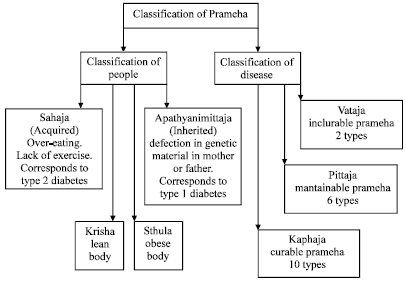
We can establish a strong correlation by looking at how Prameha is classified based on its cause and the patient's constitution.
Classification by Etiology and Constitution
Ayurvedic texts describe two primary etiologies for Prameha and two main patient types. This framework maps almost perfectly onto the modern classification of diabetes.
-
Sahaja Prameha(Hereditary/Congenital): Attributed toBeeja Dosha(defects in sperm or ovum). This directly parallels Type 1 Diabetes Mellitus (T1DM), which is an autoimmune disease with a strong genetic predisposition. -
Apathyanimittaja Prameha(Acquired): Caused by improper diet and lifestyle (Ahara-Vihara), such as excessive consumption of sweet, fatty foods and a sedentary lifestyle. This is a classic description of the risk factors for Type 2 Diabetes Mellitus (T2DM). -
Krisha Pramehi(Lean/Asthenic Patient): This constitution is associated with the hereditary (Sahaja) form, reflecting the catabolic state and weight loss often seen in T1DM. -
Sthula Pramehi(Obese Patient): This constitution is associated with the acquired (Apathyanimittaja) form, reflecting the strong link between obesity, insulin resistance, and T2DM.
The following flowchart provides a clear visual summary of these primary correlations.
3. Correlating Disease Progression: From Kapha to Vata
The 20 types of Prameha are not just distinct diseases; they represent a continuum of metabolic derangement, progressing from a curable state of dysfunction to an incurable state of degeneration.
Kaphaja Prameha: The Pre-Diabetic and Early T2DM Stage
The 10 types of Kaphaja Prameha represent the initial stage of the disease.
- Classical Picture: Dominated by increased
KaphaandMeda. It is theSadhya(curable) stage. - Modern Correlation: This stage aligns with Metabolic Syndrome, Pre-diabetes, and early Type 2 Diabetes. It's characterized by:
- Hyperinsulinemia (the body is producing excess insulin to overcome resistance).
- Dyslipidemia (
Meda Dhatu Dushti). - Central obesity (
Sthula Pramehi). - Mild hyperglycemia (e.g.,
Ikshumeha- "sugarcane juice urine").
- Broad Spectrum: Some types, like
Udakameha(profuse, clear, watery urine), show that the termPramehais broader than just diabetes, correlating here with Diabetes Insipidus, a disorder of water balance.
Pittaja Prameha: The Inflammatory and Complication Stage
The 6 types of Pittaja Prameha signify a progression where inflammation (Pitta) becomes prominent.
- Classical Picture: Urine shows signs of heat and infection (
Pittaqualities). The prognosis becomesYapya(requiring lifelong management). - Modern Correlation: This stage aligns with established T2DM where inflammatory complications begin to appear. This includes:
- Persistent hyperglycemia causing cellular damage.
- Urinary Tract Infections (UTIs).
- Early-stage diabetic nephropathy (e.g.,
Raktameha- hematuria, orHaridrameha- bilirubinuria/inflammation). - Diabetic Ketoacidosis (DKA) could be seen as an acute
Pittaaggravation.
Vataja Prameha: The Advanced, Degenerative Stage
The 4 types of Vataja Prameha represent the final, incurable (Asadhya) stage.
- Classical Picture: Dominated by
Vata, the principle of degeneration. The body begins to lose its vital essences and tissues (Ojas,Vasa,Majja,Lasika) through the urine, leading to severeDhatu Kshaya(tissue emaciation). - Modern Correlation: This stage aligns with advanced, complicated, or brittle diabetes (both T1DM and late-stage T2DM). It is characterized by:
- Hypoinsulinemia (pancreatic beta-cell exhaustion or destruction).
- Severe hyperglycemia.
- Advanced complications like end-stage renal disease (ESRD), where proteins, fats (
Vasameha- lipiduria), and other components are lost in the urine. - Severe wasting (
Krisha Pramehi).
Madhumeha("Honey Urine"): This is a subtype ofVataja Pramehaand is often used synonymously with the advanced state of diabetes. It is considered the terminal stage for all other untreatedPramehas. Here, the urine is not just sweet but also astringent (Kashaya), reflecting the tissue-wasting nature ofVata.
Let's deepen this understanding by looking at how a modern research analysis connects the core pathology of Prameha to modern concepts.
a critical analysis on the basic concept of prameha in ...
This article, 'A critical analysis on the basic concept of prameha', provides an excellent scientific bridge. It explores how the central Ayurvedic concept of Meda Dusti (deranged fat metabolism) can be understood through the modern lens of lipotoxicity.
Please read the 'Discussion' and 'Conclusion' sections. Focus on how the authors connect: Avila-Prabhuta-Mutra to osmotic diuresis (seen in diabetes) and failure of urine concentration (seen in kidney disease). Meda Dusti to the modern concept of 'lipotoxicity'—where excess fats cause cellular damage, insulin resistance, and kidney injury. This is the key mechanism linking obesity to diabetes and its complications.
This paper reinforces the idea that Prameha is not just about sugar. It's a disease of Meda Dusti or dysfunctional lipid metabolism. This dysfunction (lipotoxicity) is now understood to be a primary driver of insulin resistance, making Prameha a perfect classical analogue for Metabolic Syndrome. The Purvarupas (prodromal symptoms) of Prameha—such as lethargy, excessive sleep, and a tendency towards central obesity—are essentially a clinical description of Metabolic Syndrome.
Test your understanding!
A 45-year-old male presents with a BMI of 32, a sedentary desk job, and complains of lethargy and excessive thirst. He mentions that his urine, if left in the toilet, seems to attract ants. On examination, you classify him as a Sthula Pramehi.
Based on this information, how would you correlate his condition with both classical and modern classifications?
- What is his likely
Pramehaclassification by cause? - What is the likely
Doshicstage of hisPrameha? - What is his corresponding modern diagnosis?
Show answer
- Classical Cause: This is a clear case of
Apathyanimittaja Prameha(acquired), given his age, sedentary lifestyle, and obese constitution (Sthula Pramehi). - Doshic Stage: The symptoms point towards the
Kaphajastage. The obesity, lethargy, and sweetness in the urine (attracting ants, a classic sign forMadhurya) without signs of severe wasting or inflammation indicate an early,Kapha-dominant pathology. It is still in theSadhya(curable/reversible) phase. - Modern Diagnosis: The corresponding modern diagnosis would be Type 2 Diabetes Mellitus (T2DM), likely in its early stages, or Metabolic Syndrome with hyperglycemia.
Conclusion
Today, we have mapped the rich, nuanced classifications of Prameha onto the modern understanding of diabetes and metabolic syndrome. This integrative view is essential for a holistic clinical approach.
Key Takeaways:
Pramehaas a Spectrum:Pramehais a broad term for metabolic disorders, with Diabetes Mellitus being its most prominent manifestation,Madhumeha. It also encompasses conditions like Metabolic Syndrome and Diabetes Insipidus.- Etiological Correlation:
Sahaja(hereditary) andApathyanimittaja(acquired)Pramehastrongly correlate with T1DM and T2DM, respectively. - Constitutional Correlation:
Sthula(obese) andKrisha(lean) patient types align with the typical presentations of T2DM and T1DM. - Doshic Staging of Disease: The progression from
KaphajatoPittajatoVataja Pramehamirrors the progression of modern diabetes from an early stage of metabolic dysfunction (Pre-diabetes/Metabolic Syndrome) to an intermediate inflammatory stage, and finally to an advanced degenerative stage with severe complications. - The Central Role of
Meda Dusti: The core pathology ofPramehais deranged fat metabolism, which is understood today as lipotoxicity—the primary driver of insulin resistance and Metabolic Syndrome.
Preview of the Next Lesson:
Having established the broad correlations, our next lesson will zoom in on the most critical form of Prameha. We will analyze the Samprapti (pathogenesis) of Madhumeha using the Dosha-Dushya-Agni framework. This will allow us to understand the precise mechanisms of the disease from an Ayurvedic perspective, setting the stage for targeted therapeutic interventions.