Hello! Welcome to the first lesson in our new module, "Designing Ayurvedic Research Studies."
In the previous module, we honed our skills in critically appraising existing research, learning to evaluate study designs and interpret statistical results. We have been consumers of science. Now, we transition to becoming creators. This module is about learning to ask the right questions and designing the studies to answer them.
Today's learning outcome is to identify gaps in classical literature to formulate novel research questions. Your BAMS education has given you a deep familiarity with the Samhitas. This lesson will teach you how to read these foundational texts with a researcher's eye, uncovering areas of ambiguity, contradiction, or unexplored potential that can blossom into meaningful research. This is the essential first step in conducting research that is both authentic to Ayurvedic principles and relevant to modern healthcare.
1. Adopting a Researcher's Perspective: Two Worldviews
Before we dive into the texts, it's crucial to set the right mindset. Ayurvedic research often involves bridging two different, yet powerful, ways of understanding the world. Modern medicine is primarily built on a reductionist framework, seeking to understand the whole by studying its smallest parts. Ayurveda, rooted in Darshana philosophy, is built on a holistic framework of interconnectedness.
To explore this foundational difference, let's watch a presentation by Prof. Rama Jayasundar from AIIMS, New Delhi. She brings a unique perspective as a physicist researching Ayurveda.
Ayurveda: Antiquated or State-of-the-Art? | Prof. Rama Jayasundar | AIIMS | Physics Meets Medicine
In this video, "Ayurveda: Antiquated or State-of-the-Art?", Prof. Jayasundar explains the philosophical underpinnings of Ayurveda and contrasts its holistic, functional model with the structural model of modern medicine.
Please watch the segment from 14:17 to 23:59. As you watch, focus on understanding: The role of Darshanas as the 'basic sciences' for Ayurveda. The fundamental difference between the 'interconnectedness' worldview of Ayurveda and the 'separate building blocks' worldview of classical physics that influenced modern medicine. How this difference in foundational philosophy naturally leads to different approaches in diagnosis and treatment.
Understanding this distinction is not about judging one system as superior to the other. It's about recognizing that they ask different kinds of questions. A purely reductionist approach might ask, "Which molecule in Guduchi lowers blood sugar?" An integrated Ayurvedic approach might ask, "How does the Tikta (bitter) and Ushna (hot) properties of Guduchi modulate the Dosha-Dushya interaction in Madhumeha, and what are the measurable systemic effects of this modulation?" Today, we learn how to formulate the second type of question.
2. Identifying the "Gap": Where Research Begins
A research question begins with a research gap—a missing piece in our collective knowledge. The entire research process can be visualized as a funnel, starting from a broad area of interest and systematically narrowing down to a specific, answerable question.
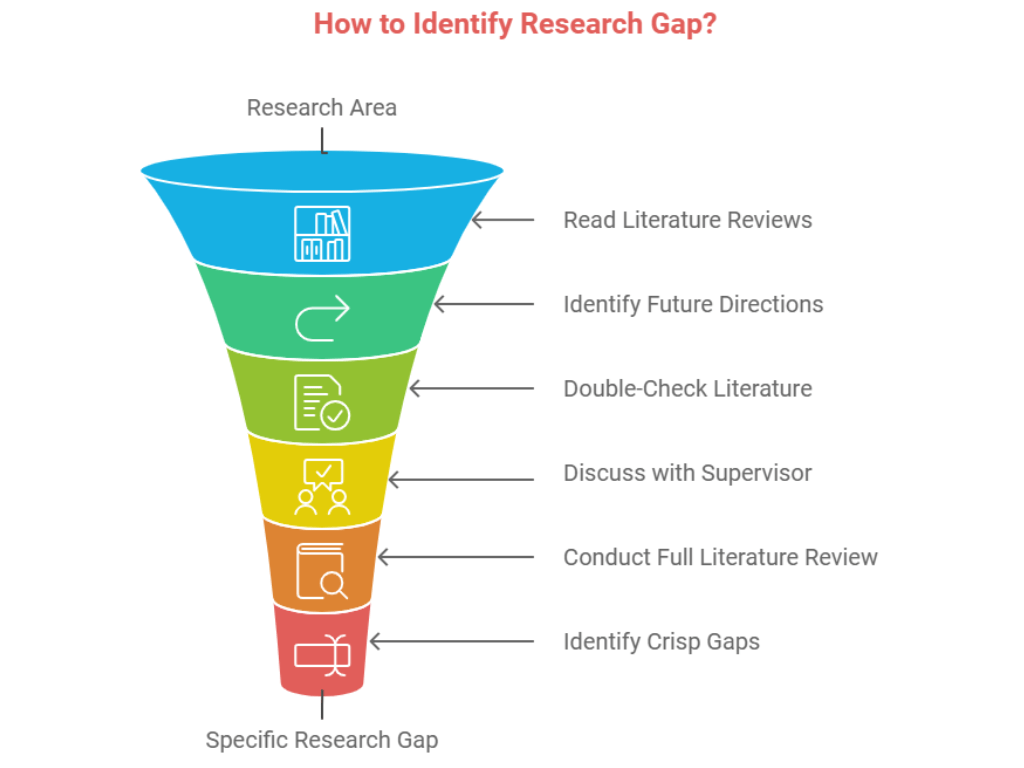
In the context of Ayurvedic classical literature, research gaps often fall into one of these categories:
- Ambiguity Gaps: A concept is mentioned but not fully defined, or it is used inconsistently across different chapters or texts.
- Example: The precise clinical differentiation between the five subtypes of Prana Vayu is often a subject of commentary rather than explicit textual definition. A research question could aim to identify distinct physiological correlates for each subtype.
- Contradiction Gaps: Different Samhitas or respected commentators offer conflicting information.
- Example: Classical texts have varying opinions on the Vipaka (post-digestive effect) of Pippali (Piper longum). This contradiction invites a study to evaluate its metabolic effects systematically.
- Application Gaps: A classical principle is well-described, but its application to a new or modern condition is not explicit.
- Example: The concept of Ama is central to many diseases. How does this concept correlate with modern markers of metabolic endotoxemia or gut dysbiosis in conditions like metabolic syndrome? This is a key area for your interest in metabolic disorders.
- Mechanism Gaps: A text describes a Karma (action) but doesn't explain how it works from a functional perspective.
- Example: Lekhana Dravyas are said to "scrape" excess Meda Dhatu. What is the cellular and metabolic mechanism behind this "scraping" action? Does it involve promoting lipolysis, enhancing fat oxidation, or some other process?
3. The Classical Toolkit for Finding Gaps
Interestingly, Ayurveda has its own intellectual tools for inquiry and deep reading that are perfectly suited for identifying these gaps. We can think of them as our "classical research methodology."
A valuable paper, "Role Of Samhita Siddhant In Developing Research Methodology In Ayurveda," explains how these principles can be mapped to modern research concepts.
“Role Of Samhita Siddhant In Developing Research ...
This paper provides a framework for using classical Ayurvedic principles as a guide for modern research. It shows that the process of scientific inquiry is deeply embedded within Ayurveda's own traditions.
Please read the section titled 'ROLE OF SAMHITA SIDDHANT IN DEVELOPING RESEARCH METHODOLOGY' and review the bulleted summary table in the middle of page 524. Then read the 'DISCUSSION' section. Focus on how the following concepts can be used as tools for inquiry: Pramana (especially Pratyaksha, Anumana, Aaptopadesha) Trisutra Siddhant (Hetu, Linga, Aushadha)
As the paper outlines, these classical concepts are powerful analytical tools:
| Classical Tool | Modern Research Equivalent | How to Use It to Find Gaps |
|---|---|---|
| Aaptopadesha | Literature Review | Compare descriptions of a disease or herb across Charaka, Sushruta, and Vagbhata. Where are the differences? This is a contradiction gap. |
| Pratyaksha | Observation / Data Collection | The texts describe observable clinical signs (Linga). Are these signs objectively measurable with modern tools? This leads to research on biomarker discovery. |
| Anumana | Inference / Hypothesis | The texts infer relationships (e.g., "This Nidana leads to this Samprapti"). Can this inferred causal chain be tested? This is a mechanism gap. |
| Yukti | Rational Application / Experimental Design | A text recommends a multi-component treatment (Ahar, Vihar, Aushadh). What is the relative contribution of each component? This is an application gap. |
Going Deeper with Tantrayukti
For even more granular analysis, we can use Tantrayukti—the 36 logical tools or canons of textual interpretation described in the Samhitas. They are designed to clarify, elaborate, and uncover hidden meanings.
The paper "Tantrayukti-Significance of Tantrayukti in Literary Research" provides excellent correlations. While all are useful, here are a few that are particularly powerful for generating research questions:
- Purvapaksha (Raising a question or objection): The Samhitas are often written in a dialectical format. Identify these ancient debates. If a question was raised but not definitively answered, it remains a research gap today.
- Uddhara (Establishing one's own thesis after refuting another): Look for places where a commentator or a later text refutes an earlier view. The point of disagreement is a natural starting point for a research question designed to resolve the conflict.
- Atidesha (Application by analogy or extrapolation): This is when a principle established in one context is applied to another. For example, if a treatment principle is described for Jwara (fever), a text might suggest it also applies to the daha (burning sensation) in Amlapitta. This extrapolation is a testable hypothesis.
By actively reading the Samhitas through the lens of Pramana and Tantrayukti, you move from passive reading to active, critical inquiry.
4. From "Gap" to a Well-Formed Research Question
Once you've identified a gap, the next step is to translate it into a formal, answerable research question. A generic video from NPTEL provides the universal structure for this process.
02 Formulating research question
This video, "Formulating research question," outlines the standard steps for creating a clear, focused, and effective research question.
Please watch the segment from 06:16 to 12:06. Pay close attention to: The six-step process for sharpening a general idea into a specific question. The FINER criteria for evaluating your final question.
Let's walk through the six-step process with an example relevant to your interest in digestive disorders:
-
General Uncertainty (The Gap): Classical texts describe Grahani Roga with different Dosha dominance (Vataja, Pittaja, Kaphaja) having different clinical features. Modern medicine identifies Irritable Bowel Syndrome (IBS) with subtypes (IBS-D, IBS-C, IBS-M). The correlation between these two classification systems is an application gap.
-
Raise the Question: Can Ayurvedic Grahani sub-types map onto modern IBS sub-types? (This is still vague).
-
Investigate & Refine:
- What are the specific Linga (symptoms) of Vataja Grahani? (e.g., variable stool consistency, bloating, abdominal pain).
- What are the specific criteria for IBS-D (diarrhea-predominant)? (e.g., Rome IV criteria).
- Is there a potential overlap? It seems Vataja Grahani might align with IBS-D or IBS-M (mixed).
-
Define Measurable Exposures & Outcomes:
- Population: Patients diagnosed with IBS according to Rome IV criteria.
- Exposure/Grouping: Classify these patients based on Ayurvedic principles into Vataja, Pittaja, Kaphaja Grahani using a validated questionnaire.
- Outcome: Compare the clinical profiles, and perhaps even objective markers like gut microbiota profiles or inflammatory markers, across these Ayurvedic sub-groups.
-
Sharpen the Question: "Among patients diagnosed with IBS, do those classified with Vataja Grahani exhibit different gut microbiota diversity and composition compared to those classified with Kaphaja Grahani?"
-
Apply the FINER Test:
- Feasible: Yes, with access to patients, an Ayurvedic expert for classification, and a lab for microbiota analysis.
- Interesting: Yes, it bridges two knowledge systems and could lead to more personalized treatments for IBS.
- Novel: Yes, this moves beyond simple symptom correlation to explore underlying pathophysiology.
- Ethical: Yes, it's an observational study and poses minimal risk.
- Relevant: Highly relevant for both Ayurvedic and gastroenterology practice, potentially validating Ayurvedic sub-typing.
Test your understanding!
Consider your interest in metabolic disorders. Medoroga (obesity) is described as an excess and vitiation of Meda Dhatu. Many herbs are classified as Medohara (fat-reducing). This presents a mechanism gap: how do they work? Using the process above, formulate a potential research question for a specific Medohara drug like Guggulu (Commiphora wightii).
Show answer
Here's one possible path:
- Gap: The mechanism of Medohara Karma is unclear.
- Initial Question: How does Guggulu reduce fat?
- Refine: Guggulu is known in modern research to affect thyroid function and lipid metabolism. In Ayurveda, it has Ushna Veerya and Katu Rasa, suggesting an effect on Agni and metabolism.
- Define: We could study this in an animal model of obesity (in-vivo) or in fat cells (in-vitro). Let's choose in-vitro. The outcome could be measuring lipolysis (the breakdown of fat) in adipocytes (fat cells).
- Sharpened Question: "Does an extract of Commiphora wightii increase the rate of lipolysis in cultured 3T3-L1 adipocytes, and if so, is this effect correlated with the upregulation of genes involved in beta-oxidation?"
- FINER Check: This question is feasible for a cell biology lab, interesting, novel, ethical, and highly relevant to understanding Medohara action.
5. Conclusion
Today we have built a bridge from being a critical reader of research to being a thoughtful generator of research ideas. You have learned that the classical Ayurvedic texts are not just repositories of ancient wisdom, but also fertile grounds for future inquiry.
Key Takeaways:
- Formulating authentic Ayurvedic research questions requires a dual perspective, appreciating both the holistic framework of Ayurveda and the structured methodology of modern science.
- Research ideas spring from "gaps" in knowledge, which can be identified in classical texts as ambiguities, contradictions, or areas needing new application or mechanistic explanation.
- Ayurveda provides its own intellectual toolkit for this discovery process, including the analytical frameworks of Pramana and the deep-reading techniques of Tantrayukti.
- A "gap" must be refined into a precise, answerable question using a systematic process and evaluated against the FINER criteria to ensure it is a worthwhile pursuit.
Preview of the Next Lesson:
Now that you know how to spot individual gaps, how do you systematically survey the literature to find all the gaps related to a specific topic? Our next lesson will address this directly. We will learn to "Define the principles and steps of a systematic review as applied to classical Ayurvedic texts," a powerful method for comprehensively mapping what is known and, more importantly, what is not.