Hello! Welcome to your next lesson in the "Foundations of Ayurvedic Research and Evidence Appraisal" module.
In our last session, we equipped ourselves to interpret the results of a study—understanding the meaning behind p-values, confidence intervals, and effect sizes. You now know that a "statistically significant" result isn't the whole story. But there's a crucial preceding question: can we even trust those results in the first place? A study with flawed methods can produce misleading statistics, no matter how impressive they seem.
Today, we will tackle this challenge directly by addressing the learning outcome: Critically appraise published Ayurvedic clinical trials for methodological quality using the CONSORT statement. Critical appraisal is the process of systematically examining research to judge its trustworthiness, value, and relevance. The CONSORT statement will be our guide—a checklist that helps us assess how transparently and completely a trial has been reported, allowing us to spot potential biases and weaknesses.
This lesson will bridge your knowledge of Dravyaguna and clinical practice with the skills needed to become a discerning consumer of modern research, a cornerstone of building an evidence-based, integrative practice.
1. What is Critical Appraisal and Why is it Essential in Ayurveda?
Before you apply the findings of any study to your clinical practice, you must first assess its quality. Not all published research is created equal. Critical appraisal helps you separate methodologically sound studies from those that might be biased or unreliable.
How to write critical appraisal of a Randomized Control Trial or RCT | 2022
To begin, let's watch a segment from the video "How to write critical appraisal of a Randomized Control Trial or RCT" by Dr. Barai. This will provide a clear definition of critical appraisal and its importance in evidence-based practice.
Please watch from 02:26 to 09:53. Focus on understanding what critical appraisal aims to judge: a study's trustworthiness, value, and relevance. Note the key questions it asks about validity, reliability, and applicability.
This process is especially vital in Ayurveda. While the volume of research is growing, many studies unfortunately suffer from methodological flaws.
Elevating Research Transparency in Ayurveda
The editorial "Elevating Research Transparency in Ayurveda" highlights some of these common issues. Reading a brief excerpt will set the context for why mastering critical appraisal is so important for an Ayurvedic scholar.
Please read the two paragraphs starting with "Empirical observations indicate that many Ayurvedic clinical trials..." and ending with "...foster continuous quality improvement." This section directly lists common shortcomings found in Ayurvedic research.
As you can see, issues like small sample sizes, poor reporting, and lack of trial registration are common. The CONSORT statement provides a framework to systematically check for these and other, more subtle, signs of a low-quality study.
2. The CONSORT Statement: Your Appraisal Toolkit
The CONsolidated Standards of Reporting Trials (CONSORT) statement is an evidence-based set of recommendations for reporting randomized controlled trials (RCTs). It consists of a checklist and a flow diagram. While it's a reporting tool for authors, we can use it as an appraisal tool to see if the authors have provided the information necessary to judge the study's quality.
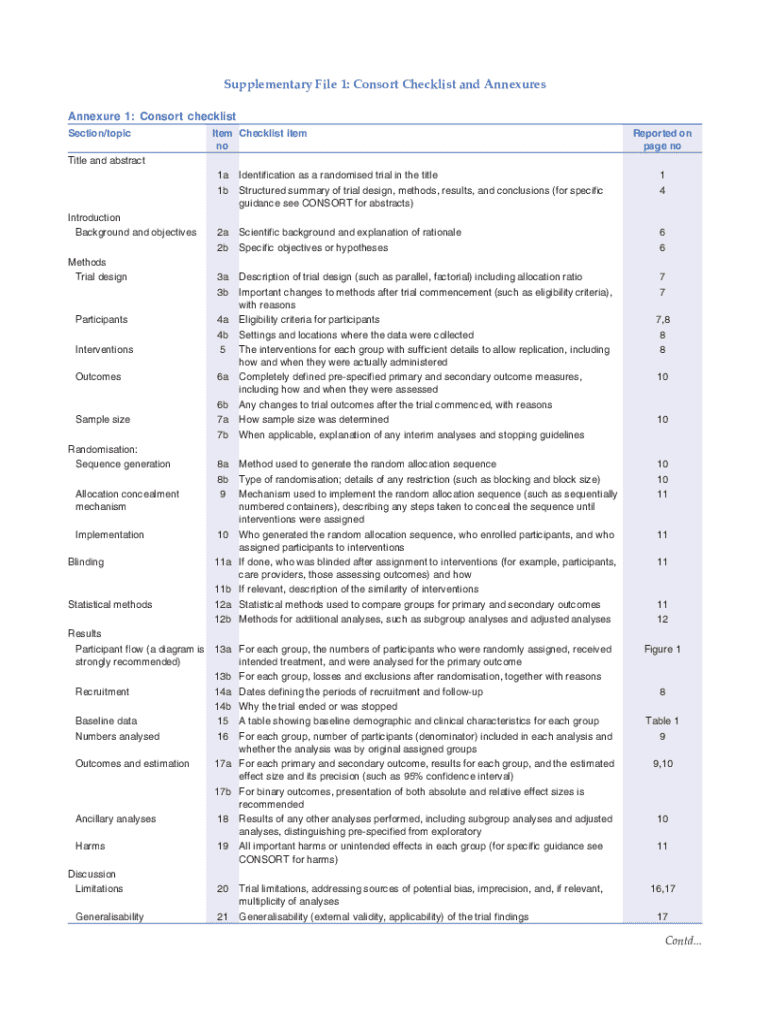
The core purpose of an RCT's methodology is to minimize bias, which are systematic errors that can lead to incorrect conclusions. Two of the most powerful techniques for this are randomization and blinding.
3. Randomised controlled trials
The video "Randomised controlled trials" from Cochrane Mental Health provides an excellent explanation of why randomization and blinding are so critical for producing reliable evidence.
Please watch from 01:19 to 05:08. Pay close attention to how: Randomization minimizes selection bias and confounding. Blinding (single and double) protects against performance bias and detection bias.
3. A Step-by-Step Guide to Appraising an RCT using CONSORT
We will now walk through the main sections of an RCT paper, using the CONSORT checklist as our guide to identify key quality indicators.
3.1 Title, Abstract, and Introduction
A well-reported trial starts with clarity.
- Title/Abstract (Item 1): Does the title identify the study as a randomized trial? Is the abstract structured and does it summarize key aspects of the trial?
- Introduction (Item 2): Is there a clear scientific background and rationale? Is the research question framed with specific objectives or a testable hypothesis?
How to write critical appraisal of a Randomized Control Trial or RCT | 2022
Let's return to Dr. Barai's video, which explains what to look for in these initial sections.
Watch from 27:54 to 30:21. This segment covers the appraisal of the title, abstract, and introduction according to CONSORT.
3.2 The Methods Section: The Heart of the Trial
This is the most important section for appraisal. Flaws here undermine the entire study.
- Trial Design & Participants (Items 3a, 4a): Is the trial design (e.g., parallel, crossover) described? Are the eligibility criteria (inclusion/exclusion) for participants clearly defined? This relates back to the 'P' (Population) in our PICO framework.
- Outcomes (Item 6): Are the primary and secondary outcomes clearly defined? This is the 'O' in PICO.
- Intervention (Item 4): Is the intervention for each group described with enough detail to be replicable? This is the 'I' and 'C' in PICO.
How to write critical appraisal of a Randomized Control Trial or RCT | 2022
This next segment covers the appraisal of the trial design, participants, intervention, and outcomes.
Watch from 30:06 to 33:28. Notice the level of detail required for describing the intervention and defining the outcomes.
Special Focus: Appraising the Ayurvedic Intervention
For Ayurvedic and herbal medicine trials, Item 4 (Interventions) is notoriously difficult and often poorly reported. As a practitioner with a background in Dravyaguna, this is where your expertise is critical. Simply stating "the patient received Ashwagandha powder" is insufficient. An extension to CONSORT was created specifically for herbal medicine trials to address this.
reporting random controlled trials of herbal medicines
To understand the level of detail required, we will look at the paper "reporting random controlled trials of herbal medicines." This paper explains why detailed reporting is crucial and what information should be included.
First, read the section that explains the variability in herbal products (search for "Crude herbal drugs are natural products..."). Then, review the detailed recommendations for describing the intervention (search for the paragraph starting with "The description of the intervention (item 4;)Table 2..."). Pay attention to details like Latin binomial, plant part, preparation, and quality control. This is the standard you should look for when appraising a study.
When you appraise an Ayurvedic trial, ask yourself:
- Is the full botanical name (Withania somnifera vs. Ashwagandha) and plant part (root, leaf) specified?
- What is the form (Churna, Kwatha, standardized extract)?
- What is the dose and frequency?
- How was the drug authenticated and its quality assured?
- If a complex formula was used, are all ingredients and their ratios listed?
- Was the control/placebo appropriate and well-described?
Now let's continue with other key aspects of the methods.
- Sample Size, Randomization, Blinding (Items 7, 8-10, 11): Was the sample size justified? How was the random sequence generated? Crucially, was allocation concealed (preventing researchers from knowing the next patient's assignment)? Were participants, clinicians, and assessors blinded?
- Statistical Methods (Item 12): Were the statistical methods appropriate for the outcomes?
How to write critical appraisal of a Randomized Control Trial or RCT | 2022
The next part of Dr. Barai's video details the appraisal of these crucial methodological steps.
Watch from 33:15 to 39:39. Focus on the distinction between generating a random sequence and concealing the allocation. Also, note the discussion on blinding and the importance of describing the statistical methods used.
3.3 The Results Section: Following the Evidence
Here, we check if the results are presented transparently. The CONSORT Flow Diagram is the first stop.

- Participant Flow (Item 13): Does the flow diagram show how many patients were assessed, randomized, received treatment, and were analyzed? How many were lost to follow-up? High or unequal dropout rates can seriously bias the results.
- Baseline Data (Item 15): Were the groups comparable at the start of the study in terms of age, gender, disease severity, etc.?
- Outcomes and Harms (Items 17, 19): Are results presented for all primary and secondary outcomes? Are effect sizes and confidence intervals reported (as we learned in the last lesson)? Were harms or adverse events systematically recorded and reported?
How to write critical appraisal of a Randomized Control Trial or RCT | 2022
This segment explains how to appraise the results section, starting with the all-important participant flow diagram.
Watch from 39:23 to 45:02. Pay attention to how the flow diagram helps you understand who was lost and why, and what information should be present in the baseline data table and results presentation.
3.4 Discussion and Other Information
Finally, we assess the authors' interpretation and other contextual information.
- Limitations (Item 20): Do the authors honestly discuss the study's limitations and potential sources of bias?
- Generalizability (Item 21): How applicable are the results to a broader patient population?
- Registration & Funding (Items 23, 24): Was the trial registered before it started (e.g., in CTRI)? This prevents selective reporting of positive results. Who funded the study, and are any conflicts of interest declared?
How to write critical appraisal of a Randomized Control Trial or RCT | 2022
This final clip covers the appraisal of the discussion section and other important administrative details.
Watch from 44:49 to 46:34. Note the importance of trial registration and disclosure of funding.
Test your understanding!
You are reading the abstract of an RCT on a new herbal compound for Sandhigata Vata (Osteoarthritis). It states:
"100 patients with knee osteoarthritis were recruited from our hospital and assigned to receive either the herbal compound or a placebo for 12 weeks. The primary outcome was a change in pain score. Patients receiving the herbal compound had a statistically significant reduction in pain compared to placebo (p=0.04). We conclude that this compound is an effective treatment for osteoarthritis."
Based on what you've learned about CONSORT, what are three critical pieces of missing information that would make you question the trustworthiness of this conclusion?
Show answer
Here are several potential answers. You only needed to identify three:
- Randomization Method: It says patients were "assigned," but not how. Was it a truly random process (e.g., computer-generated)? Was allocation concealed? Without this, there is a high risk of selection bias.
- Blinding: The abstract doesn't mention if patients, clinicians, or outcome assessors were blinded. If they knew who got the active compound, their expectations could have biased the pain reports (performance and detection bias).
- Intervention Details: The description "herbal compound" is completely inadequate. What is the plant? What part was used? What was the dose? How was it prepared and standardized? Without this, the study is not replicable and the findings are not generalizable to any specific product.
- Participant Flow / Dropouts: We don't know how many patients completed the study. If many more patients dropped out from the placebo group, for example, it could skew the results. An intention-to-treat analysis is not mentioned.
- Effect Size & Confidence Interval: The abstract only gives a p-value. A "statistically significant" result could be a tiny, clinically meaningless pain reduction. We need the actual effect size (e.g., mean difference in pain score) and the 95% CI to judge the precision and clinical relevance of the finding.
7. Conclusion
You are now equipped with a powerful, structured method for evaluating the quality of Ayurvedic clinical trials. By using the CONSORT statement as your guide, you can move beyond accepting a study's conclusions at face value and instead critically assess the foundation upon which those conclusions are built.
Key Takeaways:
- Critical appraisal is the systematic evaluation of a study's trustworthiness, relevance, and value.
- The CONSORT statement provides a checklist for transparent reporting, which we can use as a tool to spot methodological flaws and potential biases.
- Key areas to scrutinize are randomization, allocation concealment, blinding, and management of dropouts (via the flow diagram).
- For Ayurvedic trials, pay special attention to the detailed reporting of the intervention, including the plant, part, dose, preparation (Samskara), and quality control measures.
- Always check for trial registration and potential conflicts of interest from funding sources.
Preview of the Next Lesson:
In this lesson and the last, we've focused on how to evaluate a study's overall design and interpret its main findings. The next lesson, "Interpret results from comparative (t-test, ANOVA) and correlational (regression) statistical tests in sample Ayurvedic studies," will take a slightly deeper dive into the specific statistical tools researchers use. You'll learn to recognize which test is used for which type of data, adding another layer to your understanding of research methodology.