Welcome back to our course on advanced Ayurveda. In our previous lesson, we established the Samanya-Vishesha Siddhanta as the foundational logic for pathogenesis and treatment. We saw why we select substances to either aggravate or pacify Doshas based on their qualities.
Today, we move from the "why" to the "how" by focusing on one of the most critical aspects of a drug's power: Veerya (potency). This lesson will address the learning outcome: Differentiate between Veerya interpretations across classical texts (Charaka, Sushruta, and Vagbhata). You will learn that while all Acharyas agree on its importance, their classifications differ, revealing distinct philosophical and clinical perspectives. This exploration is key to mastering Dravyaguna and making nuanced therapeutic choices.
1. Understanding the Multifaceted Nature of Veerya
Before diving into the specific differences, it's helpful to appreciate that Veerya is a complex concept. Its etymology from the root "Viravikrantau" implies power, strength, and the energy to perform an action. It is the active potency of a Dravya that drives its therapeutic effect.
Over time, scholars have interpreted this "power" in several ways.
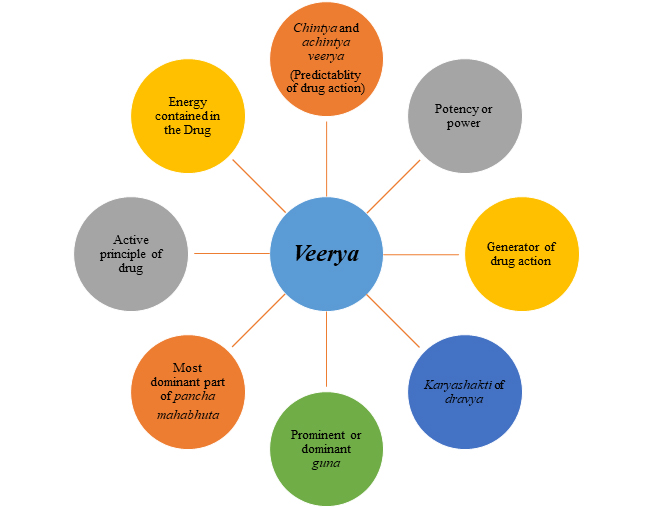
As you can see, Veerya can be viewed as a drug's dominant quality, its core energy, or its active principle. This multifaceted nature is the source of the different interpretations we will now explore.
2. The Two Major Schools of Thought on Veerya
The primary debate in classical texts revolves around whether Veerya should be classified into two primary types or eight. This leads to two main theories: Dwividha Veerya Vada (the two-fold theory) and Ashtavidha Veerya Vada (the eight-fold theory).
Charaka's Perspective: The Dwividha Veerya Vada
Acharya Charaka is the principal proponent of the two-fold theory, emphasizing that all drug actions can ultimately be categorized based on two fundamental energies:
- Ushna Veerya (Hot Potency): Associated with Agni Mahabhuta. Generally promotes metabolism, digestion, circulation, and aggravates Pitta.
- Shita Veerya (Cold Potency): Associated with Jala and Prithvi Mahabhutas. Generally has a cooling, calming, and nutritive effect, and aggravates Vata and Kapha.
Charaka's view is often referred to as Shakti Matra Virya Vada, which proposes that Veerya is pure energy. The hot/cold binary represents the two most powerful and universally influential forces, analogous to the sun (Agni) and moon (Soma) governing the cosmos. For Charaka, these two potencies are the most decisive factors in a drug's overall effect, overpowering other qualities.
Sushruta's & Vagbhata's Perspective: The Ashtavidha Veerya Vada
Acharya Sushruta, followed by Vagbhata, championed a more descriptive, eight-fold classification. This theory, known as Paaribhashika Virya Vada, identifies eight specific Gunas (qualities) that are so potent and stable throughout digestion that they are elevated to the status of Veerya.
These eight are:
- Guru (Heavy)
- Laghu (Light)
- Snigdha (Unctuous/Oily)
- Ruksha (Dry)
- Mridu (Soft)
- Teekshna (Sharp/Penetrating)
- Ushna (Hot)
- Shita (Cold)
You'll notice that Ushna and Shita are included, but here they are part of a broader descriptive framework. This model provides a more detailed picture of a drug's pharmacodynamics. For instance, knowing a drug is Shita Veerya is useful, but also knowing it is Ruksha (dry) or Snigdha (unctuous) adds a crucial layer of clinical detail.
3. A Key Textual Difference: The Enumeration by Sushruta
While the Ashtavidha list is largely consistent, there is a notable difference in Sushruta's enumeration. To understand this subtle but important point, please read the following material.
This reading from the paper 'The Critical Analysis of Ashtavidha Virya' highlights a specific variation in Sushruta's classification and explains the reasoning provided by classical commentators.
Please read the paragraph that begins 'The Virya is of eight kinds viz., Ushna (hot)...' and ends with '...Thus substantiation is done'. Focus on which two Veeryas Sushruta lists differently and the explanation for this change.
As you've just read, Acharya Sushruta accepts Picchila (slimy) and Vishada (clear/non-slimy) in place of Guru (heavy) and Laghu (light).
Why this change? The commentators Chakrapani and Dalhana suggest that Sushruta did this to avoid terminological confusion. The terms Guru and Laghu are also used to describe the three types of Vipaka (post-digestive effect) in some schools of thought. By using Picchila and Vishada for Veerya, Sushruta creates a clear distinction between these two important pharmacological concepts.
4. Reconciling the Views: Contradiction or Different Perspectives?
At first glance, the two-fold and eight-fold theories may seem contradictory. However, most scholars interpret them not as a conflict, but as a difference in emphasis and purpose.
The following reading provides a concise synthesis of this idea.
This excerpt from 'Ijapc 2018' offers a clear explanation for why Charaka and Sushruta's views on Veerya differ, framing it as a difference in clinical focus.
Please read the paragraph starting with 'Acharya Sushruta preferred Guruvadi...' and ending with '...in the name of Virya'. This is a key passage for understanding the different approaches.
This passage reveals the core of the difference:
- Charaka's focus: Stresses the site of action and a drug's specific affinity for a particular Dosha or Dushya. The Ushna/Shita binary is a powerful, high-level principle for determining the primary therapeutic vector (i.e., heating or cooling).
- Sushruta's focus: Reviews the complete pharmacotherapeutic actions and pharmacokinetics of a drug. The eight Veeryas provide a richer, more descriptive vocabulary to explain the full range of a drug's effects on the body.
Vridda Vagbhata offered a brilliant reconciliation, suggesting that Charaka's two-fold theory (Shakti Viryavada) is Shastriya (theoretical or principle-based), while Sushruta's eight-fold theory (Paribhashika Virya vada) is Laukika (practical or for worldly application).
For a structured overview of the opinions of various Acharyas and their commentators, the table in the following resource is invaluable.
Veerya (Potency) - Charak Samhita
This resource from carakasamhitaonline.com contains a table that neatly summarizes the opinions of key authors regarding Veerya.
Please review 'Table 2: Opinions of various authors regarding the concept of veerya'. This will help you consolidate the different viewpoints we've discussed.
Test your understanding!
A patient has a condition with high Pitta (manifesting as burning and inflammation) but also associated dryness and debility (a Vata-Pitta imbalance). You have two drugs that are both primarily Shita Veerya:
- Chandan (Sandalwood): Its qualities are Shita and Ruksha (dry).
- Yashtimadhu (Licorice): Its qualities are Shita and Snigdha (unctuous).
How would you use both the Dwividha and Ashtavidha models of Veerya to select the more appropriate drug for this patient?
Show answer
- Using the Dwividha Veerya model (Charaka): Both drugs are Shita Veerya, so both would be considered appropriate to pacify the aggravated Pitta Dosha. This model gives us the correct primary therapeutic direction.
- Using the Ashtavidha Veerya model (Sushruta): This model allows for a more nuanced choice. The patient also has dryness (Ruksha Guna) from the associated Vata imbalance.
- Chandan, being Ruksha, could potentially worsen the dryness while pacifying the Pitta.
- Yashtimadhu, being Snigdha, will not only pacify the Pitta due to its Shita quality but also counteract the dryness and provide nourishment due to its Snigdha quality.
Therefore, Yashtimadhu is the superior choice. This demonstrates how both models are clinically useful: Charaka's sets the main strategy (cooling), while Sushruta's helps refine the specific choice (cooling and unctuous).
Conclusion
Today, we've dissected the classical interpretations of Veerya, revealing that the apparent contradictions are, in fact, complementary perspectives. Understanding both allows for a more profound and precise application of Dravyaguna.
Key Takeaways:
- Charaka's Dwividha Veerya Vada focuses on the two primary energies, Ushna and Shita, as the ultimate determinants of a drug's action. This is a principle-based (Shastriya) approach.
- Sushruta's Ashtavidha Veerya Vada provides a more descriptive framework of eight potent qualities, offering a detailed view of a drug's pharmacodynamics. This is a practical (Laukika) approach.
- A key textual difference is Sushruta's use of Picchila and Vishada in place of Guru and Laghu to avoid confusion with Vipaka.
- Clinically, the two-fold model helps determine the primary therapeutic strategy, while the eight-fold model helps in the nuanced selection of the specific drug.
Preview of the Next Lesson:
The discussion about Sushruta's effort to avoid confusion between Veerya and Vipaka provides a perfect bridge to our next topic. Just as with Veerya, there are differing views on Vipaka (the post-digestive effect). In our next lesson, we will evaluate contradictory Vipaka theories and their clinical implications, exploring the debate between the three-fold and two-fold models of Vipaka.