Welcome back! In our last lesson, we explored the different classical interpretations of Veerya, contrasting Charaka's two-fold model with Sushruta's eight-fold one. We noted that Sushruta's classification was partly designed to avoid confusion with Vipaka. Today, we will dive deep into that very concept.
This lesson focuses on the learning outcome: Evaluate contradictory Vipaka theories and their clinical implications. Vipaka, or the post-digestive transformation, is a cornerstone of Dravyaguna. It dictates the long-term, systemic effects of a substance after it has been fully metabolized by Agni. Understanding the different schools of thought on Vipaka is not just an academic exercise; it has profound implications for predicting a drug's ultimate action on the Doshas, Dhatus, and Malas, which is essential for effective clinical practice.
1. Differentiating Avasthapaka and Vipaka
Before we evaluate the different theories, let's quickly solidify the distinction between Avasthapaka and Vipaka. As a BAMS graduate, you are familiar with these terms, so we'll treat this as a brief review to set the stage.
- Avasthapaka refers to the sequential stages of digestion that all food undergoes within the gastrointestinal tract (Koshtha). It is a general, non-specific process.
- Madhura Avasthapaka: The initial stage in the Amashaya (stomach), dominated by sweet taste and Kapha.
- Amla Avasthapaka: The second stage in the Pachyamanashaya (small intestine), dominated by sour taste and Pitta.
- Katu Avasthapaka: The final stage in the Pakwashaya (large intestine), dominated by pungent taste and Vata.
- Vipaka (also called Nishtapaka) is the specific, post-absorptive metabolic transformation that a particular Dravya undergoes, resulting in a new, dominant taste-like quality that determines its systemic actions.
For a quick visual and auditory summary of this fundamental distinction, please watch the first few minutes of the following video.
Vipaka || UNIT - 5 || Dravyaguna || BAMS 2nd year || Paper 1
This video from Ayush_Bams Course provides a clear, concise definition of Vipaka and contrasts it with Avasthapaka, which serves as an excellent refresher.
Please watch from the beginning until timestamp 03:18. Focus on the definitions of Avasthapaka and Nishtapaka (Vipaka) and the key differences between them.
This distinction is critical: Avasthapaka is what happens to the food mass in the gut, while Vipaka is the ultimate metabolic fate and systemic effect of the absorbed substance.
2. The Core Debate: How Many Vipakas Are There?
Just as with Veerya, the classical Acharyas held differing views on the number of Vipakas. Evaluating these "contradictory" theories reveals different levels of abstraction and clinical focus.
To explore this, let's turn to a detailed presentation and a comprehensive article.
Presentation - Applied aspects of vipaka.pptx
This presentation, 'Applied aspects of vipaka', and the article from Charak Samhita Online provide an excellent, in-depth look at the various theories proposed by different scholars. We will use them to dissect each theory.
Please review slides 19 through 28 of this presentation. These slides systematically cover the Shadvidha, Panchavidha, Trividha, and Dwividha Vipaka Vadas. Pay attention to which Acharyas supported each theory and the reasoning provided.
As you've just reviewed, the debate centers around four main theories. Let's break them down.
A. Shadvidha Vipaka Vada (The Six-Vipaka Theory)
This early theory proposed that each of the six Rasas transforms into a corresponding Vipaka (e.g., Madhura Rasa -> Madhura Vipaka). It was largely rejected because:
- Redundancy: If Vipaka were always the same as Rasa, it would not be a distinct concept.
- Clinical Observation: Numerous Dravyas contradict this rule. For example, Pippali (Piper longum) has a Katu Rasa (pungent taste) but undergoes Madhura Vipaka (sweet post-digestive effect). This is why it is rejuvenating (Rasayana) despite its initial pungent quality.
B. Panchavidha Vipaka Vada (The Five-Vipaka Theory)
This theory, mentioned by Sushruta, links Vipaka to the five Mahabhutas. The idea is that a Panchabhautic body digests Panchabhautic food, resulting in five types of metabolic outcomes. However, commentators like Sivadas Sen argued that these five can be logically grouped under the two qualities of Guru (heavy) and Laghu (light), making this theory a precursor to the two-fold model.
C. Trividha Vipaka Vada (The Three-Vipaka Theory) - The Charaka School
This is the most widely accepted theory, championed by Charaka and Vagbhata. It consolidates the six Rasas into three Vipakas:
- Madhura Vipaka: From Madhura (sweet) and Lavana (salty) Rasas.
- Amla Vipaka: From Amla (sour) Rasa.
- Katu Vipaka: From Katu (pungent), Tikta (bitter), and Kashaya (astringent) Rasas.
However, even within this school, there are subtle contradictions. Note the view of Parashara mentioned in the Ashtanga Sangraha.
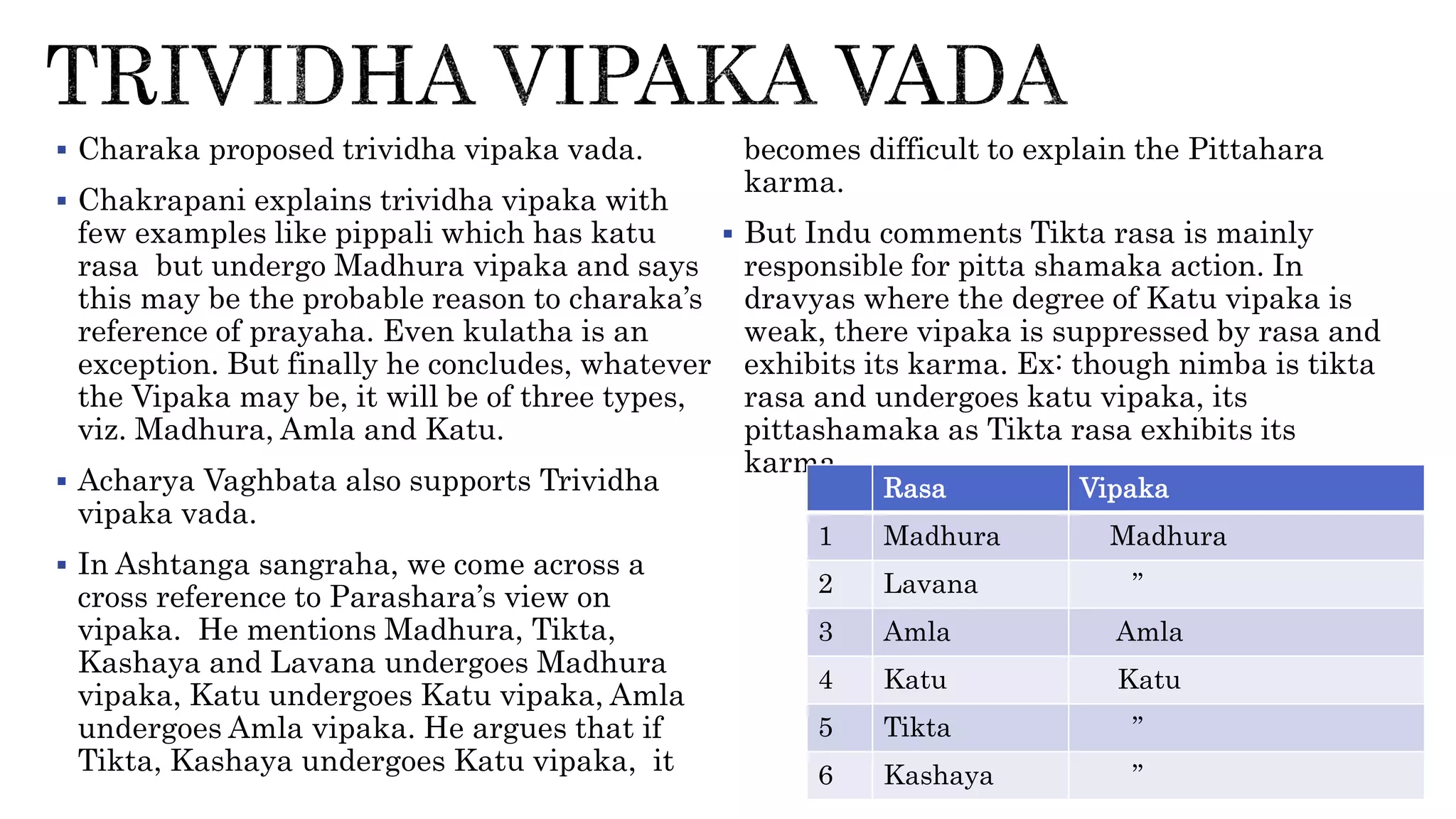
D. Dwividha Vipaka Vada (The Two-Vipaka Theory) - The Sushruta School
Sushruta proposes the most consolidated model, with only two Vipakas:
- Madhura Vipaka (or Guru Vipaka): Generally anabolic, nourishing, and heavy. It encompasses the actions associated with Charaka's Madhura Vipaka.
- Katu Vipaka (or Laghu Vipaka): Generally catabolic, lightening, and drying. It encompasses the actions of both Amla and Katu Vipaka from Charaka's model.
This framework simplifies pharmacology down to two fundamental metabolic vectors: building up (Guru) or breaking down/lightening (Laghu).
The table in the following resource neatly summarizes these differing views.
The article 'Vipaka - Charak Samhita' from carakasamhitaonline.com contains a highly useful table that lays out the various Vipaka theories with their proponents and explanations.
Please carefully review 'Table 1: Types of vipaka'. This will consolidate your understanding of the different schools of thought we have just discussed.
3. Clinical Implications: From Theory to Practice
Understanding these theories is vital because Vipaka, along with Veerya, is a more powerful determinant of a drug's action than its initial Rasa. The Vipaka governs the systemic, long-term effects.
Let's examine the actions of the three main Vipakas (using the widely applied Trividha model).
| Vipaka | Guna (Qualities) | Effect on Dosha | Effect on Dhatu (Tissues) | Effect on Mala (Wastes) |
|---|---|---|---|---|
| Madhura | Snigdha, Guru | Pacifies Vata & Pitta; Increases Kapha | Nourishing, increases Shukra (Shukrala) | Promotes elimination (Srishtavinmutra) |
| Amla | Snigdha, Laghu | Pacifies Vata; Increases Pitta & Kapha | Decreases Shukra (Shukranashana) | Promotes elimination (Srishtavinmutra) |
| Katu | Ruksha, Laghu | Pacifies Kapha; Increases Vata & Pitta | Decreases Shukra (Shukranashana) | Constipating (Baddhavinmutra) |
(Based on Charaka Samhita, Sutra Sthana 26/59-62)
This table is the key to clinical application. It shows why we can't prescribe based on Rasa alone.
Consider Amalaki (Emblica officinalis):
- Rasa: Predominantly Amla (sour), with four other subordinate tastes (it lacks Lavana).
- Vipaka: Madhura.
If we only considered its Amla Rasa, we might hesitate to use it in high Pitta conditions. However, its Madhura Vipaka and Shita Veerya make it an excellent Pitta-pacifying Rasayana that nourishes the tissues (Shukrala) rather than depleting them.
Test your understanding!
A patient with a digestive disorder characterized by Agnimandya (low digestive fire), bloating, and sluggish bowel movements (Vibandha) needs a carminative and digestive stimulant. You consider two drugs:
- Shunthi (Dried Ginger): Rasa is Katu, Veerya is Ushna, Vipaka is Madhura.
- Maricha (Black Pepper): Rasa is Katu, Veerya is Ushna, Vipaka is Katu.
Both have Katu Rasa and Ushna Veerya, making them excellent for Agnimandya. How would their different Vipakas influence your choice, especially considering the patient's sluggish bowels?
Show answer
The key difference lies in their effect on the Malas.
- Maricha, with its Katu Vipaka, is Baddhavinmutra (constipating). While it would stimulate digestion, it could potentially worsen the patient's sluggish bowel movements in the long run.
- Shunthi, with its Madhura Vipaka, is Srishtavinmutra (promotes elimination). It provides the desired digestive stimulation (Deepana-Pachana) without the long-term constipating effect. It is famously known as Vishwabhaishaj (the universal medicine) partly because its Madhura Vipaka provides a balancing, nourishing post-digestive effect.
Therefore, for this patient, Shunthi is the superior long-term choice as it addresses both the Agnimandya and supports regular elimination.
Conclusion
Today, we've moved beyond a simple definition of Vipaka to critically evaluate the different classical theories. We've seen that what appears as a contradiction is often a difference in philosophical perspective or level of clinical detail.
Key Takeaways:
- Vipaka is the specific, post-absorptive metabolic transformation of a Dravya, distinct from the general digestive process of Avasthapaka.
- The two most prominent theories are Charaka's Trividha Vipaka Vada (Madhura, Amla, Katu), which is widely used for its clinical detail, and Sushruta's Dwividha Vipaka Vada (Guru, Laghu), which provides a high-level view of metabolic effects (anabolic vs. catabolic).
- Clinically, Vipaka often overrides the initial Rasa to determine a substance's systemic effects on Doshas, tissue nourishment (Dhatu building), and waste elimination (Mala formation).
- Understanding exceptions, like Shunthi having a Madhura Vipaka, is crucial for precise and safe prescribing.
Preview of the Next Lesson:
The concept of Vichitra Pratyarabdha Dravya—substances whose actions are contrary to their Rasa-Guna-Veerya-Vipaka—serves as a perfect introduction to our next topic. What happens when a drug's action cannot be explained by any of these principles? In the next lesson, we will explore this very question as we explain the mechanism of Prabhava as distinct from Rasa-Veerya-Vipaka effects.