Welcome to your first lesson in the Advanced Dravyaguna module. This course is designed to build upon your existing BAMS knowledge, focusing on the theoretical and clinical aspects of Ayurveda, particularly in relation to metabolic, digestive, and neurological disorders.
Today's lesson addresses the first learning outcome: Apply Samanya-Vishesha Siddhanta to explain Dosha-Dushya interactions in disease pathogenesis. This principle is the bedrock of Ayurvedic pharmacology and pathology. Understanding it deeply will provide you with a logical framework for analyzing why diseases develop and how therapeutic interventions—be it diet, lifestyle, or medicine—work to restore health.
1. Revisiting the Core Principle: Samanya and Vishesha
As a BAMS graduate, you are already familiar with the Samanya-Vishesha Siddhanta. Let's briefly refine this understanding in the context of advanced application. The principle is elegantly stated in the Charaka Samhita.
To refresh your memory on the formal definitions and their place within the Shad Padarthas (six fundamental categories), please read the following brief sections from the paper "Applied aspect of Samanya-Vishesh Siddhanta".
Applied aspect of Samanya-Vishesh Siddhanta in General ...
This reading will re-establish the foundational definitions of Samanya and Vishesha, directly citing Charaka Samhita.
Please read the introduction and the section titled 'Theoretical Understanding'. Focus on the definitions and the Sanskrit verse from Charaka Samhita. This should take about 5 minutes.
In essence:
- Samanya (Similarity/Homology): Causes
Vriddhi(increase or augmentation). - Vishesha (Dissimilarity/Antagonism): Causes
Kshaya(decrease or depletion).
This applies to three categories:
- Dravya (Substance): A substance increases another substance with similar properties (e.g., muscle tissue consumption increases muscle tissue).
- Guna (Quality): A quality increases a substance with that same quality (e.g., the
Ushnaor hot quality of chili peppers increasesPitta Dosha, which is also predominantly hot). - Karma (Action): An action increases a bodily component through a similar action (e.g., a sedentary lifestyle—a
Karmaof inaction—increasesKapha, which is inherently stable and slow).
This simple logic is the key to understanding the entire process of pathogenesis (Samprapti).
2. From Principle to Pathogenesis: The Role in Samprapti
A disease does not manifest randomly. It begins with causative factors (Hetu) that disrupt the body's equilibrium. The Samanya-Vishesha Siddhanta explains precisely how these Hetus initiate the disease process.
The sequence is as follows:
- Hetu Sevana (Exposure to Causative Factors): An individual consumes food (
Ahara), engages in a lifestyle (Vihara), or experiences mental states that are Samanya (similar) in quality to one or moreDoshas. - Dosha Vriddhi (Increase of Dosha): This sustained exposure leads to the accumulation and aggravation of the corresponding
Dosha. - Dosha-Dushya Sammurchana (Amalgamation of Dosha and Dushya): This is the most critical step. The aggravated
Dosha, now overflowing from its primary site, travels through the body's channels (Srotas) and lodges in a susceptible tissue (Dhatu) or waste product (Mala). These tissues and waste products are collectively known as Dushyas (the ones that get vitiated).
The interaction and amalgamation between the vitiating Dosha and the susceptible Dushya is the birth of the disease. This interaction itself is governed by the Samanya principle. A Dosha is more likely to vitiate a Dushya that shares similar Gunas.
Let's illustrate this with an example highly relevant to your interest in metabolic disorders: Sthaulya (Obesity).
The following reading from the World Journal of Pharmaceutical Research provides an excellent breakdown of the pathogenesis of obesity, directly linking it to the Samanya-Vishesha Siddhanta.
WORLD JOURNAL OF PHARMACEUTICAL RESEARCH
This article applies the Samanya-Vishesha principle to the pathogenesis of obesity (Sthaulya or Medovriddhi), detailing the specific Doshas and Dushyas involved.
Please read the 'CONCEPT REVIEW' section. Pay close attention to the breakdown under the headings 'Dosha', 'Dushya', 'Srotas', and 'Agni & Aam'. Note how the causative factors lead to the vitiation of specific bodily elements.
As you've just read, the pathogenesis of Sthaulya is a classic example of the Samanya principle in action:
- Hetu: Excessive intake of foods with
Guru(heavy),Snigdha(unctuous), andMadhura(sweet) qualities. Lifestyle is dominated byAvyayama(lack of exercise) andDivaswapna(day sleep). - Samanya Application: These qualities and actions are Samanya to both
Kapha DoshaandMeda Dhatu(adipose tissue). - Dosha Vriddhi: This leads to a primary aggravation of
Kapha Dosha. - Dosha-Dushya Interaction: The aggravated
Kapha(with itsGuru,Snigdha,Mandaqualities) finds a natural affinity withMeda Dhatu, which shares these qualities. ThisGuna Samanyafacilitates their morbid interaction (Sammurchana), leading to the abnormal proliferation and deposition of adipose tissue, which is the hallmark of obesity.
This process illustrates how Samanya-Vishesha isn't just a philosophical concept; it is the functional blueprint for how Dosha-Dushya interactions occur.
3. Visualizing the Pathogenic Pathway: The Case of Prameha
To further solidify this concept, let's examine another major metabolic disorder, Prameha (a group of urinary disorders, including Diabetes Mellitus).
The flowchart below provides a clear visual representation of how Samanya Hetu Sevana—broken down by Dravya, Guna, and Karma—directly leads to Dhatu Vaishamya (imbalance of tissues) and the manifestation of the disease.
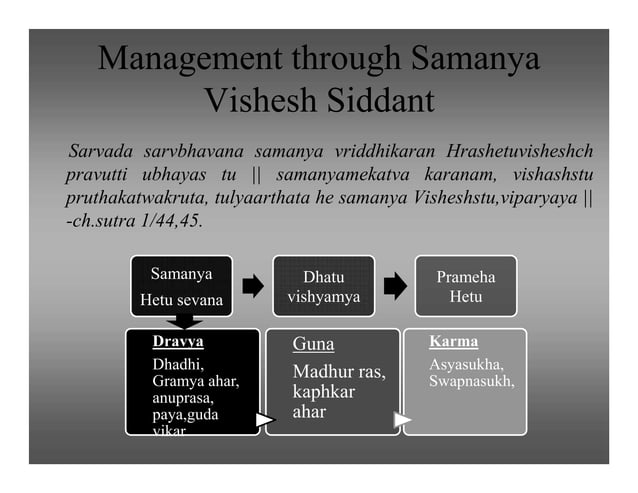
Notice how specific dietary items (Dadhi, Guda Vikar), dominant tastes (Madhur Ras), and lifestyle habits (Asyasukha - sedentary pleasure) all share Samanya with the Kapha Dosha and Meda Dhatu, which are the primary Dosha and Dushya involved in most forms of Prameha.
Test your understanding!
A patient presents with classic signs of Amlapitta (hyperacidity/GERD), including Daha (burning sensation in the chest and stomach), Tikta-Amla Udgara (bitter and sour belching), and Avipaka (indigestion).
Based on the Samanya-Vishesha Siddhanta, explain the likely pathogenesis. Identify:
- The primary
Doshainvolved. - The likely
Gunasof the causative factors (Hetu). - The primary
Dushya(in this case, the location and functional components) being affected.
Show answer
- Primary Dosha:
Pitta Dosha, specificallyPachaka Pittalocated in theAmashaya(stomach) andKledaka Kapha. - Likely Hetu Gunas: The causative factors would be Samanya (similar) to Pitta. These include
Ushna(hot),Teekshna(sharp/penetrating),Amla(sour), andVidahi(foods that cause a burning sensation), such as spicy foods, fried items, fermented foods, and excessive tea/coffee. - Primary Dushya: The aggravated Pitta directly affects the
Rasa Dhatubeing formed in the stomach and the mucous lining of theAmashaya(stomach) andAnnavaha Srotas(channels carrying food). The hot and sharp qualities of Pitta overwhelm the cooling, unctuous nature ofKledaka Kapha(which protects the stomach lining), leading to inflammation and the characteristic symptoms of burning and acidity.
4. Reversing the Process: Therapeutic Application (Chikitsa)
If Samanya is the cause of disease, then Vishesha is the principle of treatment. The goal of Chikitsa is Samprapti Vighatana—to break the pathogenic process. This is achieved by introducing Dravyas, Gunas, and Karmas that are opposite to the qualities of the aggravated Dosha and affected Dushyas.
Let's return to our example of Sthaulya (obesity).
- Pathogenic Qualities:
Guru(heavy),Snigdha(unctuous),Manda(slow),Sthira(stable). - Therapeutic (Vishesha) Qualities:
Laghu(light),Ruksha(dry),Teekshna(sharp),Chala(mobile).
The entire treatment protocol is designed around this principle of opposition. To see how this is structured, please read the following sections.
Applied aspect of Samanya-Vishesh Siddhanta in General ...
These sections detail how the Vishesha principle is applied therapeutically through substances, qualities, and actions to counteract disease.
Read the sections 'Pathological Relevance' and 'Therapeutic Implications'. Focus on how the examples given for Dravya, Guna, and Karma Vishesh directly oppose the qualities of the disease state.
This application can be seen in practice:
- Dravya/Guna Vishesha: Prescribing herbs like
Gugguluor formulas likeTriphalawhich possessRukshaandLekhana(scraping) properties to counteract theSnigdhaquality ofKaphaandMeda. A diet of barley (Yava) instead of wheat (Godhuma) is recommended because barley isLaghuandRuksha. - Karma Vishesha: Prescribing
Vyayama(exercise), which is aKarmaof movement and metabolic activity, to oppose the sedentaryKarmathat caused the disease.
Similarly, in Amlapitta, we use Dravyas with Sheeta (cold) and Manda (slow) qualities like Guduchi or Shatavari and a diet that avoids hot, spicy foods (Guna Vishesha).
Conclusion
In this lesson, we have established the Samanya-Vishesha Siddhanta as a critical tool for clinical reasoning. You can now use this principle to deconstruct the pathogenesis of a disease and construct a logical therapeutic plan.
Key Takeaways:
- Pathogenesis is driven by Samanya: Disease begins when causative factors (
Hetu) share qualities with bodilyDoshas, leading to their aggravation. - Dosha-Dushya interaction is the core of disease: The morbid amalgamation of
DoshaandDushyais facilitated by their shared qualities (Guna Samanya). - Treatment is driven by Vishesha:
Samprapti Vighatana(breaking the pathogenesis) is achieved by administering therapies (Dravya,Ahara,Vihara) with qualities opposite to those of theDoshaandDushya.
This framework allows you to move beyond simply memorizing drug actions and disease symptoms, enabling you to analyze and manage clinical conditions from first principles.
Preview of the Next Lesson:
Now that we have established the fundamental "why" of drug and diet selection, we will begin to explore the "how." Our next lesson will focus on differentiating between Veerya interpretations across classical texts (Charaka, Sushruta, Vagbhata). We will delve into Veerya (potency), a key component of a drug's power, and analyze the different perspectives offered by the great sages of Ayurveda.