Hello! Welcome to the first lesson in our module on Neurological Conditions and Neuroprotection. Given your interest in bridging classical Ayurvedic theory with modern medicine, this module will be particularly engaging. We will be exploring the vast domain of Vata Vyadhi and its parallels with contemporary neurology.
In this lesson, you will learn to correlate Vata Vyadhi classifications with major neurological and neurodegenerative disorders. This is a foundational step that will enable you to understand and articulate the Ayurvedic perspective on neurological diseases, setting the stage for the subsequent lessons on specific treatments and integrative management.
We will begin by establishing the fundamental role of Vata dosha in the nervous system, then explore the primary classifications of Vata Vyadhi, and finally, draw direct correlations between these classical concepts and modern neurological conditions like Parkinson's disease, Alzheimer's, and stroke.
1. The Ayurvedic View of the Nervous System
In Ayurveda, the nervous system's vast and complex functions—from sensory perception and motor control to thought and memory—are governed by Vata Dosha. The classical texts refer to Vata as Tantra Yantra Dhara, the one that holds and operates the machinery of the entire body. Its qualities of movement (Gati), subtlety (Sukshma), and quickness (Ashu) make it the prime mover of all physiological and psychological processes.
Disorders arising from the vitiation of Vata are collectively termed Vata Vyadhi. While there are 80 types of Nanatmaja Vata Vyadhi (disorders caused exclusively by Vata), Vata is also a key player in countless other conditions.
To understand how Vata governs neurological functions, it's helpful to look at its sub-types (prabhedas):
| Vata Sub-type | Location & Primary Neurological Functions |
|---|---|
| Prana Vata | Located in the head (Shiras), it governs higher cognitive functions: intellect (Buddhi), mind (Manas), sense organs (Indriya), and consciousness. Its imbalance directly impacts cognition, memory, and sensory processing. |
| Udana Vata | Primarily in the chest but moving upwards, it controls speech, effort, enthusiasm, and memory recall (Smriti). Its dysfunction can manifest as speech disorders, lack of motivation, and memory issues. |
| Vyana Vata | Pervading the entire body, it controls all voluntary and involuntary movements, such as flexion (Akunchana), extension (Prasarana), and blinking (Nimesha). It is central to motor neuron function and peripheral nerve signaling. |
| Samana Vata | Located in the gut, it has an indirect but crucial role via the gut-brain axis. It governs digestion and absorption, and its imbalance can lead to the formation of Ama (toxins), which can affect neurological health. |
| Apana Vata | Located in the lower abdomen, it governs elimination and nerve impulses in the pelvic region. Its dysfunction is linked to conditions like sciatica and certain neuropathies affecting the lower limbs. |
2. Classifying Vata Vyadhi: Understanding the Pathogenesis
Understanding the cause (Nidana) and pathogenesis (Samprapti) is key to correlating Vata Vyadhi with modern diseases. From a causal perspective, Acharya Charaka gives two primary classifications for Vata Vyadhi.
To explore this, please read the introductory section of the following article.
Holistic approaches to Neurological Disorders
This article, 'Holistic approaches to Neurological Disorders,' provides a concise overview of how Vata Vyadhi is classified. It introduces the two main etiological categories that are fundamental to our discussion.
Please read the first section of the article, located on the first page, which introduces the topic and outlines Charaka's classification of Vatavyadhi etiology.
As the article highlights, Vata Vyadhi can be broadly classified based on its pathogenesis into:
-
Dhatukshayajanya Vata Prakopa (Degenerative): This occurs due to the depletion or malnourishment of body tissues (Dhatus). The empty space created by the depleted tissue is filled by the mobile and pervasive Vata dosha, leading to its aggravation. This process is slow, progressive, and directly corresponds to neurodegenerative disorders, where there is a gradual loss of neuronal tissue. The primary Dushya (vitiated tissue) here is often Majja Dhatu (bone marrow and nervous tissue).
-
Margavarodhajanya Vata Prakopa (Obstructive): This occurs when the path of Vata is blocked or obstructed by other doshas (Kapha, Pitta), other tissues (Dhatus), or metabolic waste (Ama). This obstruction forces Vata to move in an abnormal direction or become trapped, causing pain, loss of function, and other symptoms. This directly correlates with conditions like ischemic stroke (obstructed blood flow), compressive neuropathies, or the stiffness and rigidity seen in some disorders.
A closely related and highly important concept is Avarana (occlusion), which is a specific type of Margavarodha. It describes the complex pathological states where the functions of Vata or its sub-types are enveloped or masked by other doshas, dhatus, or even other Vata sub-types. Avarana is often the underlying pathology in chronic, complex neurological diseases like Multiple Sclerosis or advanced Parkinson's disease.
3. Correlating Vata Vyadhi with Neurological Disorders
With this framework, we can now map specific modern neurological diseases to their Ayurvedic counterparts. The image below provides an excellent at-a-glance summary of these correlations.
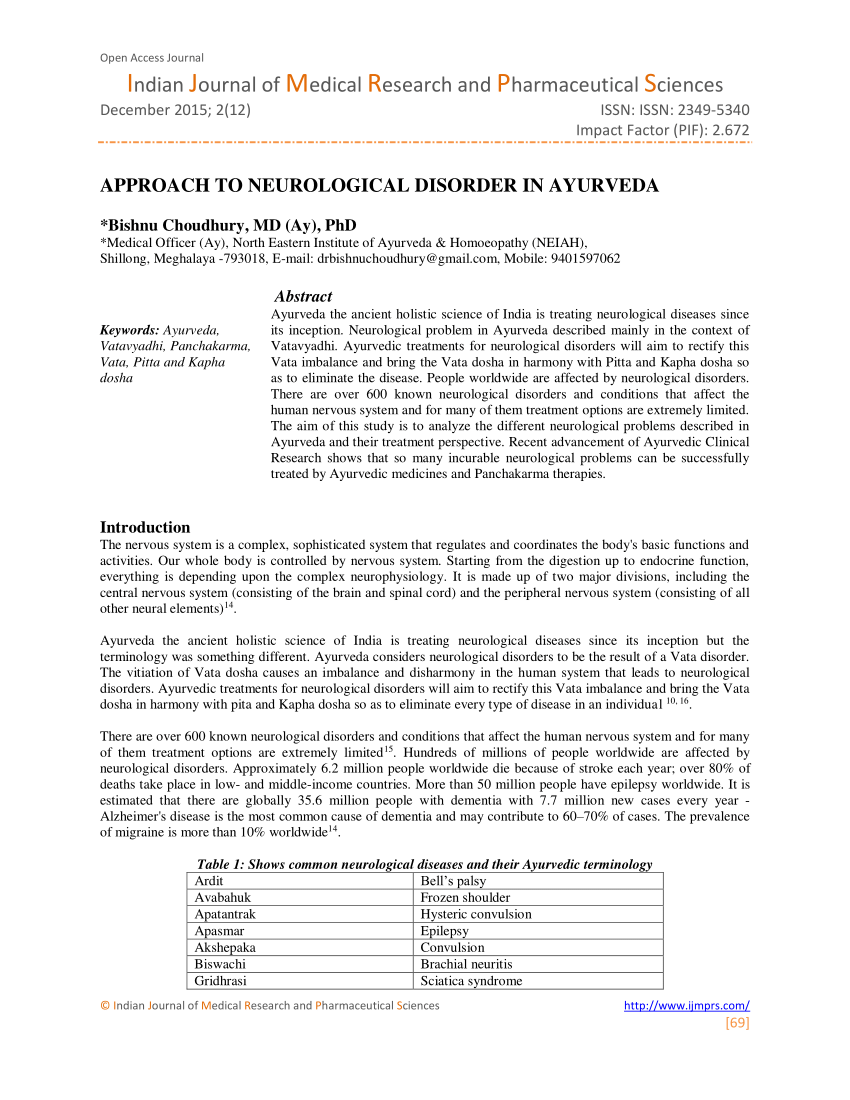
Let's dive deeper into some key examples.
A. Neurodegenerative Disorders: Parkinson's Disease as Kampavata
Parkinson's disease is a classic example of a Dhatukshayajanya process affecting the Majja Dhatu. In Ayurveda, it is most commonly correlated with Kampavata. The term itself combines Kampa (tremor) and Vata (the causative dosha).
The following video provides an excellent clinical correlation between the modern understanding of Parkinson's and the Ayurvedic view of Kampavata.
Clinical correlation of Parkinson's disease (कम्पवात) in Ayurveda | Dr. Raja Singla #drrajasingla
Dr. Raja Singla, in this video 'Clinical correlation of Parkinson's disease (कम्पवात) in Ayurveda,' masterfully connects the dots between modern symptoms and classical Ayurvedic concepts.
Please watch the segment from 30:41 to 46:00. Pay close attention to how the cardinal signs of Parkinson's are mapped to Ayurvedic terms and how the pathogenesis involving Vyan Vayu, Avarana, and Majja Dhatu is explained.
As the video explains, the correlation is strikingly precise:
- Tremor (especially resting tremor) correlates with Kampa.
- Rigidity (stiffness of muscles) correlates with Stambha.
- Bradykinesia (slowness of movement) correlates with Cheshta Sanga (impairment of activities).
- Postural instability relates to dysfunction of Vyana Vayu, which governs balance and gait.
The pathogenesis often involves Avarana (occlusion), where Kapha dosha obstructs the functions of Vata in the nervous system, leading to both stiffness (Stambha, a Kapha-like quality) and tremors (Kampa, a Vata quality).
Here's a summary of correlations for other major neurodegenerative diseases, building on the principles from the article "Holistic approaches to Neurological Disorders":
| Modern Disease | Ayurvedic Correlation & Pathogenesis | Key Ayurvedic Terms |
|---|---|---|
| Alzheimer's Disease | Majja Dhatu Kshaya and Dhatukshayajanya Vata Prakopa. Vitiation of Prana and Udana Vayu affecting higher cognitive functions. | Smritinasha, Buddhinasha |
| Multiple Sclerosis (MS) | Primarily an Avarana pathology where Vata's functions are obstructed. It also involves a deficiency of Ojas (vital essence), correlating with autoimmunity. | Avarana, Ojakshaya, Sarvanga Vata |
| ALS (Motor Neuron Disease) | A severe form of Dhatukshayajanya Vata Prakopa affecting the Mamsa Dhatu (muscle tissue) and Majja Dhatu, leading to progressive muscle wasting and weakness. | Mamsa-Majja Gata Vata, Sarvanga Vata |
B. Other Major Neurological Disorders
The principles of Margavarodha and Ekanga Vata Vyadhi (Vata disorder affecting one part of the body) help us understand other conditions.
| Modern Disease | Ayurvedic Correlation & Pathogenesis | Key Ayurvedic Terms |
|---|---|---|
| Stroke | Pakshaghata or Paksha Vadha. A classic example of Margavarodha, where an obstruction (e.g., a clot) in the Srotas (channels) of the brain leads to Vata aggravation and loss of function in half the body. | Pakshaghata, Sroto-rodha |
| Epilepsy | Apasmara. Described as a paroxysmal loss of consciousness (Smriti). It involves the obstruction of Manovaha Srotas (channels of the mind) by aggravated doshas, leading to deranged Vata activity. | Apasmara, Samjnanaasha |
| Bell's Palsy | Ardita. A classic Ekanga Vata Vyadhi where aggravated Vata affects the nerves and muscles of one side of the face, leading to paralysis. | Ardita, Ekanga Vata |
| Migraine | Ardhavabhedaka (literally, "half-sided splitting pain"). Considered a Tridoshic condition with a predominance of Vata and Pitta affecting the head (Shiras). | Ardhavabhedaka, Shirashoola |
| Peripheral Neuropathy | Often seen as Vata-Rakta or a manifestation of Sarvanga/Ekanga Vata where vitiated Vata affects peripheral nerves, causing symptoms like numbness (Suptata) and tingling. | Suptata, Vata-Rakta |
Test your understanding!
A 68-year-old patient presents with progressive difficulty in walking, slowness in daily activities, and a noticeable resting tremor in his right hand. His muscles feel stiff, and his family notes his facial expressions have become minimal. Based on what you've learned, which primary Ayurvedic pathogenic classification best describes the likely underlying process?
a) Margavarodhajanya Vata Prakopa
b) Dhatukshayajanya Vata Prakopa
c) Kevala Pitta Prakopa
d) A Raktaja Vikara (blood disorder)
Show answer
b) Dhatukshayajanya Vata Prakopa
The symptoms described—progressive nature, tremors (Kampa), slowness (Cheshta Sanga), and rigidity (Stambha)—are hallmarks of Parkinson's disease, which is correlated with Kampavata. The underlying process is degenerative (Dhatukshaya), specifically involving the depletion of Majja Dhatu (nervous tissue), which leads to the aggravation of Vata. While Avarana (a type of Margavarodha) is also involved, the primary initiating process is degenerative.
Conclusion
In this lesson, we have laid the groundwork for understanding neurological disorders from an Ayurvedic perspective. By systematically correlating classical concepts with modern diseases, you can develop a more nuanced and integrated approach to diagnosis and management.
Key Takeaways:
- Vata Dosha is the master controller of the nervous system, and its derangement is the root of Vata Vyadhi.
- The primary pathogenic classifications—Dhatukshayajanya (degenerative) and Margavarodhajanya (obstructive)—provide a powerful lens to differentiate between progressive neurodegenerative diseases and acute obstructive conditions like stroke.
- The concept of Avarana (occlusion) is crucial for understanding the complex pathology of chronic neurological conditions like MS and advanced Parkinson's.
- Specific Ayurvedic disease entities like Kampavata (Parkinson's), Pakshaghata (Stroke), Apasmara (Epilepsy), and Ardita (Bell's Palsy) show a strong and logical correlation with their modern counterparts.
Preview of the Next Lesson:
Now that we have established these fundamental correlations, our next lesson will focus on therapeutic strategies. We will analyze the neuroprotective mechanisms of key Medhya Rasayanas (nootropic rejuvenators) like Brahmi, Shankhapushpi, and Mandukaparni, exploring how they act at the Dosha and Dhatu level to manage the very pathologies we discussed today.