Hello! Welcome to our second lesson in the module on Neurological Conditions and Neuroprotection.
In our previous lesson, we established the fundamental correlations between classical Vata Vyadhi classifications and modern neurological disorders. We saw that many of these conditions, particularly the neurodegenerative ones, are rooted in a Dhatukshayajanya (degenerative) process affecting the Majja Dhatu (nervous tissue). Today, we will explore the therapeutic side of this equation by analyzing how specific Ayurvedic herbs work to counter these processes.
Your learning outcome for this lesson is to analyze the neuroprotective mechanisms of Medhya Rasayanas (e.g., Brahmi, Shankhapushpi, Mandukaparni). This aligns perfectly with your interest in understanding the evidence-based mechanisms behind classical remedies. We will bridge the gap between the Ayurvedic concept of Medhya and the modern neuroscientific framework of neuroplasticity and neuroprotection.
1. The Concept of Medhya Rasayana
Before the advent of modern nootropics, Ayurveda had a well-defined class of herbs known as Medhya Rasayanas. As you know from your BAMS studies, Rasayana refers to rejuvenation, and Medhya pertains to the intellect. These herbs are traditionally aimed at enhancing the three core components of intellect:
- Dhi: The power of acquisition and comprehension.
- Dhriti: The power of retention and processing.
- Smriti: The power of recall and memory.
The classical texts of Charaka highlight four principal Medhya Rasayanas: Mandukaparni (Centella asiatica), Yashtimadhu (Glycyrrhiza glabra), Guduchi (Tinospora cordifolia), and Shankhapushpi (Convolvulus pluricaulis). Another powerhouse in this category, often used synonymously with Mandukaparni but botanically distinct, is Brahmi (Bacopa monnieri).
Modern science allows us to look "under the hood" to see how these herbs achieve their neuroprotective and cognitive-enhancing effects. We'll explore this through the lens of neuroplasticity—the brain's ability to reorganize itself by forming new neural connections.
2. Mandukaparni (Centella asiatica): Enhancing Neurotrophic Support
Mandukaparni, also known as Gotu Kola, is renowned as a "brain tonic". Modern research is beginning to uncover a very specific and elegant mechanism for its action.
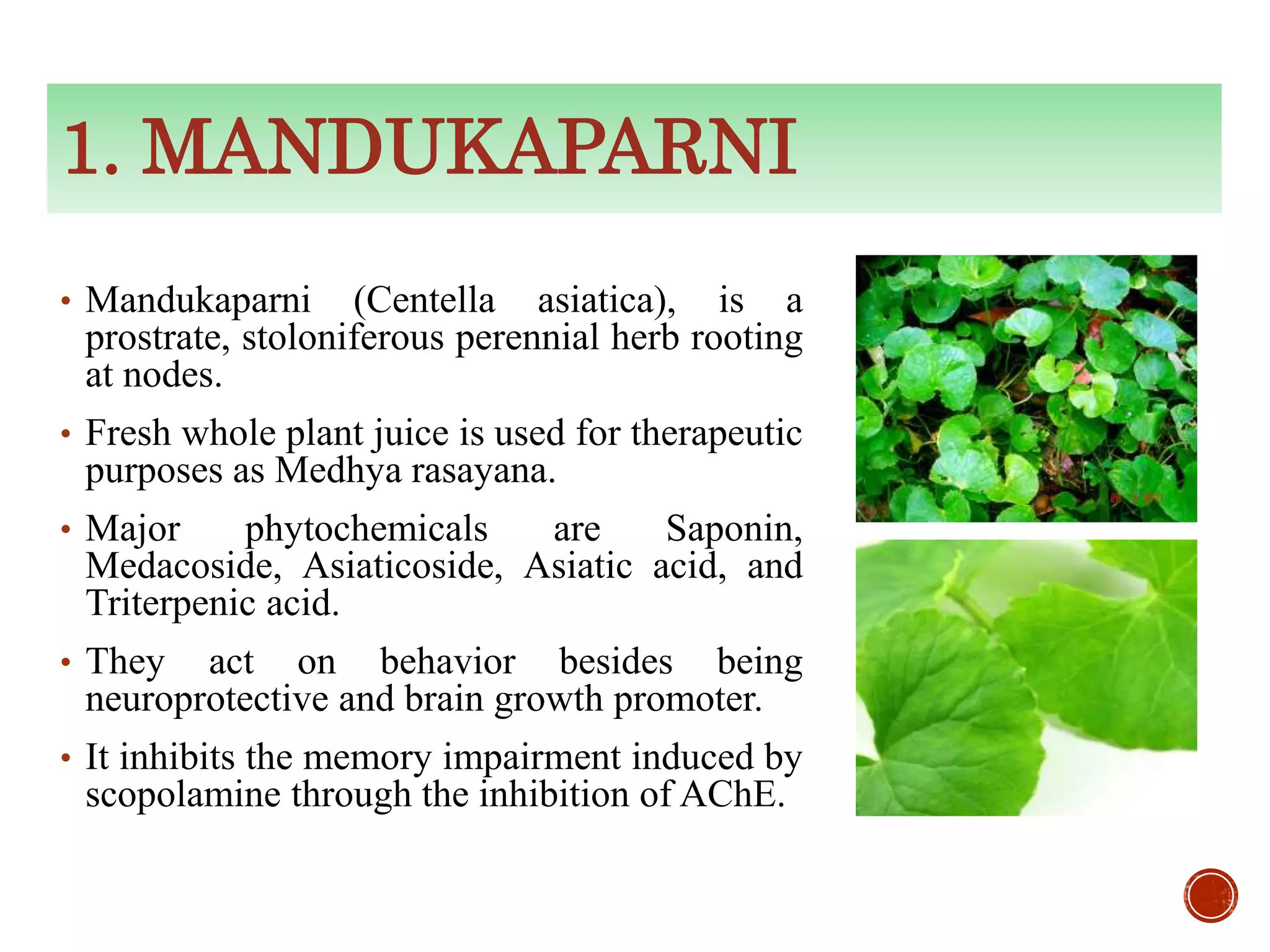
While actions like acetylcholinesterase (AChE) inhibition and antioxidant effects are important, a key modern discovery points to its role in modulating neurotrophic factors, which are proteins that support the growth, survival, and differentiation of neurons.
To understand this mechanism in detail, please read the following section from a mechanistic review on Medhya Rasayanas.
The Neuroplastic Potential of Ayurvedic Medhya Rasayanas
This section from the paper 'The Neuroplastic Potential of Ayurvedic Medhya Rasayanas' details how Centella asiatica exerts its cognitive-enhancing effects by specifically targeting a critical neurotrophic factor in the brain.
Please read the section titled 'Mandukaparni (Centella asiatica): Modulating BDNF and Cognitive Function'. Focus on the preclinical findings regarding anatomical specificity and the clinical correlates in humans.
As you've just read, the primary neuroplastic mechanism of Mandukaparni is the upregulation of Brain-Derived Neurotrophic Factor (BDNF). Let's break this down:
- Anatomical Specificity: The research shows that C. asiatica specifically increases BDNF mRNA and protein levels in the prefrontal cortex (PFC). This is highly significant, as the PFC is the hub for executive functions, decision-making, and working memory. This provides a direct neurobiological explanation for its Medhya properties.
- Functional Correlation: This molecular change isn't just theoretical. In animal models, the increase in BDNF directly correlated with improved performance in cognitive tasks that rely on the PFC.
- Translational Evidence: Human studies confirm this, showing that supplementation increases plasma BDNF levels, which in turn correlates with improved cognitive scores. This creates a strong evidence bridge from lab to clinic.
In essence, Mandukaparni acts by providing targeted trophic (nourishing) support to a key area of the brain responsible for higher cognition, effectively counteracting the Dhatukshaya at a cellular level.
3. The Shankhapushpi Complex: Multiple Paths to a Single Goal
Shankhapushpi is one of the most celebrated Medhya herbs. However, investigating its scientific basis reveals a fascinating complexity that highlights a core principle of Ayurvedic pharmacology. The name refers to a functional outcome rather than a single botanical entity.
To understand the different ways "Shankhapushpi" can enhance cognition, please read the next section from the same review paper.
The Neuroplastic Potential of Ayurvedic Medhya Rasayanas
This section explores the 'Shankhapushpi complex,' revealing that different plants used under this name achieve the same goal of cognitive enhancement through distinct and complementary neuroplastic mechanisms.
Please read the section 'The Neurogenic Potential of Shankhapushpi'. Pay close attention to the distinct mechanisms attributed to Convolvulus pluricaulis and Clitoria ternatea.
This section reveals two different, yet complementary, forms of neuroplasticity:
-
Modulation of Synaptic Plasticity (Convolvulus pluricaulis): The official source of Shankhapushpi works by fine-tuning communication at the synapse. It enhances Long-Term Potentiation (LTP)—the process of strengthening synaptic connections, which is the cellular basis of memory formation. Simultaneously, it reduces Long-Term Depression (LTD), the weakening of connections. This dual action creates an optimal state for learning and memory retention within existing neural circuits.
-
Promotion of Neurogenesis (Clitoria ternatea): In contrast, C. ternatea (often used as Shankhapushpi in South India) promotes a more structural form of plasticity: direct neurogenesis. It stimulates the proliferation and differentiation of neural stem cells into new neurons. This mechanism doesn't just optimize existing circuits; it adds new cellular hardware to them, potentially increasing the brain's capacity and flexibility.
The "Shankhapushpi" concept beautifully illustrates how traditional Ayurveda, through observation, identified a functional category of herbs that achieve a desired outcome (Medhya) via multiple distinct biological pathways.
Test your understanding!
A researcher is designing a study to investigate an herbal intervention for repairing neuronal loss after a brain injury. They are looking for a compound that can specifically promote the birth of new neurons (de novo neurogenesis). Based on the mechanisms we've discussed, which herb would be the most specific candidate for this study?
a) Mandukaparni (Centella asiatica)
b) Shankhapushpi (Convolvulus pluricaulis)
c) Shankhapushpi (Clitoria ternatea)
Show answer
c) Shankhapushpi (Clitoria ternatea)
While all three are Medhya Rasayanas, their primary neuroplastic mechanisms differ. Mandukaparni primarily boosts BDNF to support existing neurons. Convolvulus pluricaulis fine-tunes synaptic strength (LTP/LTD). Clitoria ternatea is the one specifically shown to promote the proliferation of neural stem cells and their differentiation into new neurons, which is the definition of neurogenesis.
4. Brahmi (Bacopa monnieri): A Multi-Target Neuro-Modulator
Brahmi is perhaps the most extensively researched Medhya Rasayana. Its actions are multifaceted, validating its traditional use as a "calming cognitive enhancer."

Let's first watch a short clip where a neurologist explains the accepted mechanisms of Bacopa from a modern medical perspective.
Neurologist Reviews BACOPA MONNIERI & TOP BRANDS
In this video, 'Neurologist Reviews BACOPA MONNIERI,' Dr. Kassarjian provides a concise overview of the mechanisms through which Bacopa's active compounds, bacosides, are believed to work.
Please watch the segment from 00:48 to 01:40. Note the multiple pathways mentioned, including antioxidant action, neurotransmitter support, and reduction of beta-amyloid.
As the video highlights, Brahmi is a multi-target agent, acting as an antioxidant, supporting key neurotransmitters, increasing cerebral blood flow, and even reducing beta-amyloid protein associated with Alzheimer's.
Now, let's explore a more unique mechanism that explains its "calming" quality, which has been revealed through advanced neurophysiological studies.
The Neuroplastic Potential of Ayurvedic Medhya Rasayanas
This final reading from 'The Neuroplastic Potential of Ayurvedic Medhya Rasayanas' discusses a unique finding from EEG studies on Bacopa, providing a compelling explanation for its dual calming and cognitive-enhancing effects.
Please read the section 'Brahmi (Bacopa monnieri): Modulation of Brain Oscillations'. Focus on how the seemingly counter-intuitive EEG results are interpreted as a sign of increased neural efficiency.
This brings us to a sophisticated understanding of Brahmi's action:
- Modulation of Brain Waves: Bacopa causes an attenuation (decrease) in alpha and beta wave power. In the context of cognitive impairment, which is often characterized by "noisy" or inefficient brain activity, this reduction is interpreted as an increase in neural efficiency. It "quiets the static," allowing the cognitive "signal" to be processed more clearly.
- GABAergic Activity: This effect is likely mediated by its ability to support GABA, the brain's primary inhibitory neurotransmitter, which helps reduce excessive neuronal excitability.
- Structural Plasticity: In addition to modulating brain activity, Bacopa promotes long-term structural changes. Its active compounds, bacosides, are well-documented to promote dendritic arborization—the branching of nerve endings. This enhances the physical infrastructure for synaptic communication, allowing for more robust neural networks.
In summary, Brahmi works by (1) creating a calmer, more efficient state of neural communication, (2) providing neurochemical support (e.g., acetylcholine), (3) protecting against oxidative stress and inflammation, and (4) physically enhancing the structure of neurons for better long-term connectivity.
Conclusion
In this lesson, we have moved from the classical definition of Medhya Rasayanas to a modern, mechanistic understanding of their neuroprotective actions. It is clear that these are not just generic "tonics," but sophisticated biological response modifiers that target the very essence of brain health: its neuroplasticity.
Key Takeaways:
- Mandukaparni (Centella asiatica) primarily acts as a neurotrophic promoter, selectively upregulating BDNF in the prefrontal cortex to support executive function.
- The Shankhapushpi complex demonstrates functional diversity, achieving cognitive enhancement through synaptic plasticity modulation (Convolvulus pluricaulis) or direct neurogenesis (Clitoria ternatea).
- Brahmi (Bacopa monnieri) is a multi-target modulator that enhances neural efficiency by calming brainwave activity, while also promoting structural plasticity through dendritic growth and providing broad neurochemical support.
Preview of the Next Lesson:
We have now analyzed the diverse mechanisms of Brahmi. In our next lesson, we will take this a step further by evaluating the clinical evidence for Brahmi (Bacopa monnieri) in managing cognitive decline. We will critically appraise human clinical trials to understand how these mechanisms translate into measurable outcomes in patients.