Hello! Welcome to the first lesson of our module on advanced integrative practice.
In our last lesson, we designed a comprehensive integrative protocol for Alzheimer's disease. We concluded by acknowledging that the ultimate level of therapeutic precision comes from personalizing such protocols. This is where we will begin today.
This lesson directly addresses that need for personalization. Your learning outcome is to describe how Deha-Prakriti influences drug pharmacodynamics (Prakriti-based pharmacology). We will explore how an individual's unique constitution, their Prakriti, fundamentally alters their physiological response to medicines. This is the cornerstone of Ayurvedic personalized medicine, and by understanding its scientific basis, you will be able to predict drug effects with far greater accuracy.
1. The Classical Framework: The Interplay of Dravya and Deha
From your BAMS studies, you know that Ayurvedic treatment is a dynamic interplay between the properties of the substance (Dravya) and the constitution of the individual (Deha).
- The action of a drug is predicted by its Rasa-Panchaka (taste, qualities, potency, post-digestive effect, and specific action).
- The response of the patient is determined by their unique homeostatic baseline (Prakriti) and their current state of imbalance (Vikriti).
The goal of treatment is to select a Dravya whose properties counteract the qualities of the Dosha causing the Vikriti, while being compatible with the patient's underlying Prakriti.
To refresh this crucial concept, let's examine a paper that discusses the predictive power of Dravyaguna.
Dravyaguna Principles As Predictive Tools In Ayurvedic ...
The review 'Dravyaguna Principles As Predictive Tools In Ayurvedic Pharmacology' succinctly explains this interaction. It will help us ground our discussion in the classical framework before we bridge to modern science.
Please read the section titled 'Personalized Medicine' (under heading 5) and review 'Table 2: Modern Correlations and Predictive Applications of Dravyaguna Principles'. Focus on: The explicit example of how a Pitta Prakriti individual responds to an Ushna Veerya drug. How Prakriti is listed in the table as a concept that aids in personalized drug selection and dosage.
As the article highlights, a person with a Pitta Prakriti (dominated by the fire element) may react adversely to a drug with Ushna Veerya (hot potency), even if that drug is indicated for their illness. Their inherent "hot" constitution amplifies the drug's heating effect, potentially causing side effects like gastritis or skin rashes. Conversely, a Kapha individual might tolerate or even require a stronger dose of the same drug to achieve a therapeutic effect.
This classical model is essentially a system of predictive pharmacodynamics. Prakriti serves as the primary variable that determines an individual's response profile.
2. The Modern Lens: Pharmacogenomics and Ayurgenomics
Modern medicine has arrived at a similar conclusion through a different path.
- Pharmacodynamics is the study of what a drug does to the body.
- Pharmacogenomics is a more recent field that studies how an individual's genetic makeup affects their response to drugs.
Scientists have found that variations in genes responsible for drug metabolism, drug targets (like receptors), and immune responses can lead to vastly different outcomes for patients taking the same medication. This is the scientific basis for "personalized medicine."
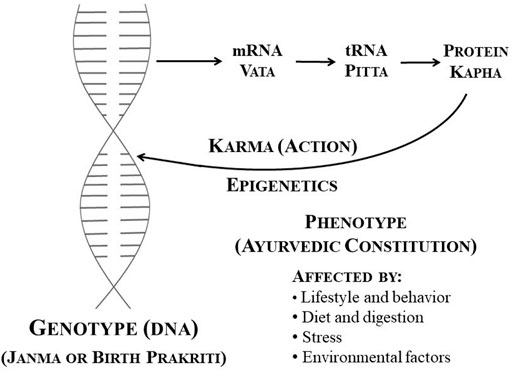
Ayurgenomics is a pioneering field that integrates the Ayurvedic concept of Prakriti with modern genomics. It hypothesizes that the phenotypic classifications of Vata, Pitta, and Kapha correspond to measurable differences at the genetic, epigenetic, and metabolic levels.
The following image provides a conceptual model for how this works.
3. Molecular Evidence for Prakriti-Based Pharmacology
If Prakriti types have distinct genetic and metabolic signatures, it stands to reason that they will process and respond to drugs differently. A growing body of research supports this.
Let's delve into a key review article that compiles this evidence. We will focus on the main conclusions rather than reading through all the specific gene-level data.
An Ayurgenomics Approach: Prakriti-Based Drug ...
The paper 'An Ayurgenomics Approach: Prakriti-Based Drug...' is a cornerstone resource for understanding this topic. It details studies that have identified molecular differences between the Prakriti types.
Please briefly skim the 'Introduction' to refamiliarize yourself with the definitions. Then, pay closer attention to the section 'Research Notes on Ayurgenomics...'. You don't need to memorize the gene names. Instead, focus on grasping the types of differences found between Prakriti groups, such as in: Drug metabolism genes (like CYP2C19). Metabolic pathway genes (like PGM1). Immune and inflammatory response genes. Baseline biochemical markers (like cholesterol and triglycerides).
The research presented in the article provides compelling molecular evidence for what Ayurvedic physicians have observed for centuries. Let's summarize the key findings and their pharmacodynamic implications:
| Prakriti Type | Key Research Finding | Pharmacodynamic Implication |
|---|---|---|
| Pitta | Upregulation of genes for energy metabolism (e.g., PGM1) and immune response. Upregulation of the drug-metabolizing gene CYP2C19. | Faster Metabolism & Heightened Inflammation: Pitta types may metabolize certain drugs and herbs more quickly, potentially requiring different dosing schedules. Their heightened baseline immune activity explains their sensitivity to Ushna Veerya drugs and predisposition to inflammatory conditions. |
| Kapha | Downregulation of CYP2C19. Higher baseline levels of total cholesterol, triglycerides, LDL, and markers of chronic inflammation. Downregulation of genes involved in fibrinolysis (blood clot breakdown). | Slower Metabolism & Metabolic Predisposition: Kapha types may metabolize certain substances more slowly, increasing the risk of accumulation and side effects. This aligns with their tendency towards Mandagni (slow metabolism). Drugs with Guru (heavy) and Snigdha (unctuous) properties could more easily exacerbate their innate tendency for weight gain and high lipids. |
| Vata | Upregulation of inflammatory genes. Tendency towards lower expression of some metabolic genes compared to Pitta. | Systemic Sensitivity & Variability: The Vata constitution is characterized by Chala Guna (mobility, variability). Their genetic profile suggests a sensitive system that can be easily perturbed. They may have unpredictable responses to drugs, benefiting most from substances and therapies that are grounding (Sthira) and nourishing (Bruhana). |

4. Clinical Application: Predicting Drug Action
Understanding these correlations allows us to move from a generalized approach to a truly personalized one. Let's consider some practical examples.
Scenario 1: Prescribing an Anti-inflammatory
You are considering prescribing Guggulu (Commiphora wightii), a potent anti-inflammatory with Ushna Veerya, for a patient with osteoarthritis (Sandhigata Vata).
- For a Kapha Patient: The Ushna Veerya of Guggulu will be beneficial, helping to counteract the cold and heavy nature of Kapha. The patient is likely to tolerate it well and benefit from its metabolic-enhancing effects.
- For a Pitta Patient: You must be cautious. The Ushna Veerya can easily aggravate their inherent Pitta, potentially causing hyperacidity or skin rashes. You might choose a lower dose, combine it with a cooling (Sheeta Veerya) herb like Guduchi (Tinospora cordifolia), or select an alternative anti-inflammatory like Shallaki (Boswellia serrata), which is Sheeta Veerya.
Scenario 2: Prescribing a Rasayana
You are prescribing Ashwagandha (Withania somnifera), a nourishing Rasayana with Guru (heavy) and Snigdha (unctuous) qualities, for stress and fatigue.
- For a Vata Patient: Ashwagandha is an excellent choice. Its heavy and unctuous qualities directly counteract the light and dry nature of Vata, providing grounding and nourishment. The response is likely to be very positive.
- For a Kapha Patient: The same qualities that help the Vata patient could be problematic for the Kapha patient. The Guru and Snigdha properties can increase Kapha, potentially leading to lethargy, heaviness, or weight gain. You would need to prescribe a lower dose, advise taking it with a warming substance like honey or ginger, or choose a lighter Rasayana.
Test your understanding!
A 45-year-old Pitta Prakriti individual is diagnosed with Type 2 Diabetes (Madhumeha). Based on the principles of Prakriti-based pharmacology, why might a formula dominated by Haridra (Curcuma longa) be a more suitable choice for this patient than a formula dominated by Pippali (Piper longum), even though both have anti-diabetic properties?
Show answer
The choice is based on the Veerya of the herbs and the patient's Prakriti.
- Patient's Constitution: The patient has a Pitta Prakriti, meaning they have a high baseline of the "fire" element and are prone to heat-related and inflammatory conditions.
- Pippali's Properties: Pippali has a potent Ushna Veerya (hot potency). While it is an excellent Deepana (metabolic stimulant) and bio-enhancer, its intense heat can easily aggravate the patient's inherent Pitta, leading to potential side effects like hyperacidity, mouth ulcers, or skin issues.
- Haridra's Properties: Haridra also has Ushna Veerya, but it is much milder than Pippali. More importantly, Haridra is renowned for its Tikta (bitter) Rasa and potent anti-inflammatory (Shothahara) properties. As we've seen, Pitta types have upregulated immune response genes, making inflammation a key concern. Haridra directly targets this inflammatory component of metabolic disease without being excessively heating.
Therefore, Haridra is a more balanced and safer choice for a Pitta individual, as it addresses the pathology without significantly aggravating their constitutional tendencies.
Conclusion
Today, we have connected the ancient wisdom of Prakriti with the cutting-edge science of pharmacogenomics. You have seen that the Ayurvedic concept of constitution is not merely descriptive but has a tangible molecular basis that directly influences how a person responds to medicines.
Key Takeaways:
- Prakriti influences pharmacodynamics: An individual's constitution determines their response to a drug's properties (Rasa-Panchaka).
- Ayurgenomics provides evidence: Research shows significant differences in gene expression related to drug metabolism (e.g., CYP enzymes), inflammation, and metabolic pathways among Vata, Pitta, and Kapha types.
- Clinical prediction is possible: This knowledge allows you to anticipate a patient's response, select the most appropriate Dravya, adjust dosage, and foresee potential side effects, leading to safer and more effective personalized treatment.
Preview of the Next Lesson:
Now that you understand the mechanism behind Prakriti-based pharmacology, we will examine its application in research. In our next lesson, we will evaluate research on Prakriti-based stratification in clinical outcomes. You will learn how scientists are proving that grouping patients by Prakriti in clinical trials leads to clearer results and more effective therapeutic strategies.