Hello! Welcome back to our module on advanced integrative practice and personalization.
In our last lesson, we explored the molecular basis for Prakriti-based pharmacology, establishing why an individual's constitution should theoretically alter their response to drugs. We saw that Ayurgenomics has begun to identify distinct genetic and metabolic signatures for Vata, Pitta, and Kapha types.
Today, we will build directly on that foundation. Your learning outcome is to evaluate research on Prakriti-based stratification in clinical outcomes. We will shift our focus from the mechanism to the evidence. You will learn how researchers use Prakriti to group patients in clinical studies and how this approach is validating the core principles of Ayurvedic personalized medicine. This is the critical step that bridges theory to evidence-based practice.
1. The Challenge of Heterogeneity in Clinical Research
Before diving into the research, it's important to understand a major challenge in modern medical studies: phenotypic heterogeneity.
Even when patients are diagnosed with the same disease, say Type 2 Diabetes, they are not a uniform group. They differ in their genetics, metabolism, lifestyle, and the specific pathological processes driving their condition. When a single treatment is tested on such a diverse group, the results represent an average. The treatment might be highly effective for a specific subgroup, ineffective for another, and cause adverse effects in a third. These nuances are often lost in the overall analysis, leading to inconclusive results.
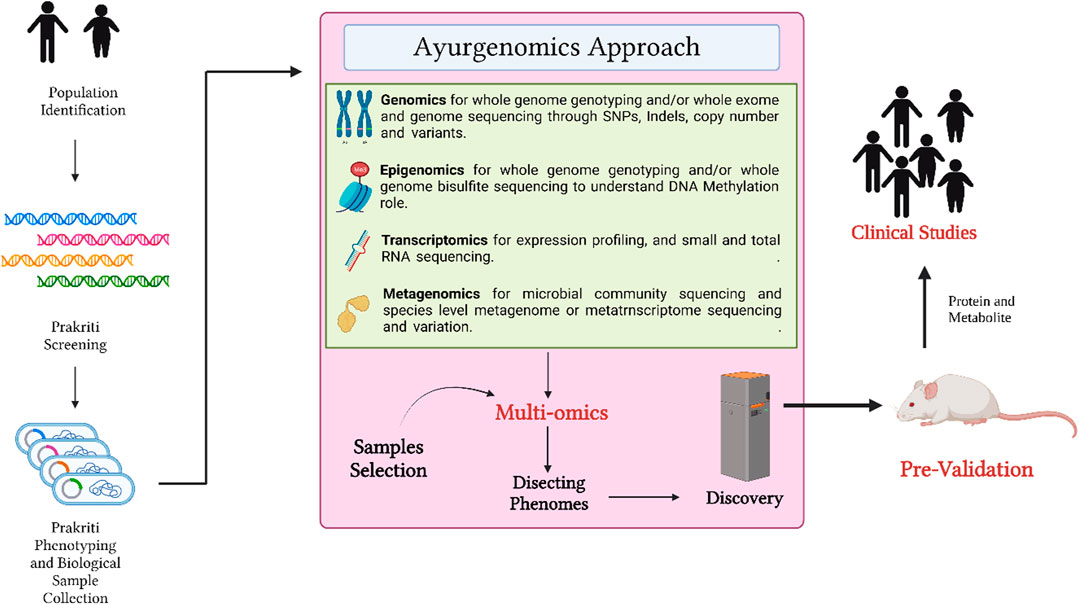
Ayurveda has always addressed this through the lens of Prakriti and Vikriti. The Ayurgenomics approach proposes using Prakriti as a scientific tool to stratify study participants into more uniform, predictable subgroups. Let's see how this works in practice.
To get a quick overview of how modern science is approaching the concept of Prakriti as a tool for personalization, let's watch a short segment from a talk by a professor at IIT Delhi.
How 5000-Year-Old Ayurveda Beats Modern Medicine:IIT Delhi Professor's Shocking Research#sangamtalks
In this clip from Sangam Talks, the speaker introduces how Prakriti defines individual variability and disease susceptibility, and how this is being explored through 'Ayurgenomics'.
Please watch from 09:42 to 13:40. Focus on the explanation of Prakriti as a basis for personalized medicine and the introduction of Ayurgenomics as the bridge to modern biology.
2. Evaluating a Landmark Study: Ayurgenomics in Rheumatoid Arthritis
Rheumatoid Arthritis (Amavata) provides an excellent model for evaluating Prakriti-based stratification. Let's analyze an exploratory study that did exactly this. The researchers' core idea was that by subgrouping patients according to Prakriti, they might uncover distinct disease pathways that are masked in a conventional analysis.
The paper we will examine is a pilot study published in PLOS ONE. It's a foundational piece of research in this area.
Potential of Ayurgenomics Approach in Complex Trait Research
This paper, 'Potential of Ayurgenomics Approach in Complex Trait Research', investigates genetic markers for Rheumatoid Arthritis (RA) by stratifying patients based on Prakriti.
Please read the 'Abstract' first to get a complete overview. Then, focus on the 'Results' and 'Discussion' sections. You don't need to understand every statistical detail, but concentrate on: Results (Univariate Analysis): Compare the findings for the 'Total cohort' with the findings for the 'Vata subgroup' and 'Pitta subgroup'. Notice which gene pathways (inflammatory vs. oxidative stress) become significant in each group. Discussion: Read the first few paragraphs. Note how the authors interpret the results, highlighting that subgrouping helped overcome sample heterogeneity and revealed distinct genetic associations for each Prakriti type.
Analysis of the Study's Findings
This study is a powerful demonstration of Prakriti-based stratification. Here are the crucial takeaways from your reading:
- When Analyzed as a Whole: When the entire group of RA patients was compared to controls, the genetic associations were weak, primarily pointing to genes related to oxidative stress (SOD3) and inflammation (IL1β).
- After Stratification: The picture became much clearer.
- Vata Subgroup: Showed significant associations with inflammatory pathway genes (IL1β, CD40). This aligns perfectly with the classical description of Vata disorders being characterized by intense, variable pain (Shula). Clinically, this group also reported the most severe symptoms.
- Pitta Subgroup: Showed strong associations with oxidative stress pathway genes (SOD3, PON1). This suggests a different underlying mechanism where oxidative damage may be more prominent, fitting with the metabolic and 'burning' nature of Pitta.
- Kapha Subgroup: Showed only minor associations, suggesting yet another, perhaps less genetically-driven or different, pathway might be involved.
Evaluation: This study provides compelling evidence that the single diagnostic label of "Rheumatoid Arthritis" encompasses biologically distinct sub-conditions that align with the Prakriti framework. Stratification didn't just confirm Ayurvedic theory; it solved a modern research problem by unmasking genetic signals that were otherwise hidden by heterogeneity.
3. Broadening the Evidence: Disease Prediction and Clinical Outcomes
The RA study is not an isolated finding. A growing body of research supports Prakriti-based stratification across various conditions. Let's look at a review article that synthesizes evidence from multiple studies.
REVIEW ON PRAKRITI-BASED PERSONALIZED MEDICINE
The article 'REVIEW ON PRAKRITI-BASED PERSONALIZED MEDICINE' consolidates findings from Ayurgenomics, connecting Prakriti types to specific disease risks and clinical outcomes.
Please read the sections titled 'Clinical Applications of Prakriti-Based Personalized Medicine' and 'Case Studies and Clinical Evidence'. Pay close attention to: The specific diseases and risks associated with each Prakriti (e.g., Kapha and metabolic syndrome). The examples of clinical trials where stratification demonstrated better outcomes (e.g., rheumatoid arthritis and metabolic diseases).
This review reinforces the value of stratification by showing its practical applications:
- Disease Risk Prediction: Research consistently links Prakriti types to predispositions for specific diseases, which is highly relevant to your clinical interests.
- Kapha: Higher risk for metabolic syndrome, Type 2 Diabetes, obesity, and dyslipidemia.
- Pitta: Higher risk for inflammatory conditions like IBD, autoimmune disorders, and liver issues.
- Vata: Higher risk for neurodegenerative disorders, anxiety, and joint diseases.
- Improved Therapeutic Efficacy: The review cites clinical examples where stratifying by Prakriti predicted treatment response.
- In an RA trial, Vata-dominant patients responded better to Ashwagandha, while Pitta patients responded better to other anti-inflammatory herbs.
- In a study on metabolic health, Kapha subjects on a Prakriti-specific lifestyle plan showed significantly greater improvements in fasting glucose and lipid profiles compared to controls.
This evidence demonstrates that Prakriti-based stratification is not just a research tool; it has direct clinical implications for improving patient outcomes.
4. The Importance of Validated Assessment Tools
A critical aspect of evaluating this research is to consider the methodology. The strength of any stratification study depends on the accuracy and reliability of the Prakriti assessment itself. Historically, this has been a subjective clinical assessment. Modern research, however, strives for objective, validated tools.

As the chart indicates, there's a significant effort to develop and validate objective tools, using everything from questionnaires and software (like Ayusoft™) to machine learning models that integrate clinical data with molecular biomarkers. When you read a study, it's important to look at how Prakriti was determined and whether the method was standardized and validated.
Test your understanding!
A new clinical trial is published for a potent Lekhana (scraping/reducing) herbal formula for obesity (Medoroga). The results show that, on average, the formula was not significantly more effective than the placebo for weight loss in the overall study population. Based on today's lesson, what is a likely reason for this disappointing result, and what would you recommend the researchers do next?
Show answer
Likely Reason: The most probable reason for the lack of significant effect is phenotypic heterogeneity. The study population likely included individuals of Vata, Pitta, and Kapha Prakriti. A Lekhana formula, which is typically drying and light, is most indicated for individuals with a Kapha constitution, who are prone to excess accumulation and sluggish metabolism. The positive effects in the Kapha subgroup were likely diluted or "averaged out" by a lack of effect (or even a negative effect, such as aggravating Vata) in the other subgroups.
Recommendation: The researchers should perform a post-hoc analysis by stratifying the data according to the participants' Prakriti. They should re-analyze the weight loss outcomes for the Vata, Pitta, and Kapha subgroups separately. It is highly probable that they will find a statistically significant and clinically meaningful weight loss effect specifically within the Kapha subgroup. This would not only salvage the study but also provide powerful evidence for the formula's targeted application.
Conclusion
Today we have moved from the "how" of Prakriti-based pharmacology to the "proof." You have evaluated research demonstrating that stratifying patients by Prakriti is a valid and powerful method for uncovering clearer, more precise clinical outcomes.
Key Takeaways:
- Prakriti-based stratification helps overcome the problem of clinical heterogeneity in research.
- Clinical studies show that individuals with the same disease but different Prakritis can have different underlying pathological pathways (e.g., inflammation in Vata RA vs. oxidative stress in Pitta RA).
- Stratification improves disease risk prediction and can identify which patients will benefit most from a specific therapy, thereby validating the principles of personalized Ayurvedic treatment.
- Evaluating this research requires a critical look at the methods used, especially the validity of the Prakriti assessment tools.
Preview of the Next Lesson:
Having established the theoretical basis and the research evidence for Prakriti-based personalization, we will now bring it into a clinical context. In the next lesson, you will analyze a case study to predict therapeutic and adverse effects of a Dravya based on the patient's Prakriti and Vikriti. This will be an opportunity to apply everything we've learned to a practical, clinical scenario.