Hello! Welcome back to our advanced study of Prameha.
In our previous lesson, we constructed a comprehensive treatment protocol for Type 2 Diabetes, integrating Nidana Parivarjana, diet, lifestyle, and herbal interventions. We established that managing Madhumeha is the primary goal. Today, we delve into one of its most challenging and common complications: diabetic neuropathy.
Our learning outcome for this session is to analyze the Ayurvedic management of diabetic neuropathy in relation to modern neuroprotective approaches. This is a perfect opportunity to bridge classical Ayurvedic pathogenesis with contemporary scientific understanding, a core goal of our course. We will explore how Ayurveda conceptualizes nerve damage in diabetes and how its therapeutic strategies align with modern concepts of protecting and regenerating nerve tissue.
1. Understanding Diabetic Neuropathy: The Modern Perspective
Before we can analyze the Ayurvedic approach, it's essential to have a clear picture of diabetic neuropathy (DN) from a modern medical standpoint. DN is not a single entity but a family of nerve disorders caused by diabetes.
To get a thorough overview of its clinical manifestations, let's turn to a detailed lecture.
Diabetic Neuropathy Types and Complications🩺
Dr. Najeeb provides a comprehensive explanation of the different types of diabetic neuropathy and their clinical consequences. This will form the foundation for our modern understanding.
Please watch the following segments carefully: Peripheral Polyneuropathy (00:00 - 05:19): Focus on the classic 'gloves and stocking' distribution and its link to diabetic foot. Mononeuropathy and Mononeuropathy Multiplex (05:19 - 08:27): Understand the difference between symmetrical polyneuropathy and asymmetrical damage to single or multiple nerves. Autonomic Neuropathy (08:27 - 16:30): Pay close attention to how DN affects involuntary systems, leading to issues like orthostatic hypotension, gastroparesis, and urogenital problems. This is often overlooked but is a critical part of the disease.
As you've seen, the main types of DN are:
- Symmetric Peripheral Polyneuropathy: The most common form, affecting sensory and motor nerves in the hands and feet. This leads to the characteristic "glove-and-stocking" pattern of numbness, tingling, pain, and weakness.
- Autonomic Neuropathy: Damage to nerves that control internal organs, leading to a wide range of issues including cardiovascular problems (e.g., postural hypotension), gastroparesis (delayed stomach emptying), and urinary or sexual dysfunction.
- Mononeuropathy: Damage to a single, specific nerve, often causing weakness or pain in its distribution (e.g., carpal tunnel syndrome, cranial nerve palsies).
The underlying pathology is complex, but key mechanisms include:
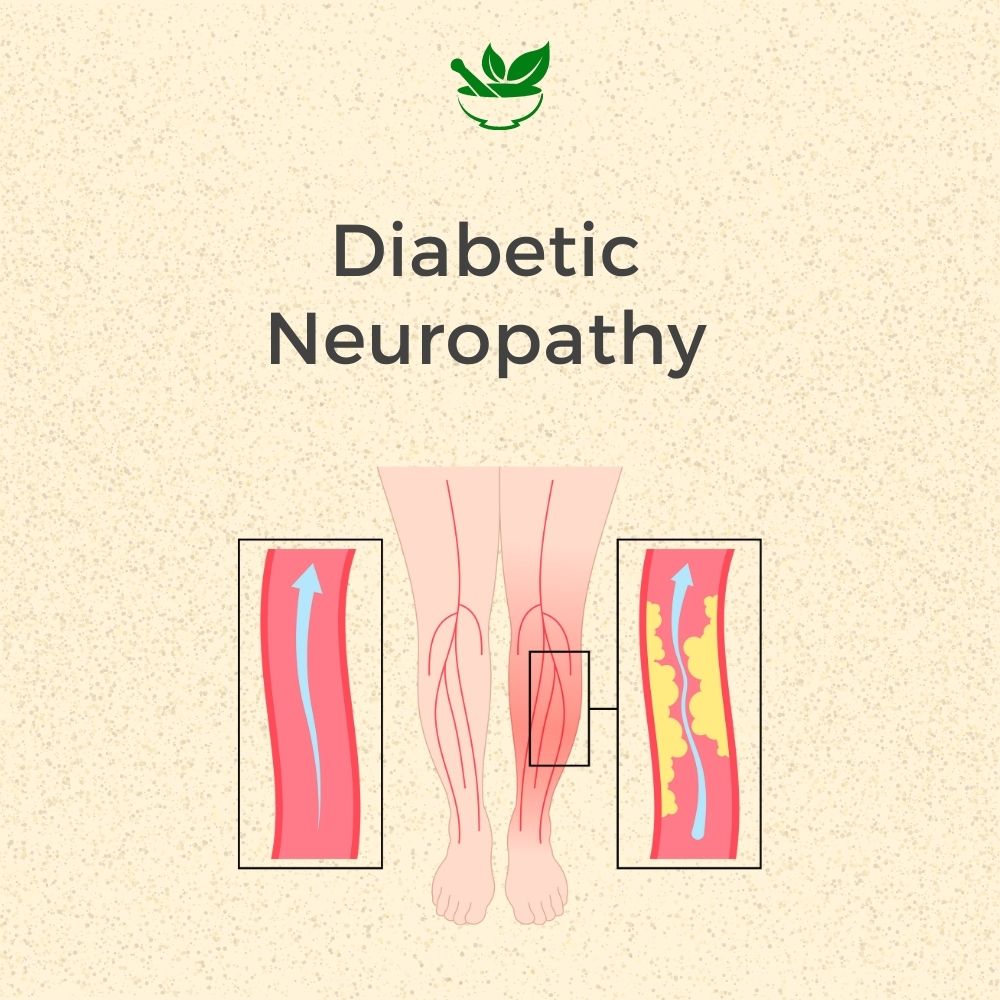
- Microangiopathy: Persistent hyperglycemia damages the small blood vessels (
vasa nervorum) that supply nutrients and oxygen to the nerves, leading to ischemic injury. - Metabolic Damage: High glucose levels trigger harmful metabolic pathways, like the polyol (sorbitol) pathway. The accumulation of sorbitol and advanced glycation end products (AGEs) causes oxidative stress, inflammation, and direct damage to nerve cells (axonal degeneration and demyelination).
2. The Ayurvedic Samprapti (Pathogenesis) of Neuropathy in Prameha
Ayurvedic classics do not describe diabetic neuropathy as a separate disease. Instead, its symptoms are detailed under the Purvarupa (prodromal signs), Rupa (symptoms), and, most importantly, the Upadrava (complications) of Prameha.
Let's start by correlating the symptoms.
Randomised controlled clinical study to evaluate the ...
This clinical study on Ayurvedic management of DPN provides a concise introduction that directly correlates modern symptoms with classical Ayurvedic terms. This helps us build a bridge between the two systems.
Please read the 'INTRODUCTION' section of this paper. Focus on the list of symptoms mentioned under Purvaroopa and Upadrava of Prameha that resemble DPN, and note the core pathological concept identified: Avarana Janya Vata Prakopa.
As the paper highlights, symptoms like:
Karapada Daha(burning sensation in hands and feet)Karapada Suptata(numbness in hands and feet)Toda(pricking/stabbing pain)Harsha/Chumchumayana(tingling sensation)Dourbalya(weakness)
...are all well-documented in Prameha. The pathology is primarily understood as a Vata Vyadhi, but its origin is complex. To understand the treatment, we must first understand the Samprapti.
A CONCEPTUAL STUDY ON DIABETIC PERIPHERAL NEUROPATHY
For a deeper dive into the pathogenesis, this conceptual review article offers a detailed explanation of the doshic interplay.
Read the section titled 'Samprapthi'. This is a critical section that explains how the Vata dosha becomes aggravated in diabetic neuropathy. Pay close attention to the concepts of Rakta dushti, Avarana janya vatakopa, and Dathukshaya janya vatakopa.
Synthesizing from these sources, the Samprapti of DN unfolds through two primary mechanisms of Vata aggravation:
-
Avarana Janya Vata Kopa(Vata Vitiation due to Obstruction):- This is the principal mechanism in most cases of Type 2 Diabetes.
- Persistent hyperglycemia (
AtiyogaofPrameha) leads to vitiation ofKapha,Pitta, and especiallyRakta(Rakta dushti). This corresponds to the modern concepts of glucotoxicity and lipotoxicity. - These vitiated
doshasanddushyas(particularlyMedaandKleda) obstruct the channels (Srotorodha). This directly correlates with microangiopathy and the occlusion of thevasa nervorum. - The natural flow of
Vata(specificallyVyana Vayu, which governs circulation and peripheral functions) is blocked. ObstructedVataaccumulates and gets aggravated, causing symptoms like pain (Toda), numbness (Suptata), and altered sensation.
-
Dhatu Kshaya Janya Vata Kopa(Vata Vitiation due to Tissue Depletion):- This is more prominent in chronic, poorly managed diabetes or in lean diabetics (
Krisha Pramehi). - The constant loss of
OjasandDhatu Sara(essence of tissues) through urine (Prabhuta Mutrata) leads to systemic tissue depletion. - As the
Dhatusdeplete, the space within the body increases, which is a direct cause for the aggravation of the light, mobileVata dosha. This leads to degenerative changes, weakness (Dourbalya), and wasting (Shosha).
- This is more prominent in chronic, poorly managed diabetes or in lean diabetics (
Therefore, diabetic neuropathy is conceptualized as a Vata-pradhana Tridoshaja Vyadhi with significant involvement of Rakta dushti and Srotorodha.
Test your understanding!
A patient with diabetic neuropathy complains of intense burning sensations (Daha) in the feet, which worsens at night. Which doshas are primarily implicated in this specific symptom, based on the Samprapti we just discussed?
Show answer
The primary doshas are Vata and Pitta.
Vatais the root cause of all neurological sensations and pain (Toda,Supti, etc.).Pittais responsible for theUshna(hot) quality and the specific sensation ofDaha(burning).
TheSampraptioften involves vitiatedVatacarryingPittafrom its normal site and depositing it in the peripheral tissues (Twak), causing localized inflammation and burning. This is further supported by the modern understanding of inflammation playing a key role in neuropathic pain.
3. Ayurvedic Management & Correlation with Modern Neuroprotection
The management of diabetic neuropathy in Ayurveda is not merely about suppressing symptoms. It is a systematic approach aimed at breaking the Samprapti. Since this is a Vata Vyadhi arising from Avarana, the treatment principle is not just Vata-shamana. The primary strategy is to remove the obstruction first.
This involves:
Kapha-Medohara(to reduceKaphaand fat)Srotoshodhana(to clear the channels)Rakta Prasadana(to purify the blood)
Once the Avarana is reduced, Vatahara (Vata-pacifying) and Rasayana (rejuvenating/neuro-regenerative) therapies are employed.
Let's explore the specific therapies and their neuroprotective rationale.
A CONCEPTUAL STUDY ON DIABETIC PERIPHERAL NEUROPATHY
The conceptual study on DPN we reviewed earlier also provides an excellent, structured breakdown of the treatment modalities.
Please scan through the 'Treatment' section, starting from 'Anthaparimarjana Chikitsa' to 'Bahiparimarjana Chikitsa'. You don't need to memorize every formulation. Instead, focus on understanding the types of treatments suggested for internal and external use, such as: Internal (Anthaparimarjana): The roles of Snehana, Virechana, Vasti, and Rasayana. External (Bahiparimarjana): The purpose of Parisheka (dhara), Upanaha, Udwartana, and Abhyanga.
A. Anthaparimarjana (Internal Therapies) and Neuroprotection
-
Shamana Chikitsa(Palliative Therapy): This is the first line of internal management.- Action: Formulations with
Tikta(bitter) andKashaya(astringent)Rasaare used. These properties areKapha-Medoharaand help inKleda Upashoshana(drying up excess moisture/metabolic waste). - Example: The clinical study on
Rajanidvandvadi Kwatha(LINK) showed it improved symptoms likeDahaandToda. Its ingredients (Haridra,Daruharidra, etc.) possess these qualities. - Neuroprotective Correlation: The
Kapha-MedoharaandLekhana(scraping) actions can be correlated with improving insulin sensitivity and reducing the inflammatory state associated with metabolic syndrome. Herbs likeHaridra(Curcumin) are potent anti-inflammatories, directly counteracting the inflammatory aspect of nerve damage.
- Action: Formulations with
-
Rasayana Chikitsa(Rejuvenation Therapy): This is the core of Ayurvedic neuroprotection and neuro-regeneration.- Action: After clearing the channels,
Rasayanadrugs are used to nourish and strengthen theDhatus, particularly theMajja Dhatu(nervous tissue). - Examples:
Guduchi,Amalaki,Ashwagandha,Shilajatu, and formulations likeKsheerabala Taila(used internally) are excellent nerve tonics (Nadibalya). - Neuroprotective Correlation:
- Antioxidant Effect:
RasayanaslikeAmalakiandAshwagandhaare rich in antioxidants, which directly combat the oxidative stress caused by AGEs and the sorbitol pathway, thus protecting nerve cells from further damage. - Nerve Regeneration: These therapies are believed to promote the repair and regeneration of damaged tissues. This aligns with the modern goal of finding agents that can support axonal regeneration and remyelination.
- Antioxidant Effect:
- Action: After clearing the channels,
B. Bahiparimarjana (External Therapies) and Neuroprotection
External therapies are crucial for providing symptomatic relief and improving local tissue health.
-
Parisheka / Dhara(Stream-pouring of medicated liquids):- Action: Continuous pouring of liquids like
Dhanyamla(fermented grain liquid), medicated milk (Ksheera), or buttermilk (Takra) over the affected limbs. - Neuroprotective Correlation: This procedure improves local microcirculation (
Srotoshodhana), reduces inflammation, and provides immediate relief from burning and pain. The improved blood flow helps clear metabolic byproducts and deliver more oxygen to the nerves, addressing the ischemic component of DN.
- Action: Continuous pouring of liquids like
-
Abhyanga(Medicated Oil Massage):- Action: Massaging with specific oils chosen based on symptoms.
Pinda TailaorChandanadi Tailafor burning (Daha), andSahacharadi TailaorKsheerabala Tailafor numbness and stiffness. - Neuroprotective Correlation: Massage stimulates peripheral nerves and improves blood flow. The lipid base of the oil helps deliver the active herbal compounds transdermally. It pacifies
Vatalocally, corresponding to a reduction in neuropathic pain signals.
- Action: Massaging with specific oils chosen based on symptoms.
Conclusion
Today we have dissected the complex issue of diabetic neuropathy from two powerful perspectives. We have seen that Ayurveda's understanding, while framed in the language of Doshas and Srotas, has remarkable parallels with modern pathophysiology.
Key Takeaways:
- Diabetic neuropathy is understood in Ayurveda as a
Vata-pradhanacomplication ofPrameha, driven byAvarana(obstruction byKapha/Pitta/Rakta) andDhatu Kshaya(tissue depletion). - The Ayurvedic
SampraptiinvolvingSrotorodhaandRakta Dushtistrongly correlates with the modern understanding of microangiopathy, inflammation, and metabolic damage. - Ayurvedic management is a sophisticated, multi-step process: it first aims to clear the obstruction (
Avarana) and then focuses on pacifyingVataand rejuvenating nerve tissue (Rasayana). - Ayurvedic interventions like
Shamanaherbs,Rasayanas, and external therapies (Dhara,Abhyanga) offer neuroprotective benefits through anti-inflammatory, antioxidant, circulation-enhancing, and neuro-regenerative mechanisms.
Preview of the Next Lesson:
In this lesson, we analyzed a clinical study as part of our exploration. This serves as a perfect lead-in to our next topic. In the upcoming lesson, we will focus on how to systematically apply research evidence to select optimal herbal formulations for glycemic control, generalizing the evidence-based approach we touched upon today to the broader management of Madhumeha.