Welcome back. In our last lesson, we analyzed the Ayurvedic and modern perspectives on diabetic neuropathy, looking at how a single clinical trial could provide evidence for a specific formulation. We saw that understanding the underlying pathology—whether Avarana or Dhatu Kshaya—is key to treatment.
Today, we will broaden our lens from a single complication to the primary goal of managing Madhumeha: glycemic control. Our learning outcome is to apply research evidence to select optimal herbal formulations for glycemic control. We will move up the evidence hierarchy from individual studies to systematic reviews, learning how to critically evaluate and use high-level evidence to make more robust clinical decisions. This is central to your goal of building an evidence-based practice that integrates classical wisdom with modern scientific validation.
1. From a Single Study to a Body of Evidence
In the previous lesson, we examined a single Randomized Controlled Trial (RCT). While valuable, an RCT provides just one piece of the puzzle. To make confident clinical choices, we need to consider the entire body of available research. This is where systematic reviews and meta-analyses come in.
- Systematic Review: A structured process of identifying, appraising, and synthesizing all relevant studies on a specific topic.
- Meta-Analysis: A statistical technique used within a systematic review to combine the results of multiple studies, providing a more precise estimate of a treatment's effect.
Think of it this way: a single RCT is one expert's opinion, whereas a meta-analysis is the consensus of a panel of experts after reviewing all the data. It provides a more powerful and reliable foundation for decision-making.
Today, we will dissect a major systematic review and meta-analysis to see what the collective evidence says about anti-diabetic Ayurvedic herbs.
2. Selecting Single Herbs Based on High-Level Evidence
Let's dive into a comprehensive review that synthesized data from nearly 200 RCTs. This is the kind of high-quality evidence that can genuinely guide our selection of Dravyas.
Effectiveness and Safety of Ayurvedic Medicines in Type 2 ...
This paper, 'Effectiveness and Safety of Ayurvedic Medicines in Type 2 Diabetes Mellitus Management' from Frontiers in Pharmacology, is a landmark systematic review and meta-analysis. It summarizes the evidence from 199 RCTs involving over 21,000 participants. It's the most robust summary of evidence we have on this topic.
First, read the 'Results' in the abstract (section 0) to get a quick overview of the key findings. Then, dive into the main results in the body of the paper. Focus on the section titled '5.5 Effects of Interventions'. You do not need to read about every single herb. Pay close attention to the herbs that show a statistically significant reduction in Glycated Hemoglobin (HbA1c) and Fasting Blood Glucose (FBG). Note the mean difference (MD) reported for each.
This review found that many herbs demonstrated a beneficial effect. The US FDA considers a reduction in HbA1c of 0.3% to 0.4% to be clinically meaningful. Several Ayurvedic Dravyas met or significantly exceeded this benchmark.
Here is a summary of some of the most effective single herbs for glycemic control, based on the meta-analysis:
| Ayurvedic Name | Botanical Name | Mean HbA1c Reduction (%) | Mean FBG Reduction (mg/dl) | Other Notable Effects |
|---|---|---|---|---|
Bael |
Aegle marmelos | -1.6% | -56 | Significant reduction in PPBG and BMI |
Stinging Nettle |
Urtica dioica | -1.3% | - | Significant reduction in PPBG |
Gudmar |
Gymnema sylvestre¹ | - | - | Well-known for glucose absorption inhibition |
Neem |
Azadirachta indica | -1.0% | -8 | Reduces PPBG and insulin resistance |
Guduchi |
Tinospora cordifolia | -0.5% | -4 | Reduces PPBG |
Methika |
Trigonella foenum-graecum | -0.6% | -14 | Reduces PPBG, insulin resistance, BMI, and TG |
Karela |
Momordica charantia | -0.3% | -14 | Reduces PPBG and fasting insulin |
Isabgola |
Plantago ovata | -0.9% | -32 | Reduces insulin resistance, increases HDL |
Haridra |
Curcuma longa | - | -10 | Reduces fasting insulin, TC, and LDL |
¹Note: While Gymnema sylvestre is a famous anti-diabetic herb, it wasn't included in the meta-analysis section of this specific paper, likely due to a lack of sufficient RCTs meeting the inclusion criteria for pooling data at the time. Its mechanism is still highly relevant.
Applying the Evidence:
This data allows us to move beyond simply knowing that an herb is "for diabetes." We can start to quantify and compare. For instance, the evidence suggests Bael (Aegle marmelos) has a particularly potent effect on HbA1c, while Methika (Trigonella foenum-graecum) shows a broader benefit across multiple metabolic parameters, including blood glucose, insulin resistance, and lipids.
This level of detail is crucial for personalizing treatment. For a patient whose primary issue is severe hyperglycemia, Bael might be a strong candidate. For a patient with metabolic syndrome characteristics (hyperglycemia, dyslipidemia, and obesity), Methika appears to be an excellent, multifaceted choice.
Test your understanding!
A patient has an HbA1c of 8.5% and also has elevated triglycerides. Based on the summary table above, you are considering either Guduchi (Tinospora cordifolia) or Methika (Trigonella foenum-graecum) as a primary single-herb intervention. Which one does the evidence suggest might be more suitable, and why?
Show answer
Based on the evidence from the meta-analysis, Methika (Trigonella foenum-graecum) would be a more suitable choice.
Here's the reasoning:
- Glycemic Control: Both show a clinically significant reduction in HbA1c, but
Methika's effect is slightly greater (-0.6% vs. -0.5% forGuduchi). - Lipid Profile: The key differentiator is the effect on lipids. The table shows
Methikasignificantly reduces triglycerides (TG), which directly addresses the patient's comorbidity. The data forGuduchiin the table does not mention a similar effect. - Broader Action:
Methikaalso shows benefits for insulin resistance and BMI, making it a more comprehensive agent for metabolic syndrome.
3. The Synergy of Polyherbal Formulations
While analyzing single herbs is a powerful bottom-up approach, Ayurvedic practice is renowned for its use of Yoga (formulations). Polyherbalism is not just a matter of mixing ingredients; it's based on the principle of synergy.
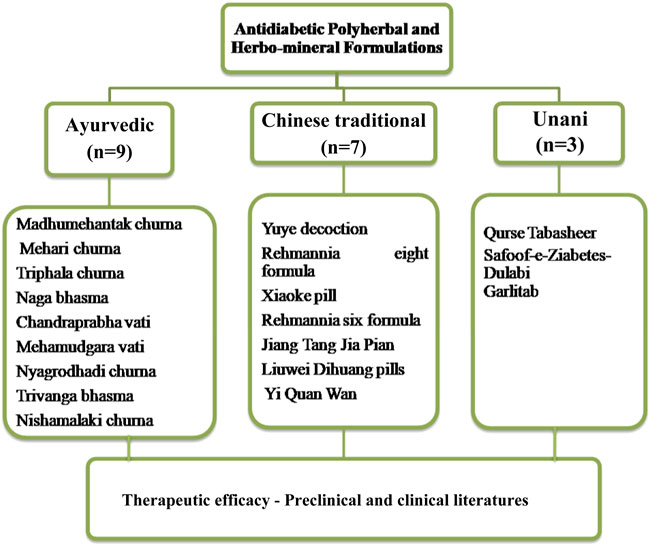
Let's explore the rationale and evidence behind using these complex formulations.
Anti-diabetic Potential of Traditional Herbal Drugs in Polyherbal Formulation
This review article, 'Anti-diabetic Potential of Traditional Herbal Drugs in Polyherbal Formulation,' provides an excellent overview of the 'why' behind polyherbalism in the context of diabetes.
Please read the following sections to understand the concept and application of polyherbal formulations: Section 2.1, 'Concept and Rationale of Polyherbal Formulations': Focus on the principles of synergy and how combining herbs can enhance therapeutic effects while reducing adverse effects. Table 1, 'Some Important Herbs Possessing Potential Anti-Diabetic Activity': Quickly scan this table. You'll recognize many herbs from our first resource. Notice the 'Mechanism of Action' column, which adds another layer to our understanding. Section 4, 'Various Other Molecular Pathways': You don't need to memorize the pathways, but appreciate how polyherbal formulations can target multiple pathological mechanisms (e.g., inflammation via the JNK pathway, oxidative stress via the Nrf-2 pathway, glucose reabsorption via SGLT2 inhibition). Tables 2, 3, and 5: Briefly look over these tables to see examples of preclinical studies, clinical trials, and commercially available formulations that have been evaluated.
The key principles of using polyherbal formulations for glycemic control are:
-
Multi-Target Action: Diabetes (
Prameha) is a complex disease (Tridoshaja) with a multi-facetedSamprapti. A polyherbal formulation can address different aspects of the pathogenesis simultaneously. For example, a formulation might contain:- One herb to enhance insulin secretion (e.g.,
Methika). - Another to reduce intestinal glucose absorption (e.g.,
Gudmar). - A third to protect the liver and improve metabolism (e.g.,
Amalaki). - A fourth to act as an antioxidant and anti-inflammatory (e.g.,
Haridra).
- One herb to enhance insulin secretion (e.g.,
-
Synergy (
Samyoga): The combination of herbs can produce a greater effect than any single herb alone. A classic example isNishamalaki(Nisha- Haridra,Amalaki- Emblica officinalis).Amalakiis a potentRasayanaand antioxidant, whileHaridrais a powerful anti-inflammatory andPramehaharaagent. Together, they create a highly effective and balanced formulation for long-term diabetes management. -
Bioavailability Enhancement: Some herbs can enhance the absorption and efficacy of others, a concept known as
Yogavahi. For instance,Trikatu(Pippali, Maricha, Shunti) is often included in formulations to improve the digestion and bioavailability of the main active herbs.
When selecting a polyherbal formulation, an evidence-based approach involves not only looking at trials on the final product but also understanding the evidence for its individual components and their synergistic rationale based on classical principles.
Conclusion
Today, we have elevated our evidence-based approach to selecting therapies for Prameha. By learning to interpret and apply data from a meta-analysis, you can now make more precise and justifiable decisions about which herbal interventions are most likely to succeed.
Key Takeaways:
- Systematic reviews and meta-analyses provide the highest level of evidence for treatment effectiveness, aggregating data from multiple studies.
- The evidence strongly supports several single Ayurvedic herbs for significant glycemic control, with
Bael,Urtica dioica,Neem, andMethikashowing particularly robust effects on HbA1c. - Selecting an "optimal" herb involves considering the magnitude of its effect (e.g., % HbA1c reduction) and its action on related comorbidities (like dyslipidemia or obesity).
- Polyherbal formulations are a cornerstone of Ayurveda, offering multi-target action and synergistic effects that are often necessary to address the complex
SampraptiofPrameha.
Preview of the Next Lesson:
We have now spent considerable time on Prameha/Diabetes. We will now shift our focus to another critical component of metabolic syndrome that you are interested in. In our next lesson, we will begin our study of obesity with the learning outcome: Analyze Medoroga (obesity) pathogenesis and its correlation with metabolic syndrome. This will allow us to build a comprehensive Ayurvedic understanding of these interrelated metabolic disorders.