Hello! Welcome to our new module focusing on obesity and dyslipidemia. In our last module, we explored Prameha and its correlation with diabetes. Now, we will delve into Medoroga (obesity), a condition that is often a precursor to or coexists with the metabolic disturbances we've discussed.
This lesson is designed to meet the learning outcome: Analyze Medoroga (obesity) pathogenesis and its correlation with metabolic syndrome. We will dissect the Ayurvedic pathogenesis (Samprapti) of Medoroga and draw clear parallels with the modern clinical entity known as metabolic syndrome. This will provide you with an integrated framework for understanding one of today's most prevalent health challenges.
1. The Modern Perspective: What is Metabolic Syndrome?
Before we explore the Ayurvedic view, let's establish a clear understanding of metabolic syndrome from a modern perspective. It's not a single disease, but a cluster of risk factors that significantly increase the likelihood of developing cardiovascular disease and type 2 diabetes.
To get a quick and precise overview, please watch the following animated video.
This short video from Alila Medical Media provides a concise definition of metabolic syndrome, its diagnostic criteria, and its primary underlying cause.
Please watch the video from the beginning until 01:50. Pay close attention to the five specific criteria used for diagnosis and the central role of insulin resistance.
As the video explains, a diagnosis of metabolic syndrome is made when a person has at least three of the following five conditions:
- Central Obesity: An enlarged waistline (≥40 inches for men, ≥35 inches for women).
- High Blood Pressure (Hypertension): ≥130/85 mmHg or taking medication for hypertension.
- High Fasting Blood Sugar (Hyperglycemia): ≥100 mg/dL or taking medication for high blood sugar.
- High Triglycerides: ≥150 mg/dL.
- Low HDL Cholesterol: <40 mg/dL for men or <50 mg/dL for women.
The video also highlights insulin resistance as the most important underlying risk factor. This is a key concept we will revisit when we analyze the Ayurvedic pathogenesis.
2. Medoroga: The Ayurvedic Concept of Obesity
Ayurveda has described a similar condition for millennia, known as Medoroga or Sthaulya (obesity). It's considered one of the eight "undesirable conditions" (Ashta Nindita Purusha) due to its potential to cause severe complications.
Let's explore its classical definition and causes. Please read the following sections from the Standard Treatment Guidelines in Ayurveda on Metabolic Disorders.
management of metabolic disorders
This document from Yenepoya Ayurveda Medical College & Hospital provides a detailed classical description of Sthoulya (Obesity), including its causes.
Please read the sections 'OBESITY' (definition) and 'A. Nidana' (etiology). You'll find these on pages 83 and 84 of the PDF. Focus on the definitions from Charaka and the categorization of causes (Aharatmaka, Viharatmaka, etc.).
As you've read, Acharya Charaka defines an Atisthula (obese) person as one with excessive accumulation of Meda (fat) and Mamsa (muscle) leading to pendulous buttocks, belly, and breasts, and a lack of enthusiasm.
The causes (Nidana) are remarkably similar to the risk factors for modern metabolic syndrome:
- Aharatmaka Hetu (Dietary Factors): Overeating (Atibhojana), eating before the previous meal is digested (Adhyashana), and excessive consumption of foods with Madhura (sweet), Snigdha (unctuous), and Guru (heavy) qualities.
- Viharatmaka Hetu (Lifestyle Factors): Lack of exercise (Avyayama) and daytime sleep (Divaswapna).
- Manasika Hetu (Psychological Factors): Absence of mental engagement (Achintana) and constant pleasure-seeking (Harshanitya).
- Anya Hetu (Other Factors): Genetic predisposition (Beeja Svabhava).
3. The Pathogenesis (Samprapti) of Medoroga
Understanding how these causes lead to the disease state is crucial. The Samprapti of Medoroga is a fascinating cascade that explains many of its seemingly contradictory symptoms.
Please read the following section from the same guidelines document.
management of metabolic disorders
This section explains the unique pathogenic cycle of Medoroga and lists its key components (Samprapti Ghataka).
Read the sections 'C. Samprapti' and 'D. Samprapti Ghataka' on page 85. Focus on the role of Meda in obstructing Vata and the paradoxical effect this has on Agni.
The pathogenesis can be summarized as a vicious cycle:
- Initial Accumulation: Due to the Nidanas, there is an increase in Kapha Dosha and accumulation of Meda Dhatu.
- Srotorodha (Channel Obstruction): This excessive, poor-quality Meda obstructs the body's channels (Srotas).
- Vata Avarana (Vata Occlusion): This obstruction traps Vata Dosha, particularly Samana Vata which governs digestion, within the gastrointestinal tract (Koshtha).
- Paradoxical Agni Stimulation: The confined Vata acts like a bellows, fanning the digestive fire (Jatharagni) and making it intensely strong (Tikshnagni).
- Increased Appetite and Digestion: This leads to excessive hunger (Atikshudha) and rapid digestion of food.
- Vicious Cycle: The individual eats more to satisfy this intense hunger, which only leads to the creation of more unstable, improperly formed Meda Dhatu, further worsening the obstruction and perpetuating the cycle.
The Samprapti Ghatakas clearly outline the key players:
- Dosha: Primarily Kapha (vitiation) and Vata (occlusion).
- Dushya: Meda (the primary tissue affected).
- Agni: Jatharagni (paradoxically increased) and Medodhatvagni (impaired).
- Srotas: Medovaha Srotas (channels carrying fat tissue).
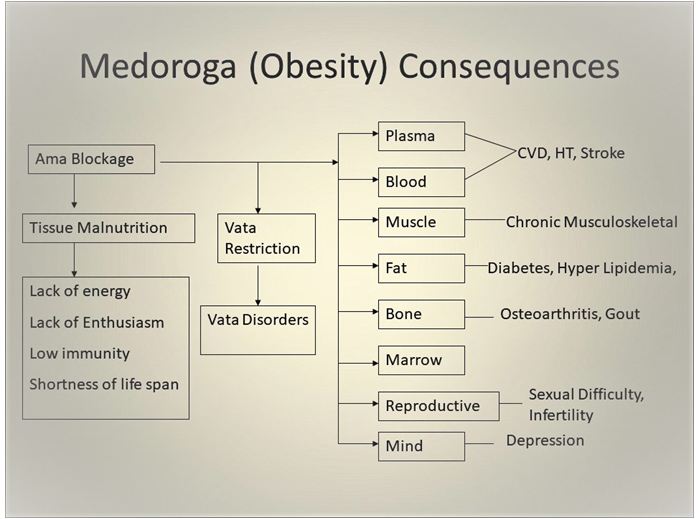
This pathogenic process is visually summarized in the flowchart below.
Test your understanding!
A patient with Medoroga reports feeling intense hunger (Atikshudha) and a ravenous appetite, which seems contrary to the sluggish metabolic state suggested by their obesity and lethargy. Based on the Samprapti of Medoroga, explain this phenomenon.
Show answer
This paradoxical symptom is a hallmark of Medoroga Samprapti. The excessive and abnormal Meda Dhatu causes Srotorodha (channel obstruction). This obstruction traps Vata Dosha (specifically Samana Vata) in the Koshtha (GI tract). The trapped Vata then abnormally stimulates the Jatharagni (digestive fire), leading to a state of Tikshnagni (intensely strong fire). This results in the symptoms of excessive hunger and a powerful appetite, even though the tissue-level metabolism (Dhatvagni), especially Medodhatvagni, is impaired.
4. Bridging the Gap: Correlating Medoroga with Metabolic Syndrome
Now, let's explicitly connect the Ayurvedic pathogenesis to the components of metabolic syndrome. A key concept that helps bridge this gap is the distinction between two types of pathological Meda.
To explore this in depth, please read the following research article, which provides an excellent synthesis of Ayurvedic and modern concepts.
WORLD JOURNAL OF PHARMACEUTICAL RESEARCH
This article from the World Journal of Pharmaceutical Research provides a detailed correlation between the Samprapti of Medoroga and the pathophysiology of dyslipidemia and metabolic syndrome.
Please read the sections titled 'PATHOGENESIS (SAMPRAPTI) OF MEDOROGA WITH CORRELATION TO DYSLIPIDEMIA', 'Clinical Progression of Medoroga', and 'DISCUSSION'. Pay special attention to the concepts of Baddha Meda and Abaddha Meda and how they correspond to obesity and dyslipidemia, respectively.
The article you just read introduces two crucial terms:
- Baddha Meda: "Bound fat," which correlates with the excessive stored adipose tissue seen in central obesity.
- Abaddha Meda: "Unbound fat," which can be understood as the circulating pathological lipids. This directly correlates with dyslipidemia—high triglycerides and low HDL cholesterol.
With this framework, we can create a clear correlation map:
| Ayurvedic Concept | Modern Correlate in Metabolic Syndrome |
|---|---|
| Sthaulya / Baddha Meda Vriddhi | Central Obesity (increased waist circumference) |
| Abaddha Meda Vriddhi | Dyslipidemia (High Triglycerides, Low HDL) |
| Medodhatvagni Mandya (impaired tissue metabolism) | Insulin Resistance, Impaired Glucose Metabolism |
| Upadrava of Prameha (complication of diabetes) | Hyperglycemia / Type 2 Diabetes Mellitus |
| Srotorodha affecting Rasa and Rakta channels | Hypertension, Endothelial Dysfunction, Atherosclerosis |
| Tikshnagni from Vata Avarana | Appetite Dysregulation (similar to leptin resistance) |
Furthermore, the "Standard Treatment Guidelines" document (LINK) you read earlier lists the modern complications of obesity under the 'Comorbidities and Complications' section (page 89). You will see it explicitly lists Metabolic Syndrome, Dyslipidemia, and Type 2 Diabetes Mellitus, confirming the Ayurvedic observation of Upadravas (complications) with modern clinical data.
Conclusion
In this lesson, we have analyzed the intricate pathogenesis of Medoroga and established its strong correlation with modern metabolic syndrome.
Here are the key takeaways:
- Medoroga is a complex metabolic disorder, not just an issue of excess weight. Its Ayurvedic equivalent, Sthaulya, is defined by pathological accumulation of Meda Dhatu.
- The Samprapti of Medoroga is a self-perpetuating cycle of Srotorodha (channel blockage), which leads to Vata Avarana (occlusion), causing a paradoxical increase in Jatharagni (Tikshnagni) and excessive hunger.
- The Ayurvedic concepts of Baddha Meda (stored fat) and Abaddha Meda (circulating lipids) provide a sophisticated framework for understanding both the physical obesity and the associated dyslipidemia seen in metabolic syndrome.
- The complications (Upadravas) of Medoroga, such as Prameha, are directly analogous to the diagnostic criteria and consequences of metabolic syndrome, including hyperglycemia and cardiovascular disease.
By understanding this integrated model, you are now better equipped to analyze the root causes of obesity and its systemic effects from both a classical and a contemporary scientific viewpoint.
In our next lesson, we will build upon this foundation to evaluate Lekhana and Medohara Dravyas (e.g., Guggulu, Triphala, Shilajatu) for weight management. We will explore how these classical herbs work to break the pathogenic cycle we've just discussed.