Hello, and welcome to our lesson.
In our last session, we analyzed Samskara as a form of ancient pharmaceutical engineering, seeing how processes like Bhāvana modify a drug's properties before administration to enhance its pharmacokinetic profile. We saw how these techniques could be understood as precursors to modern nanomedicine and targeted drug delivery.
Today, we will explore another layer of Ayurvedic therapeutic precision. Instead of modifying the drug in the pharmacy, we will focus on how its action can be modulated at the time of administration. Our learning outcome is to compare Anupana (adjuvant) effects with modern concepts of drug absorption and metabolism. This will connect a cornerstone of Ayurvedic prescription with the science of how drugs journey through the body, a field known as pharmacokinetics.
1. Recapping Pharmacokinetics: The ADME Framework
As a quick refresher, the effect of any drug is governed by its pharmacokinetics—what the body does to the drug. This is often summarized by the acronym ADME:
- Absorption: The drug moves from the site of administration into the blood.
- Distribution: The drug is transported from the blood to various tissues and organs.
- Metabolism: The drug is chemically transformed by the body (primarily in the liver) into active or inactive compounds.
- Excretion: The drug and its metabolites are eliminated from the body.
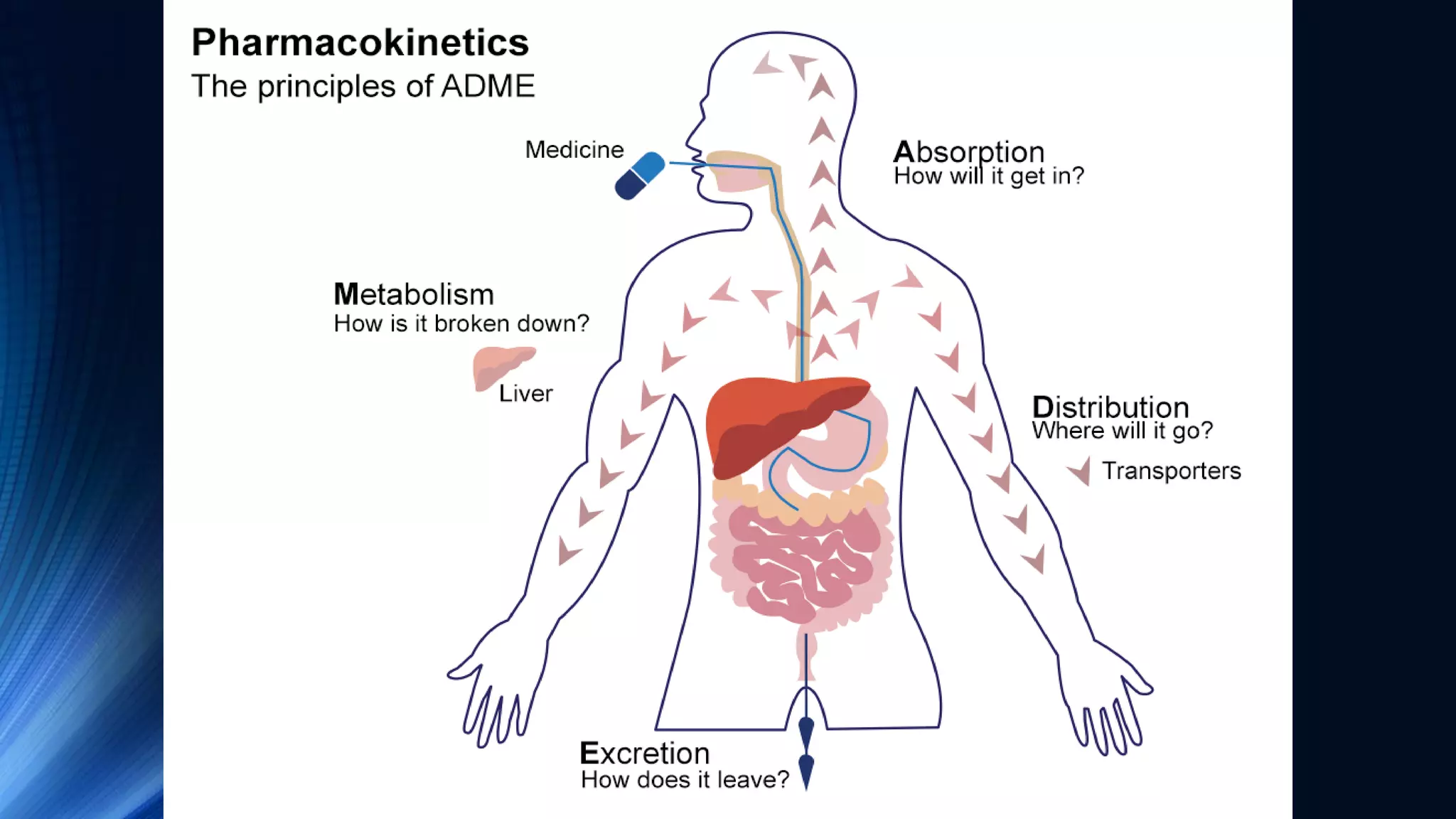
The ultimate goal of drug delivery is to ensure that an adequate concentration of the active substance reaches its target site. Ayurveda developed a sophisticated method to achieve this using Anupana.
2. Anupana: The Classical Concept
From your BAMS studies, you know Anupana as the vehicle or adjuvant administered with or after a medicine (Aushadha) or food (Ahara). Classical texts describe its function with a simple yet profound simile:
Just as a drop of oil spreads rapidly over the surface of water, a medicine administered with the correct Anupana quickly pervades the body.
This tells us that Anupana is not a passive carrier. It is an active and intelligent component of the prescription, designed to facilitate the drug's journey and action. To understand how, we need to bridge this classical concept with modern pharmacology.
Let's begin by reading a short paper that introduces Anupana and immediately frames it in a modern context, even drawing a parallel to a cutting-edge pharmaceutical technology.
Anupana:TheSilentArchitectOfAyurvedicPharmacodynamics
The paper 'Anupana: The Silent Architect Of Ayurvedic Pharmacodynamics' provides an excellent overview. We'll start by reading the sections that define Anupana and link it to modern concepts.
Please read the following sections: Start with the 'INTRODUCTION' and 'DEFINING THE VEHICLE' sections to refresh the classical concept. Next, read the section 'UNLOCKING DRUG DESTINY: ANUPANA’S MECHANISTIC ROLE'. Focus on the definitions of 'Bio-Enhancing activity' and 'Yogavahi action'. Finally, read the section 'COCRYSTALS AS A TECHNOLOGICAL PARALLEL TO ANUPANA'. This presents a powerful modern analogy. As you read, consider how Anupana is being reframed from a simple 'vehicle' to a functional 'bio-enhancer'.
3. Anupana as a Bioavailability Enhancer
As highlighted in the reading, the classical role of Anupana directly corresponds to the modern concept of a bioavailability enhancer.
Bioavailability is the proportion of a drug that enters the systemic circulation after administration and is able to have an active effect. For orally administered drugs, bioavailability can be quite low due to incomplete absorption or extensive first-pass metabolism in the liver.
An Anupana functions as a bio-enhancer by:
- Increasing the absorption of the main drug from the gut.
- Protecting the drug from being metabolized too quickly.
This leads to several key therapeutic advantages:
- Increased Efficacy: A higher concentration of the drug reaches the target tissues.
- Dose Reduction: A smaller dose of the main drug is needed to achieve the desired effect.
- Reduced Toxicity & Side Effects: Lower doses mean less risk of adverse reactions.
4. Decoding the Mechanisms: How Anupana Influences ADME
Now, let's delve into the specific mechanisms through which Anupana enhances bioavailability, using a second, more detailed research article.
An appraisal of the bioavailability enhancers in Ayurveda ...
The paper 'An appraisal of the bioavailability enhancers in Ayurveda...' details the specific scientific mechanisms behind these effects. We will focus on the sections explaining how these enhancers work.
Please read the following sections: Read the section 'Yogavahi' and the subsection 'Recent scientific evidences for bio-enhancing effect of Pippali (piperine)'. This is a critical section detailing the action of piperine. Briefly review the short section on 'Anupana'. Finally, read the section 'Mechanisms of action of herbal bio-enhancers' for a concise summary of the different ways these substances work. Pay close attention to the names of the enzymes and transporters mentioned, like CYP3A4 and P-glycoprotein.
Based on these readings, we can map the actions of Anupana directly onto the ADME framework.
A. Enhancing Absorption
Anupanas can improve how much of a drug is absorbed from the gastrointestinal tract in several ways:
- Increased Solubility: Many herbal active compounds are poorly soluble in water. An Anupana like ghrita (clarified butter) or tila taila (sesame oil) provides a lipid medium, increasing the solubility of lipophilic (fat-soluble) drugs and facilitating their passage across the lipid-rich cell membranes of the gut lining.
- Increased Blood Flow: Some Anupanas, particularly those with Ushna Veerya like ginger juice or honey, can cause local vasodilation in the gut. This increases blood supply to the area, creating a steeper concentration gradient that drives more drug from the intestine into the bloodstream.
- Altering Membrane Permeability: Certain compounds within Anupanas can temporarily and reversibly alter the structure of the gut's epithelial cell membranes, making them more permeable to the main drug.
B. Modifying Metabolism (Inhibiting First-Pass Effect)
This is perhaps the most significant mechanism. The liver is equipped with a family of enzymes called the Cytochrome P450 (CYP450) system, which metabolizes and detoxifies foreign substances, including drugs. CYP3A4 is one of the most important of these enzymes. Additionally, the gut wall contains an efflux pump called P-glycoprotein (P-gp) that actively pushes drugs back into the intestinal lumen, preventing their absorption.
Many Anupanas act as potent inhibitors of these systems:
- The Piperine Example: Pippali (Piper longum), a key component of Trikatu and a common Anupana, contains the alkaloid piperine. Research has conclusively shown that piperine inhibits both CYP3A4 and P-gp.
- By inhibiting CYP3A4, piperine reduces the breakdown of co-administered drugs in the liver (the first-pass effect).
- By inhibiting P-gp, it prevents the drug from being pumped out of the intestinal cells.
- The result is a dramatic increase in the bioavailability of the main drug. This is why Pippali is a classic Yogavahi—it "carries" other drugs, enhancing their effect.
This mechanism is not limited to piperine. Quercetin (found in citrus) and glycyrrhizin (from Yashtimadhu) have similar bio-enhancing properties.
Test your understanding!
A patient with a metabolic disorder is taking Glibenclamide, a conventional anti-diabetic drug. You know from modern pharmacology that this drug is metabolized by the CYP450 enzyme system. You consider prescribing an Ayurvedic formula that includes Trikatu as a Deepana-Pachana agent. Based on what you've learned about Anupana and bio-enhancers, what potential interaction should you be aware of?
Show answer
The Trikatu in the formula contains Pippali (piperine), a known inhibitor of the CYP450 system (specifically CYP3A4). Glibenclamide is metabolized by this same system. Therefore, co-administering Trikatu could inhibit the metabolism of Glibenclamide, causing its levels in the blood to rise unexpectedly. This could potentiate its glucose-lowering effect, potentially leading to hypoglycemia. This is a classic herb-drug interaction that illustrates the powerful metabolic effects of substances used as Anupanas. It highlights the need to consider these mechanisms in an integrative practice.
5. A Modern Parallel: Anupana and Pharmaceutical Cocrystals
The brilliance of the Anupana concept is further highlighted by its parallel in modern drug development. As mentioned in the first reading, a new technology called pharmaceutical cocrystals is gaining traction.
- Cocrystals are crystalline structures where an Active Pharmaceutical Ingredient (API) is combined with a pharmaceutically acceptable "coformer."
- The coformer interacts with the API through non-covalent bonds (like hydrogen bonds). It doesn't change the drug's chemical structure, but it alters its physical properties, such as solubility and dissolution rate.
- The goal is to take a poorly soluble drug (BCS Class II/IV) and, by pairing it with the right coformer, make it more bioavailable.
This is precisely what Anupana does. The main drug (Aushadha) is the API, and the Anupana acts as the coformer. The combination enhances the absorption and bioavailability of the drug without chemically altering it, echoing an ancient Ayurvedic principle in modern pharmaceutical science.
Conclusion
Today, we have deconstructed the classical concept of Anupana and reassembled it using the language of modern pharmacokinetics. It is far more than a simple liquid to help swallow a pill; it is a functional, intelligent component of therapy.
Key Takeaways:
- Anupana is a classical Ayurvedic concept that functions as a modern bioavailability enhancer.
- Its primary mechanisms involve enhancing absorption (by increasing solubility and gut permeability) and modifying metabolism (by inhibiting drug-metabolizing enzymes like CYP3A4 and efflux pumps like P-gp).
- The action of Pippali (piperine) as a Yogavahi is a well-documented example of inhibiting first-pass metabolism, leading to increased drug efficacy.
- Modern pharmaceutical technologies like cocrystals work on a principle analogous to Anupana, validating the scientific sophistication of this ancient practice.
Preview of the Next Lesson:
We have now discussed how to process a raw drug (Samskara) and how to ensure its optimal delivery in the body (Anupana). But how do we guarantee the quality and authenticity of the raw drug to begin with? In our next lesson, we will address this by learning to interpret pharmacognostic and phytochemical standards for quality assessment of raw drugs.