Welcome to our next lesson.
In our previous session, we explored how the inherent potency of a drug, its Veerya, can be understood through modern pharmacology, specifically by correlating it with thermogenic and metabolic effects mediated by TRP channels. We established a molecular basis for why Ushna Veerya drugs feel "hot" and Shita Veerya drugs feel "cool."
Today, we shift our focus from a drug's inherent properties to how we can intentionally modify them. Our learning outcome is to analyze the role of Samskara (processing methods) in modifying the pharmacokinetic properties of Dravyas. You're already familiar with the principles of Bhaishajya Kalpana from your BAMS studies. This lesson will build on that foundation, aiming to decode Samskara using the modern language of pharmacokinetics—absorption, distribution, metabolism, and excretion (ADME). This bridge between ancient pharmaceutical techniques and modern drug delivery science is crucial for an evidence-based practice.
1. Samskara: The Science of Transformation
As Acharya Charaka stated, "Saṁskārāḥ guṇaantarādānām ucyante"—Samskara is the process through which new qualities are infused into a substance. It's a purposeful transformation designed to:
- Enhance potency (Guna Samvardhana)
- Reduce or eliminate toxicity (Vishaghna)
- Impart new therapeutic actions (Naveena Guna)
There are numerous types of Samskara, but for this lesson, we will focus primarily on Bhāvana (levigation or wet trituration) as it is a foundational process that beautifully illustrates the link to pharmacokinetics.
2. Pharmacokinetics: What Happens to a Drug in the Body?
Before we connect Samskara to its effects, let's briefly frame the journey of a drug using the ADME model:
- Absorption: How the drug gets from the site of administration (e.g., the gut) into the bloodstream.
- Distribution: How the drug is spread throughout the body's tissues and organs.
- Metabolism: How the drug is chemically altered by the body, often in the liver, to be used or prepared for elimination.
- Excretion: How the drug and its byproducts are removed from the body.
A major challenge for orally administered drugs is first-pass metabolism. After absorption from the gut, a drug travels directly to the liver, where a significant portion may be metabolized and inactivated before it ever reaches the systemic circulation. This reduces its bioavailability—the fraction of the active drug that reaches the target tissues.
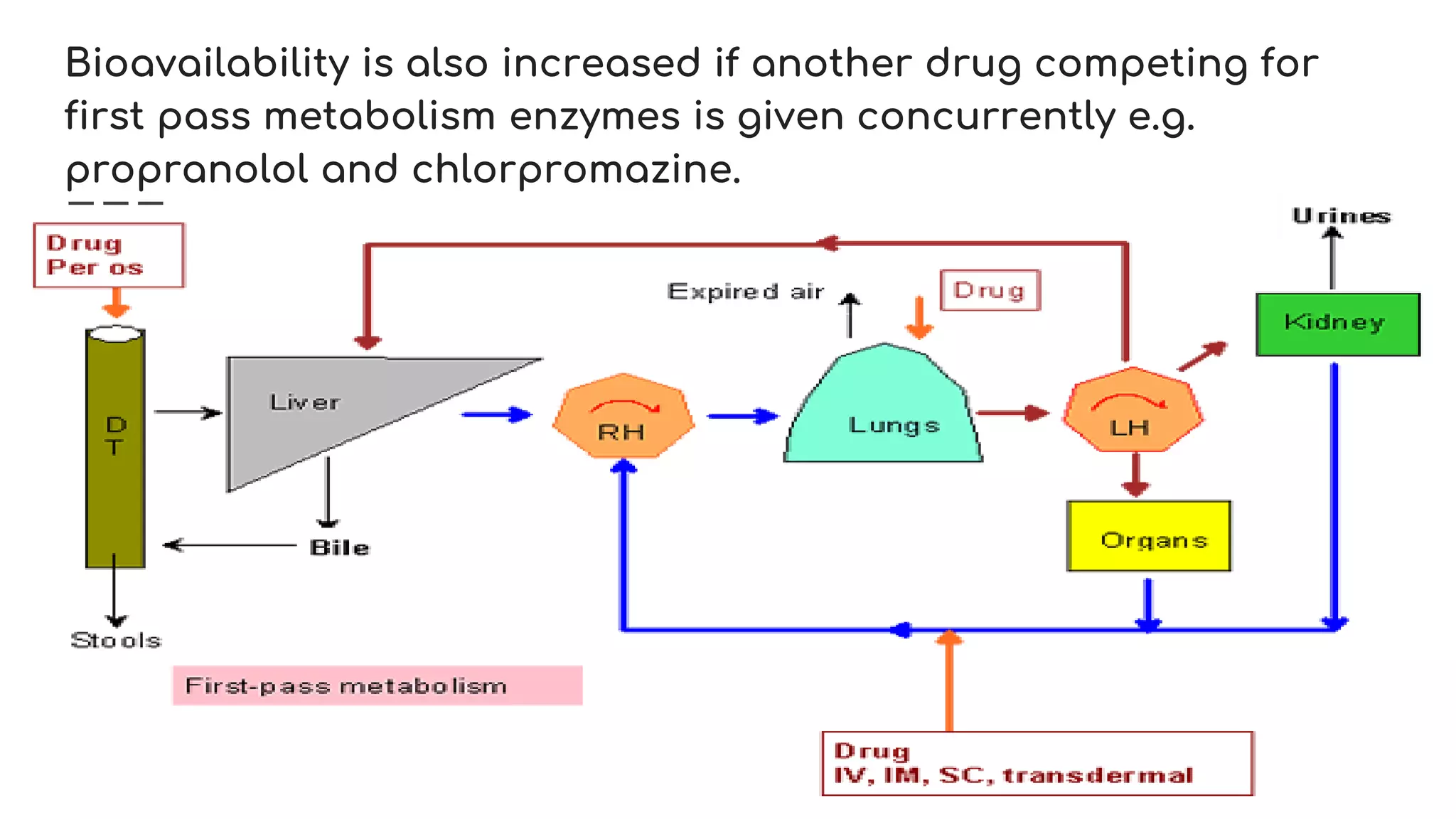
Now, let's analyze how Samskara acts as an ancient solution to these modern pharmacokinetic challenges.
3. How Samskara Modifies a Drug's Pharmacokinetic Profile
The processes involved in Samskara are not merely ritualistic; they induce profound physicochemical changes that directly impact a drug's ADME profile. The following reading provides an excellent, in-depth analysis of Bhāvana, correlating its mechanisms with modern scientific principles.
Role of Bhāvana Saṁskāra in Enhancing the Potency of ...
We will now study the paper 'Role of Bhāvana Saṁskāra in Enhancing the Potency of Rasa Yogas: A Review'. It provides a comprehensive bridge between the classical understanding of Bhāvana and its modern pharmacokinetic implications.
Please read the following three sections: Start with the section titled 'Modern Scientific Investigations' and review the subsections 'Particle Size Reduction', 'Surface Modification', and 'Phyto-metallic Complex Formation'. Next, read the section 'DISCUSSION' focusing on the paragraphs under the heading 'Physicochemical Transformation: A Microscopic Rationale'. Finally, read the section 'Bhāvana and Detoxification: A Functional Filter'. Focus on how each described mechanism (e.g., nanosizing, complex formation, surface modification) would logically affect a drug's absorption, distribution, and safety.
Based on the reading and other evidence, we can map the effects of Samskara directly onto the principles of pharmacokinetics.
A. Enhancing Absorption through Particle Size Reduction
- Ayurvedic Process: Bhāvana (levigation) and Marana (incineration) involve repeated grinding and heating, which breaks down coarse materials.
- Pharmacokinetic Effect: This process acts as a form of micronization or nanosizing. As the reading highlights, SEM studies confirm that particle sizes can be reduced to the nano- or sub-micron level. This drastically increases the surface-area-to-volume ratio of the drug.
- The Result: A larger surface area enhances the drug's dissolution rate in the gastrointestinal fluids, leading to faster and more complete absorption into the bloodstream. This directly increases the drug's bioavailability.
B. Modifying Metabolism and Distribution through Chemical Transformation
- Ayurvedic Process: During Bhāvana, a base substance is triturated with a liquid medium (Bhāvana Dravya), like a herbal juice or decoction.
- Pharmacokinetic Effect: This is not simple mixing. The process facilitates the formation of new organo-metallic or phyto-metallic complexes. The phytochemicals from the herbal juice (e.g., flavonoids, alkaloids) can bind to or coat the mineral particles.
- The Results:
- Altered Metabolism: These new, larger complexes may be absorbed through different pathways (e.g., lymphatic system), potentially bypassing first-pass metabolism in the liver. This preserves the active components of the drug, significantly increasing bioavailability.
- Targeted Distribution: The choice of Bhāvana Dravya is highly specific. Using a Medhya Dravya (nootropic herb) like Brahmi to process a Bhasma is believed to direct its action toward the nervous system. In modern terms, the phytochemicals from Brahmi may act as ligands, guiding the drug complex to specific receptors or tissues, akin to modern targeted drug delivery systems.
C. Improving the Safety Profile (Detoxification)
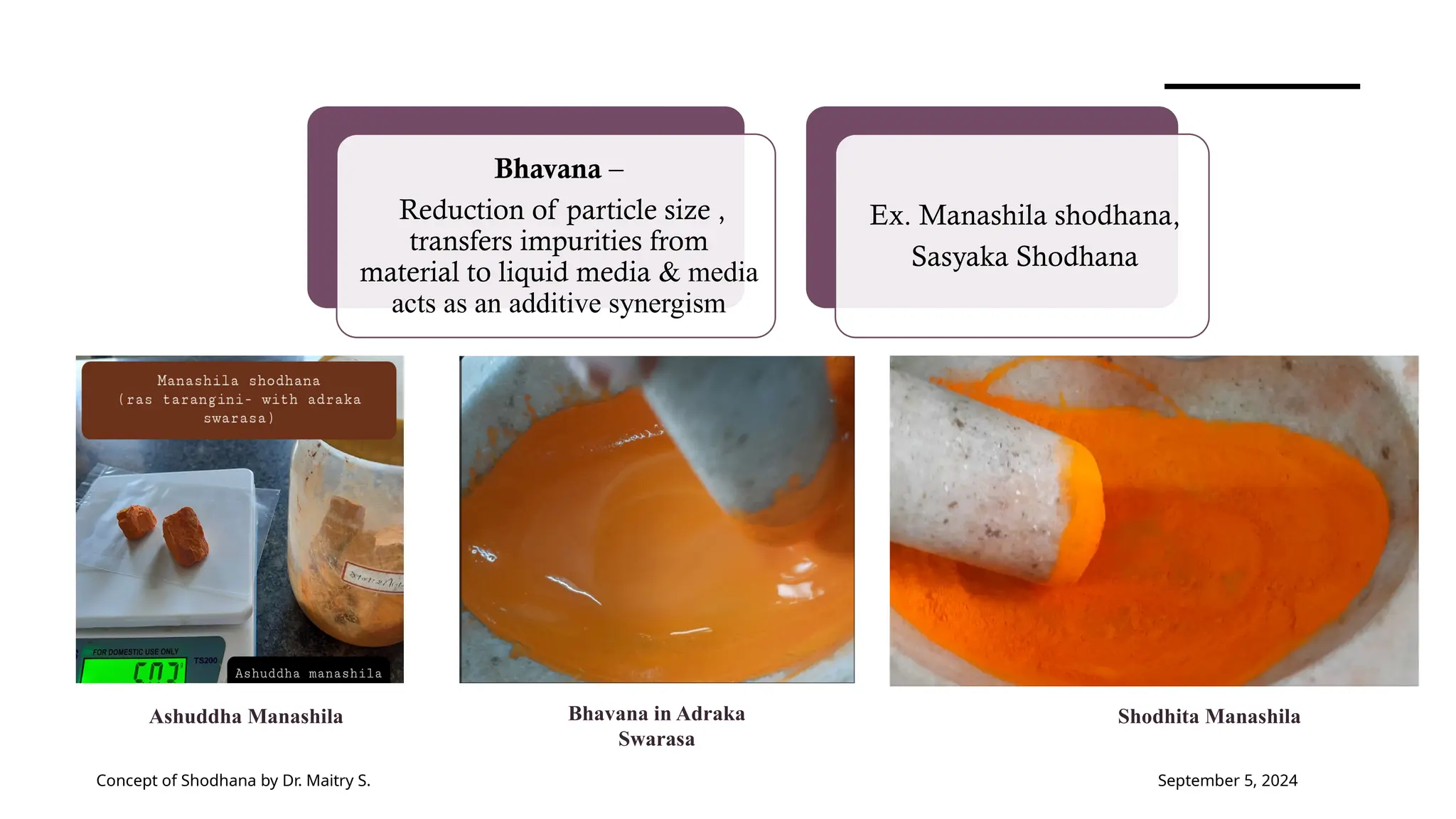
- Ayurvedic Process: Shodhana (purification), often involving Bhāvana with specific liquids, is performed before a drug is used. For example, toxic minerals like
Manashila(realgar) are processed with herbal juices. - Pharmacokinetic Effect: This process converts toxic, free elemental forms of metals and minerals into more stable, biocompatible, and often less soluble compounds (e.g., sulfides, oxides).
- The Result: This transformation reduces toxicity and minimizes adverse effects. The resulting substance is safer for the body to metabolize and is less likely to cause cellular damage.
Test your understanding!
Classical texts describe subjecting Abhraka (mica) to over 100 cycles of Bhāvana with Guduchi Svarasa (giloy juice) to create a potent Rasayana (rejuvenative). Based on the pharmacokinetic principles discussed, propose two distinct ways this intensive processing enhances the final drug's efficacy and safety.
Show answer
- Enhanced Bioavailability (Absorption & Metabolism): The 100 cycles of trituration would reduce Abhraka particles to a nano-scale, drastically increasing their surface area for better absorption. Furthermore, phytochemicals from Guduchi would form complexes with the Abhraka particles. These phyto-complexes might be absorbed via pathways that bypass first-pass metabolism, protecting the active compounds and ensuring more of the drug reaches systemic circulation.
- Targeted Action & Synergy (Distribution & Potentiation): Guduchi is a renowned immunomodulator. The Guduchi phytochemicals coating the Abhraka particles could act as ligands, guiding the final compound to immune cells. This creates a synergistic effect, where Abhraka acts as a potent carrier and Guduchi provides the specific therapeutic intelligence, leading to a more targeted and powerful Rasayana effect than either substance would have alone.
4. A Case Study: The Science Behind 30 Days of Grinding
The principles of Samskara are not just theoretical. Modern research is beginning to validate these ancient processes, sometimes with surprising results. The following video discusses a study on Vilwadi Gulika, a traditional pill that requires 30 days of grinding.
How 5000-Year-Old Ayurveda Beats Modern Medicine:IIT Delhi Professor's Shocking Research#sangamtalks
Let's watch a short segment from a talk by an IIT Delhi professor discussing research on a classical Ayurvedic process. This provides a powerful, real-world example of Samskara in action.
Please watch from 14:36 to 19:16. The speaker discusses a research study on the 30-day grinding process for a tablet called Vilwadi Gulika. Pay close attention to what happens to the drug's properties over time and the final conclusion about why this long duration is necessary.
As the research on Vilwadi Gulika demonstrates, the extended Samskara (in this case, Mardana or grinding) was not just for particle size reduction. It facilitated aerobic microbial fermentation, leading to the production of new, highly potent secondary metabolites. The antimicrobial and antifungal activity of the formulation only reached its peak after 27-30 days. This is a stunning example of biotransformation, where the process itself creates the final active drug—a concept far ahead of its time.
Conclusion
Today we have analyzed Samskara not as a collection of ancient recipes, but as a sophisticated system of pharmaceutical engineering. By applying the lens of modern pharmacokinetics, we can appreciate that these processes were designed to solve fundamental challenges in drug delivery.
Key Takeaways:
- Samskara is a transformative process that modifies a drug's properties to enhance efficacy and safety.
- These modifications directly impact a drug's pharmacokinetic profile (ADME).
- Key mechanisms include particle size reduction (nanosizing) to improve absorption, formation of new phyto-complexes to alter metabolism and distribution, and chemical conversion to reduce toxicity.
- These ancient techniques can be viewed as precursors to modern concepts like nanomedicine, targeted drug delivery, and biotransformation.
Preview of the Next Lesson:
We've seen how a drug can be modified before it is administered through Samskara. But Ayurveda also has a science for modifying a drug's action during administration using specific vehicles. In our next lesson, we will compare Anupana (adjuvant) effects with modern concepts of drug absorption and metabolism. This will complete our picture of how Ayurveda masterfully controls the journey of a medicine within the body.