Introduction
In our last lesson, we formalized our analysis of Event 2, the boudoir competition, by applying hoop and smoking-gun tests to the primary hypotheses. We found that the contestant's unique physique and the powerful contrast of her attire with her persona not only passed necessary evidentiary hurdles (hoop tests) but were also confirmed by uniquely damning evidence (smoking guns), particularly the judge's private notes.
This lesson shifts our focus back to Event 1, the cuckold-hotwife dynamic, to complete a crucial step in our causal inquiry. Having previously found strong support for our primary hypotheses—the wife's unmet needs and the husband's trust in his best friend—we now turn our attention to the rival explanations. Today's goal is to apply process-tracing tests to the rival hypotheses for Event 1, articulating the justification for eliminating each one. This process of elimination is as vital to a strong causal claim as is the confirmation of your main argument, a principle central to robust causal analysis.
The Logic of Eliminating Rivals
A causal explanation becomes compelling not only through the evidence that supports it, but also through its demonstrated superiority over plausible alternatives. In process tracing, we don't just look for evidence that confirms our favored theory; we actively seek evidence that could either confirm or disconfirm rival explanations.
The four tests we have discussed—straw-in-the-wind, hoop, smoking gun, and doubly decisive—are not just for confirmation. As the matrix below illustrates, they have specific implications for how we treat rival hypotheses.
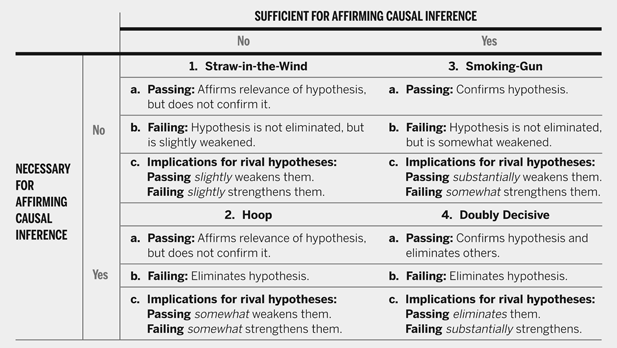
The most potent tool for elimination is the hoop test. If a rival hypothesis predicts that a certain piece of evidence must exist for it to be true (a necessary condition), and we find that evidence is absent, the hypothesis fails the hoop test and can be confidently rejected.
For a deeper dive into the logic of elimination, let's revisit a classic resource and a new one with powerful examples.
[PDF] Process tracing is the examination of diagnostic pieces of evidence ...
In this excerpt from the Sherlock Holmes 'Silver Blaze' story, which we've referenced before, pay close attention to Holmes's reasoning about the curried mutton. It's a masterclass in eliminating a rival hypothesis.
Read the paragraph where Holmes explains his reasoning about the curry. Focus on how he uses the clue of the curried mutton to definitively eliminate Fitzroy Simpson as a suspect. Notice how he concludes it's "unthinkable" for the evidence to align with Simpson's involvement, thus eliminating him from the case.
The Sherlock Holmes example is illustrative. For more formal social science applications, the following text demonstrates how scholars use this same logic to adjudicate between competing theories.
[PDF] Bennett Chapter in Brady and Collier Second Edition - PhilSci-Archive
This chapter by Andrew Bennett provides clear, real-world examples of using process-tracing tests to eliminate rival hypotheses in political science.
Read the two examples provided in the chapter. First, focus on the Fashoda Crisis example, specifically how Schultz rejects the neorealist argument because it fails a hoop test (it can't explain why the crisis occurred in the first place). Then, examine the World War I example and note how Goemans rejects the 'bad learner' hypothesis by showing that German leaders, contrary to the hypothesis, were well aware they were losing the war.
Applying Elimination Tests to Event 1 Rivals
Let's now apply this rigorous logic to the three rival hypotheses we generated for the success of the couple's 5-year cuckold-hotwife dynamic. Our goal is to assess if they can survive scrutiny or if they must be eliminated.
Recall the rivals from Module 2:
- RH1: The couple's success stems from a pre-existing ideological openness to non-monogamy.
- RH2: The dynamic was primarily driven by the husband's voyeuristic desires.
- RH3: The outcome was caused by the wife's independent assertiveness in pursuing her goals.
Rival Hypothesis 1: Pre-existing Openness
- The Hypothesis: This explanation posits that the couple already held values conducive to open relationships, and this ideological foundation is the primary reason for their success, rather than a reaction to specific circumstances.
- The Test (Hoop): If this hypothesis were the primary cause, we must find evidence of the couple discussing, researching, or expressing interest in non-monogamy before the period of marital crisis and sexual dissatisfaction began. The timing is critical.
- Evidence Review: Our evidence matrix (from M9, LO1) contains E1 (Couples' Joint Interview), E4 (Wife's Private Journal), and E5 (Husband's Private Journal).
- In E1, both partners explicitly state their upbringing was "highly traditional" and they entered marriage with "strictly monogamous expectations."
- E4 and E5, which cover the first decade of their marriage, contain no entries about non-monogamy. The topic first appears in the wife's journal entry detailing her deep sexual frustration, where she writes, "I don't know the solution... maybe we need to think about things I never imagined before." The husband's journal first mentions it as a "terrifying idea" proposed in response to his wife's unhappiness.
- Justification for Elimination: RH1 fails the hoop test. The evidence of "openness" appears after the causal trigger (unmet needs), not before it. This suggests that the adoption of non-monogamous ideas was a consequence of the problem and a feature of the solution, not the pre-existing cause of the arrangement's success. The hypothesis is eliminated as a primary driver.
Rival Hypothesis 2: Husband's Voyeuristic Desires
- The Hypothesis: This rival explanation claims the arrangement was initiated and sustained primarily because the husband had a latent or active voyeuristic fetish, which he sought to fulfill.
- The Test (Hoop): If this were the main causal driver, we must see evidence that the husband was the prime mover. We would expect to find him initiating the discussion, showing enthusiasm for the prospect of watching his wife with another man, and framing it in terms of his own excitement, rather than as a concession to her needs.
- Evidence Review:
- E5 (Husband's Private Journal): His entries from the crisis period are filled with anxiety, fear of loss, and jealousy. He writes, "I am doing this for her, but I am terrified. The only thing that makes it bearable is that it's [best friend's name]."
- E2 (Wife's Interview): She confirms, "He was dead set against it at first. It took months to convince him... He only agreed when he saw how miserable I was and when we agreed it had to be [the bull]."
- E3 (Bull's Interview): The bull states, "[Husband] laid down so many rules at the start. He was clearly very nervous. It wasn't about his fun; it was about making sure his marriage didn't fall apart."
- Justification for Elimination: RH2 fails the hoop test. The evidence from all three participants directly contradicts the claim that the husband was the eager initiator. His emotional state and the focus of his actions were on threat mitigation and relationship preservation. While he may have developed enjoyment from voyeurism over the 5 years (which could be a sustaining factor), the evidence decisively rules it out as the triggering cause.
Rival Hypothesis 3: Wife's Independent Assertiveness
- The Hypothesis: This explanation suggests the outcome is simply a product of the wife's strong, assertive personality enabling her to get what she wants.
- The Test (Straw-in-the-Wind & Hoop): This is more nuanced. We can test it as a primary cause. If her assertiveness alone were the main driver, we'd expect two things: 1) She would have pushed for this outcome regardless of the husband's conditions. 2) The specific identity of the bull would not have been a critical factor.
- Evidence Review:
- The evidence strongly supports the wife's assertiveness in identifying and communicating her unhappiness. E4 (Wife's Journal) shows her resolve not to live in a sexually unfulfilling marriage. This is a "straw-in-the-wind" that confirms her personality is part of the story.
- However, the evidence also shows the final arrangement was a heavily negotiated compromise. E1 (Couples' Interview) and E6 (Communication Logs) reveal that the condition of the bull being the husband's best friend was a "deal-breaker" for the husband, a condition the wife agreed to respect. She did not simply impose her will.
- Justification for Downgrading (Not Full Elimination): This hypothesis fails a hoop test to be considered the sole or primary cause. Her assertiveness was necessary to start the conversation, but it cannot, by itself, explain the specific, stable outcome. It doesn't account for why this particular solution (with the best friend) was chosen and why it was stable. It was a crucial background condition or contributing factor, but it lacks the explanatory power of the primary hypotheses (Unmet Needs + Best Friend Trust), which together explain both the motive for the change and the enabling conditions for this specific, stable arrangement. We therefore downgrade it from a rival primary cause to a contributing background condition.
Conclusion
In this lesson, we have moved from confirming our primary hypotheses to the equally important task of disconfirming the alternatives. By formally applying process-tracing tests, we have systematically evaluated the rival explanations for the success of the couple's cuckold-hotwife dynamic in Event 1.
Here are your key takeaways:
- Elimination is a core component of causal inference. A strong claim rests on showing that plausible alternatives are inconsistent with the evidence.
- Hoop tests are the primary tool for elimination. By identifying a necessary piece of evidence for a rival hypothesis and demonstrating its absence, we can falsify that explanation.
- For Event 1, we eliminated 'pre-existing openness' and 'husband's voyeurism' as primary causes because they failed critical hoop tests related to timing and motivation.
- We downgraded 'wife's assertiveness' from a primary cause to a background condition. While her assertiveness was present and necessary, it was not sufficient to explain the specific, stable outcome of the case.
With our primary hypotheses for both events confirmed and the main rivals eliminated, we have constructed a robust foundation for our causal claims. However, one final analytical step remains. In the next and final module, we will use counterfactual analysis to probe the necessity and sufficiency of our confirmed causes, further strengthening our final conclusions for both Event 1 and Event 2.