Introduction
In our last lesson, we constructed the detailed evidence matrix for Event 2, the boudoir competition. This exercise allowed us to systematically map our collected facts against each hypothesis and perform an initial analysis. The matrix immediately revealed the weakness of the rival explanations—posing skill, coaching, and lingerie quality—while showing strong, multi-sourced support for our two primary hypotheses: H1 (Body Type) and H2 (Attire/Persona Contrast).
Building on that foundation, this lesson moves from preliminary assessment to formal hypothesis testing. Our goal is to apply hoop tests and search for smoking-gun evidence for the primary hypotheses in Event 2. Just as we did for Event 1, we will now use this formal logic to scrutinize the evidence supporting H1 and H2, allowing us to specify the inferential power of each piece of data and build a more robust causal claim. This step is crucial for transitioning from seeing that evidence is consistent with a hypothesis to arguing that it provides strong confirmation for it.
The Logic of Process-Tracing Tests
At the heart of process tracing is the idea that not all evidence is created equal. Some pieces of evidence are merely suggestive, while others can be nearly decisive. To formalize this, the methodology uses a set of tests to evaluate the "probative value" of each evidentiary "fingerprint." As a statistician, you can think of this as a qualitative analogue to assessing the power of a statistical test or the weight of evidence in a Bayesian framework.
The four primary tests are categorized along two dimensions: whether passing the test is necessary for the hypothesis to be viable, and whether it is sufficient to confirm it.
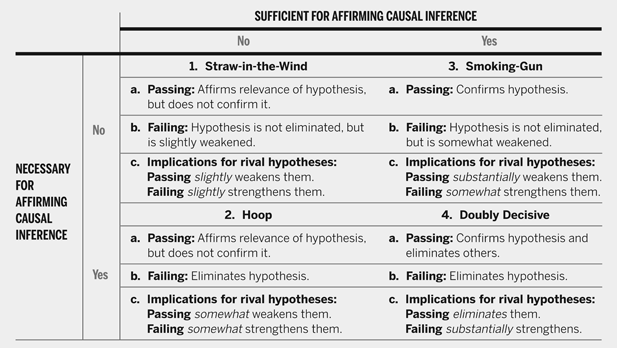
Let's delve into the definitions of these two key tests.
[PDF] Process tracing is the examination of diagnostic pieces of evidence ...
This paper by David Collier provides the classic definitions of the process-tracing tests, using illustrations from a Sherlock Holmes story to make the logic clear.
First, read the introductory section 3. Process Tracing to understand the necessity/sufficiency framework. Then, read the specific definitions and examples for Hoop tests and Smoking gun tests. Focus on how a hoop test serves to eliminate hypotheses, while a smoking-gun test serves to confirm them.
The Collier reading gives you the formal logic. For a more practical perspective, the following resource offers a very intuitive way to think about applying these tests.
[PDF] Process Tracing as a Practical Evaluation Method
This guide translates the formal theory of process tracing into practical evaluation questions.
Please read the section that distinguishes the inferential power of the tests, noting the phrasing that not failing a hoop test "whispers in favour" of a hypothesis, while passing a smoking gun test allows you to "shout" in its favor. Also, pay close attention to the section on "Mitigating bias", which proposes a simple but powerful way to frame the search for evidence: a hoop test corresponds to what you “need to see”, while a smoking gun test is what you would “like to see”.
Applying the Tests to Event 2
Armed with these definitions, let's now re-examine the evidence from our matrix for Event 2 through the formal lenses of hoop and smoking-gun tests.
Hoop Tests: What We Need to See
A hoop test establishes a necessary standard of evidence. If a hypothesis cannot "jump through the hoop," it is falsified. For our primary hypotheses in Event 2, what are the essential hoops?
Hypothesis 1: Body Type Advantage
- The Hoop: For H1 to be plausible, we must find objective evidence that the contestant's physique was observably distinct from her competitors in the manner hypothesized (i.e., toned yet unusually well-endowed). Without this, the entire hypothesis collapses.
- The Evidence: Our evidence matrix contains E3 (Comparative Photo Analysis), which "confirms the winner possesses a rare combination of low body fat and large bust, a physique not present in the other finalists."
- The Verdict: H1 successfully passes this critical hoop test. Had the analysis shown her physique was typical for the competition, we would have immediately eliminated H1, regardless of any other supporting evidence.
Hypothesis 2: Attire/Persona Contrast
- The Hoop: For H2 to be viable, we must find evidence that there was a pre-existing perception of the contestant as modest or shy, which could then be contrasted with her provocative attire. If she was already known for a bold persona, the "contrast" mechanism could not operate.
- The Evidence: We have two key pieces. First, E2 (Judge Interviews), where judges mention her "shy girl" bio. Second, E6 (Rival's Testimony), where a competitor states, "We all thought she would go for a sweet, modest look."
- The Verdict: H2 also passes its hoop test. The evidence confirms that the baseline persona necessary for the contrast effect to work was indeed in place.
Both of our primary hypotheses have cleared the first, most fundamental hurdle: they are consistent with necessary conditions.
Smoking-Gun Tests: What We Would Like to See
A smoking-gun test is not necessary—its absence doesn't disprove a hypothesis—but its presence provides powerful, sufficient confirmation. It's evidence that is highly unique to the hypothesis and difficult to explain otherwise. Did our investigation uncover any smoking guns?
Hypothesis 1: Body Type Advantage
- The Search: We are looking for a piece of evidence that provides unique and strong confirmation that her body type was a direct cause of the win.
- The Evidence: Consider E10 (Judge's Private Notes), which state: "Physique is a 10/10, a classic pin-up ideal that is rare to see."
- The Verdict: This is a definitive smoking gun. It is not just an observation; it is a normative judgment from a key decision-maker, recorded privately and contemporaneously, that explicitly identifies the physique as exceptional ("10/10," "rare to see"). It's hard to imagine finding a piece of evidence that would more strongly or uniquely support H1.
Hypothesis 2: Attire/Persona Contrast
- The Search: We are looking for direct evidence linking the "surprise" or "contrast" to the judges' and audience's positive reaction.
- The Evidence: We have a wealth of it.
- E2 (Judge Interviews): Judges explicitly use words like "surprised" and "impressed by the 'boldness'" and reference the "contrast".
- E5 (Winner's Interview): The winner confirms her strategy was to "shatter expectations." This reveals the mechanism's intent.
- E10 (Judge's Private Notes): This is again the most powerful piece. The judge writes that the physique is a 10/10, but then adds the crucial causal link: "...The contrast with her shy persona in the bio makes it unforgettable."
- The Verdict: We have multiple pieces of smoking-gun evidence. E10 is particularly powerful because it doesn't just confirm the presence of the contrast; it explicitly articulates its effect ("makes it unforgettable"). This directly links the mechanism (contrast) to a key component of the outcome (memorability, which was a judging criterion as per E1).
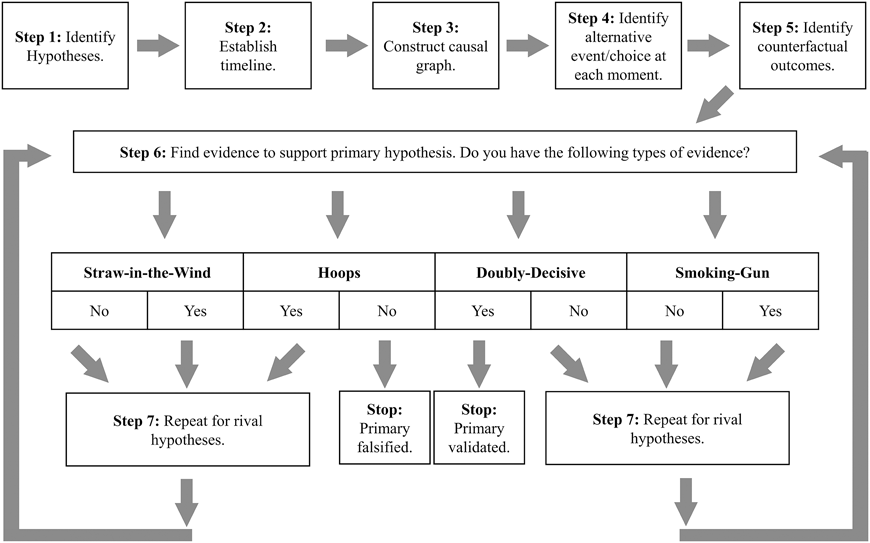
The flowchart below shows how finding such "Yes" answers for Hoops and Smoking-Guns leads to validation.
Conclusion
In this lesson, we advanced our analysis of Event 2 by formally applying the core process-tracing tests to our primary hypotheses. By moving beyond a simple inventory of facts, we were able to assess the specific inferential weight of our key pieces of evidence.
Here are the key takeaways:
- Process-tracing tests (hoop, smoking gun) provide a rigorous logical framework for moving from correlation to causation in a single-case study by evaluating evidence against standards of necessity and sufficiency.
- Hoop tests function as elimination criteria. For Event 2, both the 'Body Type' (H1) and 'Attire/Persona Contrast' (H2) hypotheses successfully passed their necessary hoop tests, confirming their basic plausibility.
- Smoking-gun tests function as powerful confirmatory criteria. For Event 2, we found definitive smoking-gun evidence for both H1 and H2, most notably in the judge's private notes (E10), which explicitly validated both the physique's exceptional quality and the unforgettable impact of the persona contrast.
- The fact that a single piece of evidence (E10) serves as a smoking gun for both hypotheses strongly supports our earlier intuition that these two causes were not merely independent but synergistic, working together to produce the win.
Having now applied these rigorous tests to the primary hypotheses of both our cases, our next task is to formally justify the elimination of the alternative explanations we generated. In the next lesson, we will apply these same tests to the rival hypotheses for Event 1, articulating precisely why each one fails to provide a compelling explanation for the couple's successful dynamic.