Introduction
In our previous lesson, we applied the rigorous standards of hoop and smoking-gun tests to our primary hypotheses for Event 1. This analytical step confirmed the strong causal roles of both the wife's unmet needs (H1) and the husband's trust in his best friend (H2) in explaining the couple's successful long-term dynamic. By systematically vetting our evidence, we moved from mere consistency to high inferential confidence.
This lesson continues our parallel investigation by turning our focus squarely to Event 2: the boudoir competition win. Our objective is to construct an evidence matrix that maps all our observed facts against the primary and rival hypotheses for this case. Creating this matrix is the foundational step for systematic hypothesis testing. It provides a comprehensive, at-a-glance view of the entire evidentiary landscape, allowing us to see which explanations are strengthened by the data and which are weakened or falsified.
The Evidence Matrix: A Tool for Structured Analysis
Before we build the matrix, let's formalize what it is and why it's so crucial. An evidence matrix is a table, typically created in a spreadsheet, that organizes your analysis. The rows represent your hypotheses (both primary and rival), and the columns represent the individual pieces of evidence or facts you have collected. The cells of the matrix document the relationship between each fact and each hypothesis—does it support, contradict, or is it irrelevant?
For a researcher with your background in statistics and operations research, you can think of this as the qualitative equivalent of structuring a dataset before running a model. It forces a disciplined accounting of all information, mitigates the risk of confirmation bias by compelling you to consider disconfirming evidence, and clearly identifies evidentiary gaps.
The following resources provide excellent practical guidance on this process.
Fact Matrix from Transcripts: Build an Element-by-Element Evidence ...
This article from GoTranscript, while written for a legal context, offers a superb, practical guide to building an evidence grid. Its logic is directly transferable to our causal analysis.
Read the sections from the beginning through the worked example. Pay attention to how it breaks down the process. Where the guide says “elements” or “issues,” you should substitute “hypotheses.” Where it says “facts to prove,” think of our “observable implications” or “evidence fingerprints.” The provided template is an excellent model for the structure we will create.
[PDF] Jewlya Lynn Sarah Stachowiak Jennifer Beyers - ORS Impact
This guide from ORS Impact offers a more social-science-oriented perspective on the same task. It frames the process in terms of testing a Theory of Change.
Focus on the section "Assemble relevant data to test hypotheses." Note the five data elements it recommends for each hypothesis, which include data on the activities, the outcome, the linkage, and, crucially, the alternate explanations. The guide's suggestion to use a spreadsheet with hypotheses as rows and data elements as columns, as shown in the sample spreadsheet in Appendix C, directly mirrors the structure we are about to build.
Constructing the Evidence Matrix for Event 2
Now, let's apply this method. We'll begin by recalling our hypotheses and then map our collected (hypothetical) evidence against them.
The Hypotheses (Rows)
From our work in Module 3, we have two primary and three rival hypotheses for why the contestant won:
- H1 (Body Type): The win was caused by her distinctive physique (toned yet well-endowed), which stood out from competitors.
- H2 (Attire/Persona Contrast): The win was driven by the powerful contrast between her known modest persona and her provocative lingerie choice, creating a 'surprise' effect.
- HR1 (Posing Skill): She won due to technically superior posing skills.
- HR2 (Professional Coaching): She had received elite professional coaching that other contestants lacked.
- HR3 (Lingerie Design Quality): The lingerie itself was of a uniquely superior design and construction, giving her an edge.
The Evidence (Columns)
Let's assume our data collection phase (Module 4) yielded the following key facts:
- E1 (Judge's Scorecards): The winner's scores were highest in the "Overall Impact" and "Memorability" categories, while being average on "Technical Posing."
- E2 (Judge Interviews): Two of the three judges independently mentioned being "surprised" and "impressed" by the "boldness" of her presentation, explicitly referencing the contrast with her "shy girl" bio.
- E3 (Comparative Photo Analysis): An objective comparison of the top 5 finalists' photos confirms the winner possesses a rare combination of low body fat and large bust, a physique not present in the other finalists.
- E4 (Audience Poll Data): Online polling data shows a massive vote spike for the winner immediately following her performance. Comments frequently use words like "wow," "unexpected," and "stunning transformation."
- E5 (Winner's Interview): The contestant stated she deliberately chose the highly provocative lingerie to "shatter expectations" and create a memorable moment.
- E6 (Rival's Testimony): A competitor who knew the winner beforehand said in an interview: "We all thought she would go for a sweet, modest look. When she came out in that, everyone's jaw dropped."
- E7 (Expert Posing Review): A professional photographer hired to review the competition footage concluded that the winner's posing was "proficient," but that at least two other contestants displayed "more advanced and varied technical posing skills."
- E8 (Background Research): Our investigation confirms that none of the top 5 finalists, including the winner, had employed a professional competition coach.
- E9 (Lingerie Sourcing): The lingerie worn by the winner was identified as being from a popular, accessible online brand. In fact, another contestant in the preliminary round wore a different piece from the same brand and did not advance.
- E10 (Judge's Private Notes): We gained access to one judge's contemporaneous notes, which read: "Physique is a 10/10, a classic pin-up ideal that is rare to see. The contrast with her shy persona in the bio makes it unforgettable."
The Matrix
Now we map these facts against the hypotheses. We'll use ++ for strong support, + for support, 0 for irrelevant, - for contradiction, and -- for strong contradiction.
| Hypothesis | E1 (Scores) | E2 (Judge Surprise) | E3 (Physique) | E4 (Audience) | E5 (Intent) | E6 (Rival) | E7 (Posing) | E8 (Coaching) | E9 (Lingerie) | E10 (Judge's Notes) |
|---|---|---|---|---|---|---|---|---|---|---|
| H1: Body Type | + |
0 |
++ |
+ |
0 |
0 |
0 |
0 |
0 |
++ |
| H2: Contrast | + |
++ |
0 |
++ |
++ |
++ |
0 |
0 |
0 |
++ |
| HR1: Posing Skill | - |
0 |
0 |
0 |
0 |
0 |
-- |
0 |
0 |
0 |
| HR2: Coaching | 0 |
0 |
0 |
0 |
0 |
0 |
0 |
-- |
0 |
0 |
| HR3: Lingerie Quality | 0 |
0 |
0 |
0 |
0 |
0 |
0 |
0 |
-- |
0 |
Initial Analysis of the Matrix
This structured layout allows for immediate, powerful insights:
-
Elimination of Rivals: The rival hypotheses are decisively falsified.
- HR1 (Posing Skill) is contradicted by the judge's scores (E1) and strongly contradicted by the expert review (E7).
- HR2 (Coaching) is strongly contradicted by the background research (E8).
- HR3 (Lingerie Quality) is strongly contradicted by the sourcing information (E9). Your own expertise in lingerie design would likely lead to a similar assessment—a piece can be effective without being haute couture.
-
Strong Support for Primary Hypotheses: Both H1 and H2 receive compelling support from multiple, independent sources of evidence.
- H1 (Body Type) is strongly affirmed by the objective photo analysis (E3) and the judge's private, candid notes (E10). It's also consistent with the high impact scores (E1) and audience reaction (E4).
- H2 (Contrast) is overwhelmingly supported. We see it in the judges' public statements (E2) and private notes (E10), the audience reaction (E4), the winner's own strategic intent (E5), and even the testimony of a rival (E6).
-
Synergy between H1 and H2: Critically, the judge's private note (E10) does not treat these causes as separate. The judge explicitly links them: "Physique is a 10/10... The contrast... makes it unforgettable." This suggests the two causes may interact and amplify one another—a crucial insight for our final causal narrative.
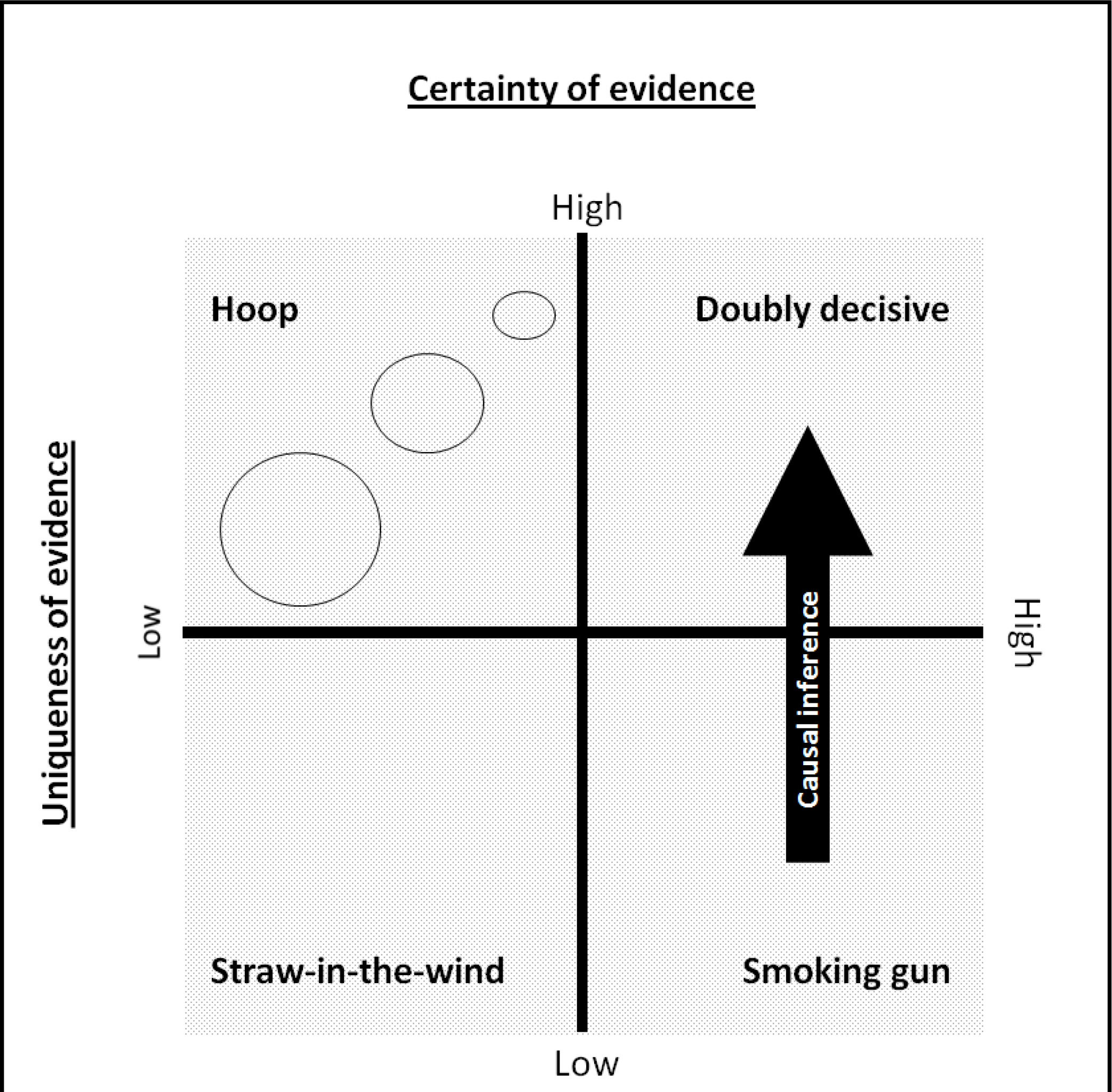
This matrix provides the foundation for the more formal tests we'll apply next. Evidence like E7, E8, and E9 represents failed hoop tests for the rival hypotheses, justifying their elimination. Evidence like E2, E5, and especially E10 function as near "smoking guns" for H2.
Conclusion
In this lesson, we transitioned our analysis to Event 2 and constructed a vital analytical tool: the evidence matrix. This disciplined process of mapping facts to hypotheses has allowed us to systematically organize our complex data and draw preliminary, yet powerful, conclusions.
Here are the main takeaways from this exercise:
- An evidence matrix provides a structured, transparent framework for hypothesis testing, mitigating bias and revealing the overall pattern of evidence.
- By populating the matrix for Event 2, we have found clear, strong, and direct evidence falsifying all three rival hypotheses (Posing Skill, Coaching, Lingerie Quality).
- The matrix shows robust, multi-sourced support for our two primary hypotheses: H1 (Body Type) and H2 (Attire/Persona Contrast).
- We've uncovered a crucial piece of evidence (E10) that suggests an interactive, synergistic relationship between our two primary causes.
With this solid foundation in place, we are now prepared to scrutinize our surviving hypotheses more formally. In the next lesson, we will apply hoop tests and search for smoking-gun evidence for H1 and H2, assessing the inferential weight of each piece of supporting evidence to build an even more confident causal claim for Event 2.