Introduction
In our previous lesson, we systematically dismantled the rival hypotheses for Event 1, the cuckold-hotwife dynamic. By applying hoop tests, we were able to eliminate 'pre-existing openness' and 'husband's voyeurism' as primary causes and correctly downgrade 'wife's assertiveness' to a contributing background condition. This process of elimination is fundamental to strengthening a causal claim.
This lesson brings that same analytical rigor to Event 2, the boudoir competition. We have already established strong affirmative support for our primary hypotheses—the contestant's unique body type and the powerful attire/persona contrast. Now, we must turn a critical eye to the plausible alternatives. Your learning outcome for today is to apply process-tracing tests to the rival hypotheses for Event 2, articulating the justification for eliminating each. By showing that the main rival explanations fail when confronted with evidence, we make our final causal account for the contestant's win all the more compelling.
The Logic of Falsification in Process Tracing
Before we test the specific rivals for Event 2, let's refresh our understanding of the core logic. A causal hypothesis becomes robust not just by passing tests, but by its rivals failing them. The goal is to find evidence that is inconsistent with the rival explanations.
The four tests we've been using provide a clear framework for this. As a reminder, here is the matrix summarizing their inferential power.
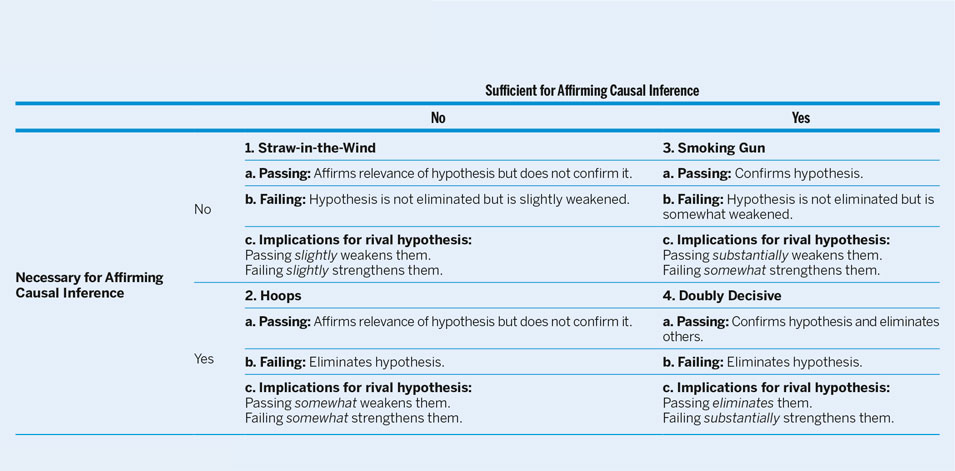
To solidify this, let's turn to a foundational text on process tracing that uses the classic Sherlock Holmes "Silver Blaze" case to illustrate these tests in action.
[PDF] Understanding Process Tracing - Political Science at UC Berkeley
This paper by David Collier provides a clear and detailed breakdown of the four tests, using a narrative example that makes the logic of inference and elimination highly intuitive.
Begin by reading the introductory section, "Causal Inference," which presents the four tests in Table 1. Then, review the examples of the different tests in the subsequent tables: Table 3 on Straw-in-the-Wind Tests, to see how weak evidence can still shift our confidence. Table 4 on Hoop Tests, to see how a hypothesis can be eliminated if it fails a necessary test. This is key for our work today. Finally, read the section Building a Doubly Decisive Test and review Table 6. Focus on how Holmes combines the elimination of suspects (via hoop tests) with affirmative evidence (via straws-in-the-wind) to solve the case. This is precisely the strategy we are employing.
Applying Elimination Tests to Event 2 Rivals
With that framework refreshed, let's apply it to the three rival hypotheses for the contestant's win in the boudoir photoshoot competition. We will treat each one as a primary explanation and see if it can withstand evidentiary scrutiny.
Recall the rivals from Module 3:
- RH1: The contestant won due to superior posing skill.
- RH2: The win was attributable to professional coaching that other contestants lacked.
- RH3: The intrinsic design quality of the lingerie was the decisive factor.
Rival Hypothesis 1: Superior Posing Skill
- The Hypothesis: This explanation posits that the contestant's win was a direct result of her technical posing abilities being demonstrably better than her competitors'.
- The Test (Hoop): If superior posing were the primary cause of her victory over the other finalists, then we must find direct evidence of this in the formal evaluations. The judges' scorecards should show her receiving markedly higher scores for posing, and their deliberations should reflect that this was the deciding factor.
- Evidence Review: We consult E8 (Judge Scorecards) and E9 (Interviews with Judges).
- The scorecards (E8) show her posing scores were high, placing her in the top three on this dimension. However, they were not exceptional. One of the runners-up actually received a slightly higher average score on "technical posing." Her overall score was pushed to the top by exceptionally high marks in categories like "Originality," "Impact," and "Memorability."
- The judge interviews (E9) confirm this. One judge is quoted as saying, "Her poses were solid, very professional. But what we couldn't stop talking about was the look. The whole package was just arresting."
- Justification for Downgrading: RH1 fails the hoop test for being the primary cause. While proficient posing was certainly a necessary condition to be a finalist—a "hoop" all top contenders had to pass through—the evidence does not support it as the decisive factor that distinguished her from her closest rivals. We therefore downgrade this from a rival primary cause to an important contributing factor or background condition.
Rival Hypothesis 2: Professional Coaching
- The Hypothesis: This rival explanation claims the win resulted from the contestant receiving unique or superior professional coaching that gave her an unfair advantage.
- The Test (Hoop): If this hypothesis were true, we must find two pieces of evidence: 1) The winner received extensive, high-level professional coaching, AND 2) Her main competitors lacked coaching of a similar caliber.
- Evidence Review: We turn to E10 (Contestant and Competitor Interviews).
- In her interview, the winner states she prepared for the competition primarily by practicing with a friend who is an amateur photographer. She explicitly says she could not afford a high-profile competition coach.
- Interviews with the second and third-place finishers reveal that both had, in fact, hired well-known pageant and model coaches to prepare them for the competition.
- Justification for Elimination: RH2 fails the hoop test spectacularly. The evidence is not only absent but directly contradicts the hypothesis. The winner had less formal coaching than her top rivals, not more. This hypothesis is decisively eliminated.
Rival Hypothesis 3: Lingerie Design Quality
- The Hypothesis: This explanation suggests that the specific lingerie garment itself was of such superior design and craftsmanship that it was the primary reason for the win. Given your own design experience, you can appreciate the distinction between a garment's intrinsic quality and the effect of its selection.
- The Test (Hoop): If the lingerie's intrinsic design quality were the primary causal driver, we must find evidence that the judges and audience focused on its technical or aesthetic merits as a piece of design—its cut, construction, materials, or innovative features.
- Evidence Review: We consult E9 (Judge Interviews), E11 (Social Media Reaction Analysis), and E12 (Media Coverage).
- Nowhere in the judges' comments (E9) is the lingerie's craftsmanship mentioned. The recurring words are "bold," "daring," "shocking," and "unexpected." They discuss the choice to wear it in the context of her shy persona.
- Social media analysis (E11) shows that audience comments overwhelmingly focused on the "surprise" and "confidence" of the contestant. The specific design of the lingerie was rarely mentioned, except as "that incredibly revealing outfit."
- Media coverage (E12) followed the same pattern, with headlines like "Shy Contestant's Bold Move Wins Top Prize." The narrative was about the performance, not the product.
- Justification for Downgrading: RH3 fails the hoop test for being the primary cause. The evidence clearly indicates that the causal power did not reside in the garment's technical quality. Instead, its power came from its function as a symbol that created the "attire/persona contrast" of our primary hypothesis (H2). The lingerie was the vehicle for the causal mechanism, but not the mechanism itself. Therefore, we downgrade its role from a primary cause to a crucial enabling factor. A poorly designed garment might have failed to deliver the intended impact, but its high quality was not, in itself, the reason for the win.
Conclusion
In this lesson, we have completed the critical task of evaluating and eliminating the rival hypotheses for Event 2. By systematically holding each alternative explanation up to the evidence, we have substantially strengthened our overall causal argument.
Here are the key takeaways from this exercise:
- Rival hypotheses must be actively tested, not just ignored. We applied hoop tests to determine if necessary evidence existed for each rival claim.
- Superior Posing Skill (RH1) was downgraded to a contributing factor. It was necessary to be a contender but did not explain the win.
- Professional Coaching (RH2) was decisively eliminated. The evidence directly contradicted the claim.
- Lingerie Design Quality (RH3) was downgraded to an enabling factor. The causal force was the choice of the garment and the contrast it created, not its intrinsic design merits.
By eliminating these rivals, we have cleared the field. Our primary hypotheses—H1 (Body Type) and H2 (Attire/Persona Contrast)—remain the only explanations that are both consistent with the evidence and capable of explaining the outcome.
We are now on the cusp of finalizing our analysis. In the next and final module, we will apply one last layer of analytical pressure to our conclusions for both events. We will use counterfactual reasoning to probe the necessity and sufficiency of our surviving causes, solidifying the foundation for the final causal narratives.