Introduction
Welcome to the final module of our analysis. In our last lesson, we solidified the causal argument for Event 2 by systematically testing and eliminating the most plausible rival hypotheses. We concluded that 'superior posing skill' and 'lingerie design quality' were merely contributing or enabling factors, not primary causes, and that 'professional coaching' was directly contradicted by the evidence. This process of falsification has left our primary hypotheses for the competition win standing on much firmer ground.
Now, we pivot back to Event 1—the successful cuckold-hotwife dynamic—to apply a final, powerful layer of analytical scrutiny. In this lesson, we will use counterfactual reasoning to probe the causal claims we've developed. Your learning outcome is to formulate counterfactuals to assess if each cause for Event 1 was necessary for the sustained, successful outcome. This method of asking "what if?" allows us to isolate the impact of each cause and is a cornerstone of robust causal inference, bridging the quantitative techniques you're familiar with and the qualitative demands of a single-event study.
From "What Is?" to "What If?": The Role of Counterfactuals
In causal analysis, we often speak of a "ladder of causation." The first rung is association (seeing), the second is intervention (doing), and the highest is counterfactuals (imagining). While our process-tracing tests have operated heavily on the first two rungs, counterfactuals push us to the third, asking what would have happened in a world that is different from the one we observed.
Counterfactuals: Causal Inference Bootcamp
To begin, let's watch a brief segment from a Mod•U video that introduces this core idea. It explains how causality boils down to comparing actual outcomes with counterfactual ones.
Watch the first two minutes, from the beginning to the Churchill example. Pay attention to the distinction between an actual outcome (what we observe) and a counterfactual outcome (what would have occurred if something had been different).
As the video highlights, this kind of reasoning is not just for statisticians; it's fundamental to how historians and qualitative researchers make sense of unique events. Our task is to construct these "what if" scenarios in a disciplined and evidence-based way.
The Logic of Necessity
The specific goal of our counterfactual exercise today is to assess necessity. A cause is considered necessary if, in its absence, the outcome would not have occurred. For example, oxygen is a necessary cause of fire; without oxygen, the fire would not happen.
Formally, we are testing the "Probability of Necessity" (PN), a concept central to Judea Pearl's structural causal models.
Causality: Counterfactuals | Part A
This video from the UCLA Automated Reasoning Group provides a more formal introduction to counterfactuals and the Probability of Necessity. Given your background, you will find its structured approach familiar.
First, watch the introductory segment from the beginning to the end of the introduction to see how counterfactuals sit at the top of the causal hierarchy and involve transferring information from a real-world scenario to a hypothetical one. Then, jump to the section explaining the Probability of Necessity. Watch from the first counterfactual query to where the speaker discusses its use in legal contexts. The key query is: "given that X and Y both occurred, what is the probability Y would not have occurred if we set X to false?"
In our qualitative study, we won't calculate a numerical probability, but the logic is identical. We will use our case evidence to argue whether the outcome was likely or unlikely in the counterfactual world.
Constructing Plausible Counterfactuals
The challenge, as you might anticipate, is that a counterfactual world is unobservable. To prevent our analysis from descending into pure speculation, we must adhere to strict principles when constructing these alternate scenarios. The most important of these is the minimal rewrite rule.
The minimal rewrite rule demands that we alter only the antecedent of interest (the cause we are testing) and keep everything else about the "real world" as it was. This is the qualitative equivalent of an intervention in a controlled experiment.
[PDF] Concrete Counterfactual Tests for Process Tracing - APSA Preprints
This paper by Rosa Runhardt provides a rigorous, interventionist framework for using counterfactuals in process tracing. It formalizes the intuitions behind good counterfactual reasoning.
Focus on the following sections in the first part of the paper: Section 2.1.1, titled "Describing the causal claim." Notice how a vague claim is made precise by clearly stating the associated counterfactual. Section 2.1.2, titled "Choosing an appropriate intervention." This section explains the logic of changing one factor while holding others constant. Section 2.2.2, titled "The minimal rewrite rule." This directly addresses the core principle we'll be using, connecting it to the formal interventionist logic.
This framework ensures our thought experiments are targeted and plausible. We are not rewriting history wholesale; we are performing a "surgical" intervention on the past to isolate a specific causal relationship.
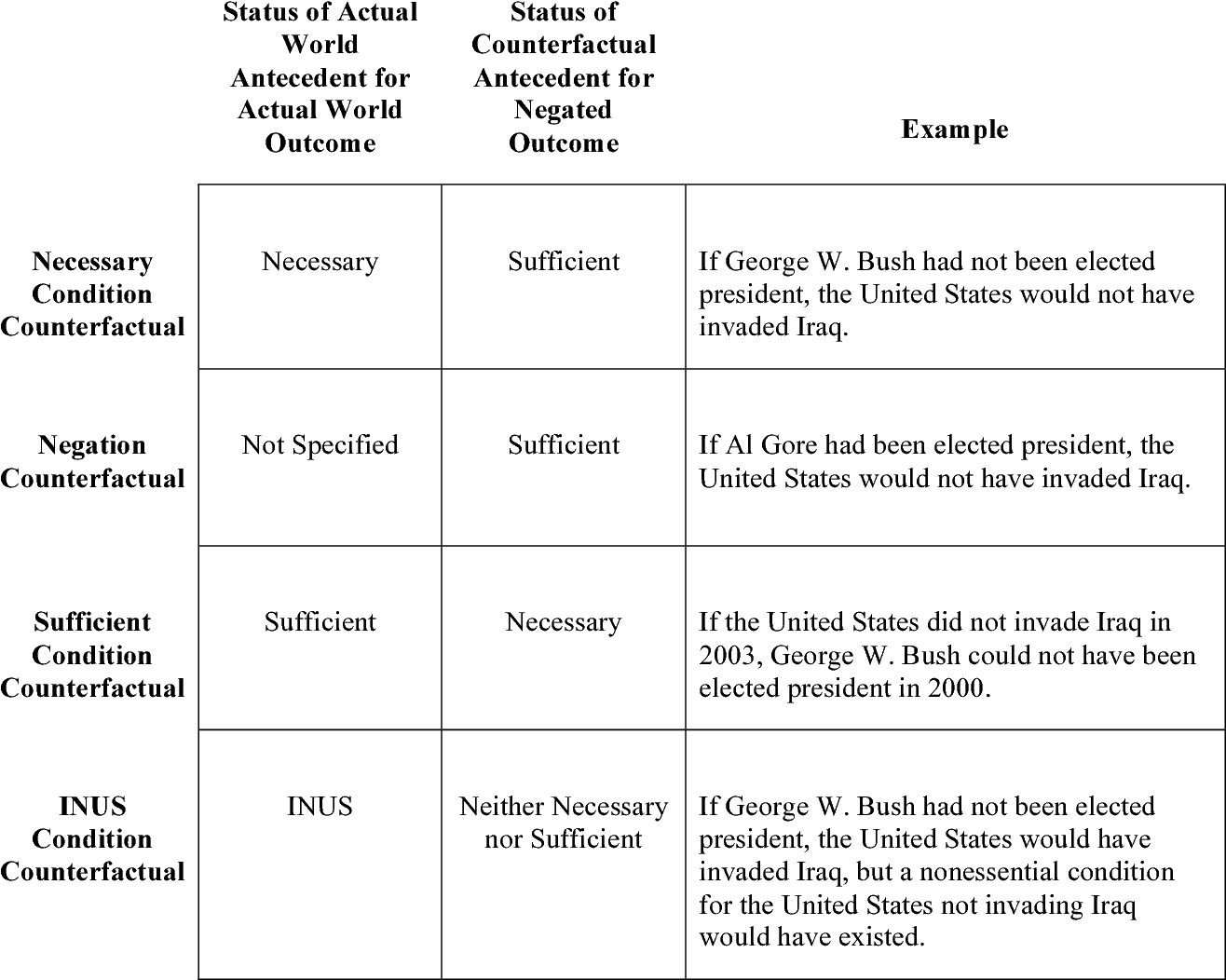
To further ground our approach, the table below illustrates how a "Necessary Condition Counterfactual" is typically framed.
Applying Counterfactual Tests to Event 1
We have two primary causes for the 5-year success of the cuckold-hotwife dynamic:
- H1: Unmet Sexual Needs: The wife's needs were fulfilled by the bull.
- H2: Best Friend Trust: The bull was the husband's best friend.
Let's formulate a counterfactual to test the necessity of each.
Test 1: Necessity of the 'Best Friend Trust' (H2)
- Causal Claim: The husband’s trust, enabled by his best-friend relationship with the bull, was necessary for the arrangement's long-term stability and success.
- Counterfactual Formulation: "If the third party had been a stranger selected by the couple, instead of the husband's best friend, would the arrangement have been successfully established and sustained for five years?"
To evaluate this, we apply the minimal rewrite rule. We imagine an alternative past where all conditions are identical—the wife's unmet needs, the couple's communication patterns, their socio-cultural context—but we change only the identity of the bull from "best friend" to "stranger."
We then consult our case evidence (E1-E5, covering interviews, communications, and the case chronology). Let's assume we find the following:
- The husband repeatedly stated in interviews (E1) that he "could never have agreed to this with anyone but [friend's name]" because he "knew his character" and trusted him "not to try and steal my wife."
- Communication logs (E2) from the initial stages show the husband's anxiety was high, but he frequently reassured himself by referencing his long history with the friend.
- The critical juncture analysis (E3) shows that the initial proposal only became viable when the wife suggested the best friend as a possibility, a suggestion the husband initially resisted but later accepted as the only workable option.
Conclusion of the Test: Based on this evidence, the counterfactual outcome appears to be failure. It is highly unlikely the husband would have overcome his initial anxiety and jealousy to provide the consistent consent needed for a five-year dynamic. The arrangement likely would have either never started or collapsed early on. Therefore, we conclude that the 'best friend trust' cause (H2) passes the necessity test.
Test 2: Necessity of 'Unmet Sexual Needs' (H1)
- Causal Claim: The fulfillment of the wife's previously unmet sexual needs was a necessary motivating force for establishing and sustaining the arrangement.
- Counterfactual Formulation: "If the wife had been fully sexually satisfied within the marriage from the outset, would the couple have pursued and sustained a cuckold-hotwife dynamic for five years?"
Here, the minimal rewrite is to imagine a version of the couple's history where sexual incompatibility was never an issue. All other factors—their deep emotional bond, communication style, and the husband's friendship with the bull—remain unchanged.
We again consult our evidence file:
- The wife’s interview (E1) details years of sexual frustration and a feeling of "being unseen" as a sexual being, which she identifies as the primary driver for wanting to "explore something new."
- The case chronology (E5) shows that the first conversations about non-monogamy were directly preceded by a period of acute marital tension explicitly linked to their lack of sexual intimacy.
- The husband's account (E1) confirms that his primary motivation for agreeing was his love for his wife and his pain at seeing her unhappy, stating "I was desperate to find a solution to make her happy again."
Conclusion of the Test: In this counterfactual world without the sexual dissatisfaction, the primary impetus for seeking a drastic change to their marital structure is removed. While they might have been "open-minded," the powerful, emotional need that drove them through the difficult early stages of the arrangement would be absent. The most plausible counterfactual outcome is continued monogamy. Therefore, we conclude that the 'unmet sexual needs' cause (H1) also passes the necessity test.
Conclusion
In this lesson, we have moved to the highest rung of the causal ladder, using disciplined counterfactual thought experiments to probe our primary hypotheses for Event 1.
The key takeaways are:
- Counterfactuals test causality by asking "what if," comparing the actual outcome to a plausible, imagined alternative.
- For a counterfactual to be analytically useful, it must follow the "minimal rewrite rule," surgically altering only the cause being tested.
- We formulated a counterfactual for the 'best friend trust' cause, concluding it was necessary for the arrangement's success. Without it, the husband's consent would have been unlikely.
- We formulated a counterfactual for the 'unmet sexual needs' cause, also concluding it was necessary. Without this motivation, the couple would have had no compelling reason to initiate the arrangement.
By establishing that both causes were necessary, we have significantly strengthened our claim that they were central to the outcome.
In our next lesson, we will apply this same rigorous logic to Event 2. We will formulate counterfactuals to assess whether the contestant's body type and the attire/persona contrast were also necessary, and whether they were jointly sufficient, for her to win the competition.