Introduction
Welcome to your next lesson on international trade. In our previous session, we established why countries trade, focusing on the principle of comparative advantage. We learned that by specializing in producing goods where they have a lower opportunity cost, countries can increase total world output, creating gains for everyone.
Today, we'll delve deeper into those gains. This lesson addresses the learning outcome: Describe the welfare effects of international trade (gains and losses). While trade makes a country better off as a whole, it doesn't benefit everyone within that country equally. We will use the concepts of consumer surplus and producer surplus—which you'll recall from our first module on market efficiency—to precisely identify who wins, who loses, and how we measure the overall net benefit to the nation.
1. The Framework: Autarky vs. The World Price
To analyze the effects of trade, we need a baseline. Economists call this baseline autarky, which is a state where a country does not trade with others. In autarky, the price of a good is determined solely by domestic supply and demand.
When a country opens up to international trade, its domestic price is influenced by the world price—the price of that good prevailing in the global market. The relationship between the autarky price and the world price dictates whether a country will become an exporter or an importer.
- If the world price is higher than the domestic autarky price, domestic producers will be eager to sell their goods abroad to fetch the higher price. The country will become an exporter.
- If the world price is lower than the domestic autarky price, domestic consumers will be eager to buy the cheaper goods available from abroad. The country will become an importer.
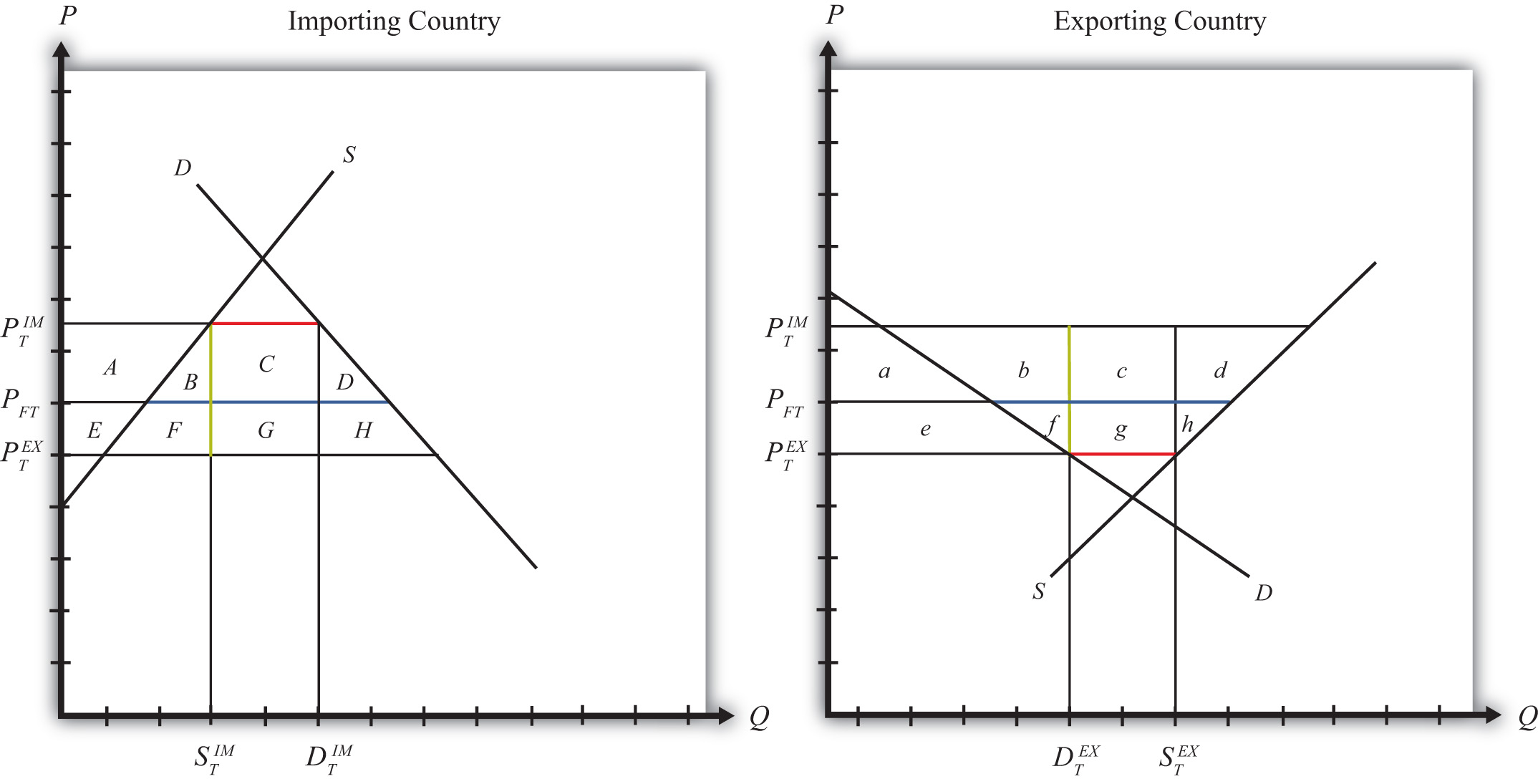
The image below illustrates these two scenarios. We will spend this lesson breaking down the welfare changes shown in these graphs.
2. Welfare Effects in an Exporting Country
Let's first consider a country whose domestic price for a good, let's say textiles, is lower than the world price. When it opens to trade, it will export textiles. The following video explains the consequences for producers and consumers.
Chapter 9: International Trade
This video from DrAzevedoEcon clearly explains how to analyze the welfare effects when a country opens to trade and becomes an exporter. It uses a standard supply and demand graph to show the changes in consumer and producer surplus.
Please watch the segment from 05:35 to 13:47. Focus on how the price changes to the world price and how this impacts the quantities supplied and demanded domestically. Pay close attention to the identification of the 'winner' (producers) and 'loser' (consumers) and the new area of total surplus gained.
As the video demonstrated, opening to trade has several clear effects in an exporting country:
- Price: The domestic price rises to meet the higher world price.
- Producers (Winners): Domestic producers are clear winners. They now receive a higher price for their product and increase their production. Their producer surplus—the area above the supply curve and below the price—increases substantially.
- Consumers (Losers): Domestic consumers are worse off. They must pay a higher price for textiles and, as a result, consume less. Their consumer surplus—the area below the demand curve and above the price—shrinks.
- National Welfare (Net Gain): While consumers lose, the gain for producers is larger than the consumers' loss. This creates a net increase in total surplus for the country. This net gain represents the economic value created by exporting.
Looking at the "Exporting Country" graph in the image above, the gain in producer surplus is areas b + c, while the loss in consumer surplus is area b. The net gain for the country's total surplus is therefore area c.
3. Welfare Effects in an Importing Country
Now, let's look at the opposite scenario: a country where the domestic price for a good, say, smartphones, is higher than the world price. When this country opens to trade, it will import smartphones.
Chapter 9: International Trade
We'll continue with the same video, which now explains the welfare effects for an importing country. The logic is a mirror image of the exporter case.
Please watch the segment from 13:47 to 20:36. Focus on how the lower world price benefits consumers and harms domestic producers. Again, identify the winner, the loser, and the net welfare gain.
Here is a summary of the effects in an importing country:
- Price: The domestic price falls to meet the lower world price.
- Consumers (Winners): Domestic consumers are the winners. They enjoy a lower price and can purchase more smartphones. Their consumer surplus increases significantly.
- Producers (Losers): Domestic producers are worse off. They must now compete with cheaper imports, so they receive a lower price and reduce their production. Their producer surplus shrinks.
- National Welfare (Net Gain): The gain for consumers is larger than the loss for producers. Just as with exporting, this leads to a net increase in the country's total surplus.
Referring back to the "Importing Country" graph in our image, the gain in consumer surplus is areas E + F + G, while the loss in producer surplus is area E. The net gain in national welfare is the sum of areas F + G.
4. Synthesis: The Overall Gains and the Political Debate
We have seen that whether a country imports or exports, opening to trade increases its overall economic welfare. The gains of the winners are always greater than the losses of the losers.
Chapter 9: International Trade
This short concluding clip summarizes the core message and explains why, despite the clear overall benefits, international trade often sparks intense political debate.
Please watch from 20:15 to 22:18. This section synthesizes the findings and connects the economic theory to real-world policy discussions.
The video makes a crucial point: from a societal viewpoint, trade is beneficial because the economic pie gets bigger. In theory, the winners could compensate the losers and still be better off. However, in practice, this redistribution rarely happens completely, leading to real economic hardship for those in industries that must compete with imports. This explains the political pressure for trade protection.
The CFA curriculum emphasizes understanding both the benefits and the drawbacks. Let's briefly watch a final clip that frames these effects in the context of a CFA exam perspective.
International Trade – Module 6 – Economics – CFA® Level I 2025 (and 2026)
This video from FinQuiz Pro provides a concise summary of the benefits and drawbacks of international trade, framing them in terms relevant to financial analysis.
Watch the segment from 00:17 to 01:25. Note the broader benefits like economic growth and competition, and the costs like income inequality and job losses.
The concepts of job losses in declining sectors and increased income inequality are the real-world manifestations of the decrease in producer surplus (for importing countries) that we analyzed graphically. For the CFA exam, it's important to connect the theoretical surplus analysis to these tangible economic outcomes.
Conclusion
In this lesson, we moved from the "why" of trade to the "who" and "how much" of its effects. You learned how to use the supply and demand framework to analyze the distribution of gains and losses from international trade.
Key Takeaways:
- The relationship between a country's autarky price and the world price determines whether it will be an importer or an exporter.
- In an exporting country, domestic producers win, and domestic consumers lose.
- In an importing country, domestic consumers win, and domestic producers lose.
- In both scenarios, the gains to the winners outweigh the losses to the losers, resulting in a net increase in national welfare (total surplus).
- The existence of groups who are harmed by free trade explains the persistent political demand for trade protection, even though trade is beneficial for the economy as a whole.
Preview of the Next Lesson:
The fact that free trade creates losers leads governments to implement policies designed to "protect" domestic industries from foreign competition. In our next lesson, we will analyze the economic impact of tariffs, quotas, and other trade restrictions. We will see how these policies interfere with the free market, and we will use the same welfare analysis tools to measure their costs to the economy.