Introduction
Welcome to the first lesson of our module on International Trade and Capital Flows. In our previous module, we concluded our study of domestic macroeconomic policy by examining how monetary and fiscal policies interact. Now, as previewed, we are broadening our perspective to the global stage to understand why countries trade with one another.
This lesson addresses a foundational concept in international economics: Explain absolute and comparative advantage and use opportunity costs to determine trade patterns.
We will start by defining two key theories of trade: absolute advantage, developed by Adam Smith, and the more nuanced theory of comparative advantage, introduced by David Ricardo. The core of our lesson will focus on understanding and calculating opportunity cost, the crucial element that determines comparative advantage. You will learn a step-by-step method to analyze production data, identify which country has a comparative advantage in which good, and predict the resulting patterns of specialization and trade. This analytical skill is essential for the CFA exam and for understanding the basis of global commerce.
1. Why Do Countries Trade? Absolute vs. Comparative Advantage
At its heart, trade is a voluntary exchange that benefits both parties. This is true for individuals buying coffee and it's true for countries trading goods and services. But what determines which countries sell what? Two major theories provide the answer.
Let's begin with a short video that introduces the fundamental idea that trade is mutually beneficial and sets the stage for our two key concepts.
Comparative Advantage and Trade - Macro Topic 1.3 (Micro Topic 1.4)
This video from Jacob Clifford starts with a fun, intuitive example of how trade creates value, before introducing the concepts of absolute and comparative advantage.
Please watch the first 2 minutes and 38 seconds of the video (00:00-02:38). Focus on the core idea that trade is a 'mutually beneficial exchange' and how the video defines absolute advantage.
As the video explained, the first and most intuitive theory is absolute advantage.
Absolute Advantage
This theory, proposed by Adam Smith, states that a country has an absolute advantage if it can produce a good or service using fewer resources (like labor hours) or produce more of it with the same amount of resources, compared to another country. It's a straightforward measure of productivity.
For example, if one worker in Country A can produce 10 shirts per day, while one worker in Country B can only produce 5, Country A has an absolute advantage in producing shirts.
Comparative Advantage
David Ricardo, another classical economist, argued that absolute advantage was too simple to explain the full picture of global trade. He introduced the concept of comparative advantage.
A country has a comparative advantage in producing a good if it can do so at a lower opportunity cost than another country.
Opportunity cost is what you give up to produce something else. For instance, if a country uses its resources to produce a car, the opportunity cost is the amount of, say, wheat it could have produced with those same resources.
Comparative advantage is the cornerstone of modern trade theory. It shows that even if one country has an absolute advantage in producing all goods, mutually beneficial trade is still possible as long as the opportunity costs of production differ between the countries.
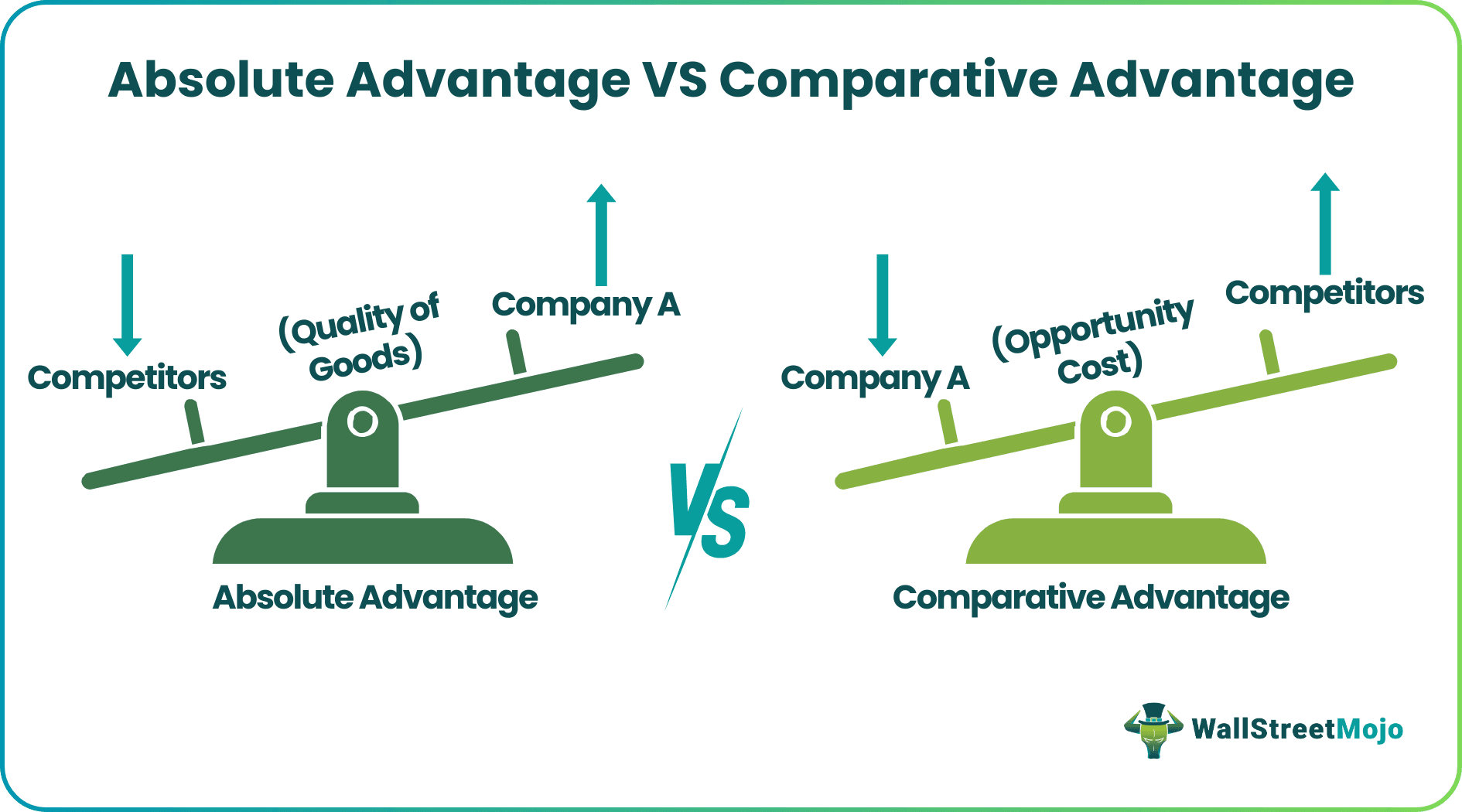
The image below provides a simple visual to help distinguish these two ideas.
2. The Core Calculation: Opportunity Cost
To determine comparative advantage, you must be able to calculate opportunity cost from production data. The CFA exam frequently tests this skill. Data is typically presented in one of two ways:
- Output problems: Showing how much can be produced with a given amount of resources (e.g., units per day).
- Input problems: Showing how many resources are needed to produce one unit (e.g., hours per unit).
Let's work through both.
Calculating Opportunity Cost from Output Data
The following video provides an excellent walkthrough of how to calculate opportunity costs from a table of output data.
Comparative Advantage - Why Does Trade Take Place?
This video by EconplusDal demonstrates a clear, step-by-step method for calculating opportunity cost and identifying comparative advantage from a production table.
Watch the segment from 02:21 to 05:52. Pay close attention to how the presenter sets up a separate table to calculate the 'per-unit' opportunity cost for each country and good.
Let's formalize the method shown in the video. When given output data (e.g., max units of Good X or Good Y), the opportunity cost of producing one unit of Good X is calculated as:
Example from the video:
India can produce 20 tons of cotton or 10 computers.
- To get 1 ton of cotton, India gives up computers.
- To get 1 computer, India gives up tons of cotton.
Ghana can produce 16 tons of cotton or 2 computers.
- To get 1 ton of cotton, Ghana gives up computers.
- To get 1 computer, Ghana gives up tons of cotton.
By comparing these, we see Ghana has a lower opportunity cost for cotton (0.125 < 0.5), while India has a lower opportunity cost for computers (2 < 8). Therefore:
- Ghana has the comparative advantage in cotton.
- India has the comparative advantage in computers.
Calculating Opportunity Cost from Input Data
Now let's look at an "input" problem, where the data is given in terms of resources needed per unit of output. The logic is similar, but the calculation starts from a different point.
Calculating Absolute and Comparative Advantage
This textbook section provides a clear, step-by-step guide to calculating comparative advantage from input data (worker-hours per unit).
Read the 'Work It Out' feature near the end of the webpage. This section details a practice problem involving Canada and Venezuela, demonstrating how to find absolute and comparative advantage from input data.
3. Determining Trade Patterns and Gains from Trade
Once you've identified the comparative advantages, determining the pattern of trade is straightforward: countries specialize in producing the good in which they have a comparative advantage and trade for the other good.
- In our first example, Ghana should specialize in cotton production, and India should specialize in computer production. India would then export computers to Ghana in exchange for cotton.
This specialization leads to gains from trade. By focusing on what they do relatively best, total world production increases, and both countries can consume more than they could if they produced everything domestically.
The Critical Test: What if a Country is Better at Everything?
A common point of confusion is what happens if one country has an absolute advantage in both goods. Does trade still make sense? The theory of comparative advantage proves that it does.
To solidify your understanding, please read the introduction to the following section. It tackles the crucial scenario where one country has an absolute advantage in all goods, showing why comparative advantage is the true driver of trade.
Read the first four paragraphs of section '19.2 What Happens When a Country Has an Absolute Advantage in All Goods'. Focus on the example of the United States and Mexico, where the U.S. is more productive in making both shoes and refrigerators.
The key insight from this reading is powerful: even though the U.S. worker is more productive in making both shoes and refrigerators, the degree of its advantage differs. The U.S. advantage is relatively greater in refrigerators. Mexico's disadvantage is relatively smaller in shoes.
This difference in relative productivity creates different opportunity costs, which is all that is needed for mutually beneficial trade. The U.S. should specialize in refrigerators (its comparative advantage), and Mexico should specialize in shoes (its comparative advantage). By trading, both countries end up better off.
This principle demonstrates that trade is not a zero-sum game where one country's gain is another's loss. It is a positive-sum game driven by differences in opportunity costs.
Conclusion
In this lesson, we have laid the foundation for understanding international trade. You learned the fundamental theories that explain why countries engage in commerce across their borders.
Key Takeaways:
- Absolute Advantage refers to being able to produce a good with fewer resources or in greater quantity than a competitor.
- Comparative Advantage refers to being able to produce a good at a lower opportunity cost. It is the fundamental driver of international trade.
- Opportunity Cost is the value of the next-best alternative that is given up when making a choice. It is calculated by comparing the trade-offs between producing different goods.
- To determine trade patterns, you must calculate the opportunity cost for each country and good. A country will specialize in and export the good for which it has a comparative advantage.
- Gains from trade exist even when one country has an absolute advantage in all goods, as long as opportunity costs differ.
Preview of the Next Lesson:
We've established that specialization and trade based on comparative advantage can increase total world output, allowing countries to consume more than they could produce on their own. But how are these gains distributed? In our next lesson, we will address the learning outcome: Describe the welfare effects of international trade (gains and losses). We will analyze how international trade affects consumer surplus and producer surplus within a country, identifying the specific groups that win and lose from opening up to trade.