Introduction
Welcome back! In our last lesson, we explored the welfare effects of free international trade. We established a crucial foundation: while opening to trade increases a nation's total economic welfare, it creates distinct winners and losers within the country. Specifically, producers in importing countries and consumers in exporting countries face losses, which often leads to political demands for protection from foreign competition.
Today's lesson directly addresses this political reality. We will analyze the economic impact of tariffs, quotas, and other trade restrictions. Using the same surplus analysis tools from our previous lessons, you will learn to dissect how these protectionist policies work, who they benefit, who they harm, and what their ultimate cost is to the economy. This is a core topic for the CFA exam, as understanding trade policy is vital for assessing risks and opportunities in global markets.
1. An Overview of Trade Restrictions
Governments have a variety of tools to limit free trade. These policies are generally known as trade restrictions or protectionism. Before we dive into the detailed analysis of each, let's get a quick overview of the main types and the justifications often provided for them.
International Trade – Module 6 – Economics – CFA® Level I 2025 (and 2026)
This video from FinQuiz Pro provides a concise introduction to the most common types of trade restrictions, such as tariffs, quotas, and export subsidies, and briefly touches on why governments implement them.
Please watch the first 2 minutes and 35 seconds of the video. Focus on identifying the different types of restrictions and the stated goals of these policies.
As the video outlined, while protecting domestic industries and jobs are the most common reasons given, these policies come with significant economic consequences. Let's now analyze those consequences in detail, starting with the most common form of trade restriction: the tariff.
2. The Economic Impact of a Tariff
A tariff is simply a tax levied on imported goods. Its primary effect is to raise the price of the imported product in the domestic market. This sets off a chain of effects on consumers, producers, and the government.
The following video provides a step-by-step graphical analysis of a tariff's impact, which is a critical skill for the exam.
CFA® Level I Economics - Trade Restrictions (Tariffs, Quotas, VERs, Export Subsidies)
This video from PrepNuggets clearly illustrates the welfare effects of a tariff using a supply and demand diagram. It visually breaks down the changes in consumer surplus, producer surplus, government revenue, and the resulting deadweight loss.
Please watch from 01:21 to 02:48. Pay close attention to how the tariff increases the price from the 'World Price' and how this changes the areas representing surplus and government revenue.
Let's solidify this analysis by looking at a static version of the diagram.
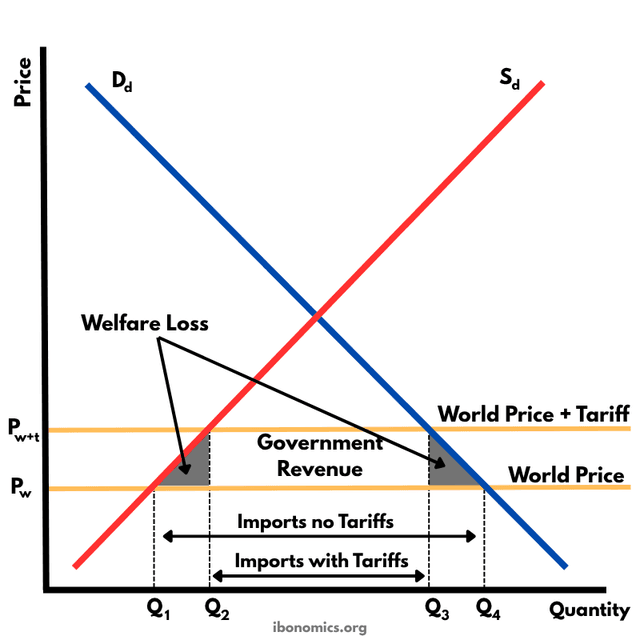
Based on the video and the diagram, we can summarize the effects of a tariff on the importing country:
- Consumer Surplus: Decreases. Consumers now pay a higher price and buy less of the good.
- Producer Surplus: Increases. Domestic producers are shielded from some foreign competition, receive a higher price, and sell a larger quantity.
- Government Revenue: Increases. The government collects tax revenue equal to the tariff amount multiplied by the quantity of imports. In the diagram above, this is the rectangular area labeled "Government Revenue."
- National Welfare: Decreases. The loss in consumer surplus is greater than the combined gain in producer surplus and government revenue. The net loss in welfare is called a deadweight loss, represented by the two triangular areas labeled "Welfare Loss." This loss occurs because the tariff distorts incentives, leading to inefficiently high domestic production and inefficiently low consumption.
A Note on "Large" vs. "Small" Countries
The CFA curriculum distinguishes between "small" and "large" countries in the context of trade.
- A small country is a price taker on the world market; its policies cannot affect the world price. For a small country, a tariff always leads to a net welfare loss.
- A large country (one that is a major importer of a good) can potentially influence the world price. By imposing a tariff, it can force foreign exporters to lower their prices to remain competitive. In this theoretical case, if the gain from the lower world price (an improvement in its "terms of trade") is larger than the deadweight loss, the large country could experience a net welfare gain. However, this assumes other countries do not retaliate with their own tariffs.
3. Import Quotas and Voluntary Export Restraints (VERs)
Next, we'll examine non-tariff barriers, starting with import quotas.
An import quota is a direct quantitative limit on the amount of a good that can be imported. A voluntary export restraint (VER) is similar, but it's a limit imposed by the exporting country at the request of the importing country.
Let's see how the effects of a quota compare to a tariff.
CFA® Level I Economics - Trade Restrictions (Tariffs, Quotas, VERs, Export Subsidies)
We'll return to the PrepNuggets video to analyze quotas and VERs. The key is to understand the similarities to a tariff and the one crucial difference.
Please watch from 02:48 to 04:15. Focus on the concept of 'quota rent' and who captures it under a quota versus a VER.
Here's the key distinction:
- Tariff vs. Quota: A quota that restricts imports to the same level as a tariff will create the same price increase, the same changes in consumer and producer surplus, and the same deadweight loss. The crucial difference is what happens to the area that would have been government revenue under a tariff. This value is known as quota rent.
- Quota Rent: This is the extra profit earned by those who are given the right to import under the quota (i.e., the import license holders), because they can buy the good at the world price and sell it at the higher domestic price.
- If the government of the importing country sells or auctions the import licenses, it can capture the quota rent, making the effect on national welfare identical to a tariff.
- If the government gives the licenses to domestic importers or foreign exporters for free, those firms capture the quota rent.
- Voluntary Export Restraints (VERs): In this case, the government of the exporting country administers the quota. This means the quota rents are captured by the foreign exporters or the foreign government. For the importing country, a VER is therefore the costliest form of trade protection, as the welfare loss is larger than that of an equivalent tariff because the quota rents are transferred abroad.
4. Export Subsidies
The final major restriction to consider is an export subsidy. This is a payment by the government to a firm for each unit of a good it exports. The goal is to stimulate exports from a specific domestic industry.
Types of Trade Restrictions | CFA Level 1
To understand the impact of export subsidies, let's read a section from the AnalystPrep article. It explains how these subsidies affect the exporting country's domestic market and national welfare.
Please read the section titled 'Export Subsidies.' Pay attention to how the subsidy affects the domestic price, consumption, and the government's budget.
The effects of an export subsidy on the exporting country are:
- Domestic Price: Increases, because domestic producers will only sell at home if the price matches what they could get from exporting (world price + subsidy).
- Consumer Surplus: Decreases due to the higher domestic price.
- Producer Surplus: Increases due to the higher price received and increased production.
- Government Revenue: Decreases, as the government must pay for the subsidy.
- National Welfare: Decreases. The cost of the subsidy plus the efficiency losses from distorted production and consumption lead to a net welfare loss for the exporting country.
Importing countries may respond to export subsidies by imposing countervailing duties, which are tariffs designed to offset the effect of the subsidy.
5. Summary and Application
The effects of these different policies are a critical area for the CFA exam. The tables below provide a concise summary of their impact on the domestic market and national welfare.
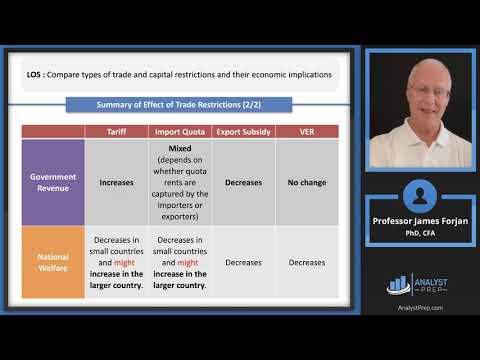
To solidify your understanding, let's work through a typical CFA-style question.
Types of Trade Restrictions | CFA Level 1
This is a practice question from the AnalystPrep article we reviewed earlier. Read the question and its solution to test your understanding of how different restrictions impact government finances.
Read the multiple-choice question and the provided solution. Make sure you understand why answer A is correct and why B and C are incorrect based on our discussion of tariff revenue, quota rents, and subsidy costs.
The key to the question is recognizing that only a tariff directly and necessarily increases government revenue. The revenue effect of a quota is uncertain (depending on how licenses are distributed), and an export subsidy is a cost to the government.
Conclusion
In this lesson, we analyzed the economic impact of the main forms of trade restrictions. You learned how to use welfare analysis to measure the consequences of these policies for different groups and for the nation as a whole.
Key Takeaways:
- Tariffs raise the domestic price, benefiting producers and the government at the expense of consumers. They create a net welfare loss for the country (unless it's a large country that benefits from improved terms of trade without retaliation).
- Import Quotas have similar effects to tariffs on price and quantity, but they create quota rents. Who captures these rents (the government, domestic importers, or foreign exporters) determines the precise welfare impact.
- Voluntary Export Restraints (VERs) are the most harmful form of protection for an importing country because the quota rents are transferred to the exporting nation.
- Export Subsidies harm the country that imposes them by increasing domestic prices and creating a drain on the government budget, leading to a net welfare loss.
- The overarching conclusion is that trade restrictions, while benefiting specific protected industries, generally lead to a decrease in national welfare and an inefficient allocation of resources.
Preview of the Next Lesson:
The tendency of nations to use harmful trade restrictions, and the desire to manage global economic issues, led to the creation of powerful international institutions. In our next lesson, we will describe the roles of the World Trade Organization (WTO), the International Monetary Fund (IMF), and the World Bank in shaping international economics and promoting trade.