Introduction
Welcome to your next lesson in CFA Level 1 Economics. In our last session, we established that the balance of payments must always balance. A country with a current account deficit (importing more than it exports) must finance this gap with a corresponding surplus in its financial and capital accounts, meaning it must be a net borrower from the rest of the world.
Today, we will connect this international reality to a country's domestic economy. This lesson directly addresses the learning outcome: to explain the relationship between the trade balance, national savings, and domestic investment. We will derive and analyze a crucial equation that links these three components. Understanding this relationship is not just an academic exercise; it provides a powerful framework for analyzing economic policy and is a frequently tested concept on the CFA exam.
1. Deriving the Fundamental Relationship
To understand the link between trade, savings, and investment, we need to begin with a core principle of macroeconomics: for an economy as a whole, total income must equal total expenditure (or output). This is the basis of the Gross Domestic Product (GDP) accounting we've seen before.
We can express this principle using two fundamental equations:
- The Expenditure Equation: Total expenditure (GDP, or
Y) is the sum of Consumption (C), Investment (I), Government spending (G), and Net Exports (X-M).
- The Income Equation: Total income (
Y) is allocated in one of three ways: it is spent on Consumption (C), Saved (S), or used to pay Taxes (T).
Since Y is the same in both equations, we can set them equal to each other to uncover the relationship between their components. The following video provides a clear, step-by-step derivation of this core macroeconomic identity.
Level 1 CFA Economics: Currency Exchange Rates-Lecture 6
This video from IFT will walk you through the derivation of the key formula starting from the basic income and expenditure identities. This explains the 'why' behind the relationship we are studying.
Watch the entire video (approximately 5 minutes). Focus on how the two fundamental equations for income and expenditure are combined to produce the final relationship: (X - M) = (S - I) + (T - G).
2. Deconstructing the Savings-Investment Identity
As the video demonstrated, by setting the income and expenditure equations equal (C + S + T = C + I + G + (X - M)) and cancelling out consumption (C), we can rearrange the terms to get our central formula:
Let's break down what each part of this equation represents:
- (X – M): The Trade Balance. This is the value of exports minus the value of imports. It is the largest component of the current account balance.
- (S – I): The Private Sector Balance. This is the difference between private savings (
S) and domestic investment by firms (I). IfS > I, the private sector is a net saver. IfS < I, it is a net borrower. - (T – G): The Government (Fiscal) Balance. This is the difference between government tax revenue (
T) and government spending (G). IfT > G, the government has a budget surplus. IfT < G, it has a budget deficit.
The equation tells us that a country's trade balance must be equal to the sum of its private sector balance and its government fiscal balance.
To reinforce this, the following reading presents the same relationship, but arranged in slightly different ways. Seeing the equation from multiple angles can deepen your understanding.
Savings, Investment & Trade Balance | CFA Level 1 - AnalystPrep
This article from AnalystPrep provides another look at the fundamental identity. It starts with the familiar GDP formula and presents the savings-investment equation in a way that highlights the different uses of savings.
Read the article from the beginning down to the end of the 'Fiscal Policy' section. Notice how it presents the identity as S = I + (G – T) + (X – M). This is just a rearrangement of the formula we derived, emphasizing that domestic savings (S) must fund domestic investment (I), the government budget deficit (G-T), and net exports (X-M).
3. Interpreting Economic Scenarios
The true power of this identity lies in its ability to explain real-world economic situations. Let's analyze two main scenarios.
Scenario 1: Trade Deficit (X – M < 0)
If a country runs a trade deficit, it is importing more goods and services than it is exporting. According to our formula, this means that the sum of the private and public sector balances must also be negative:
This can be rearranged to:
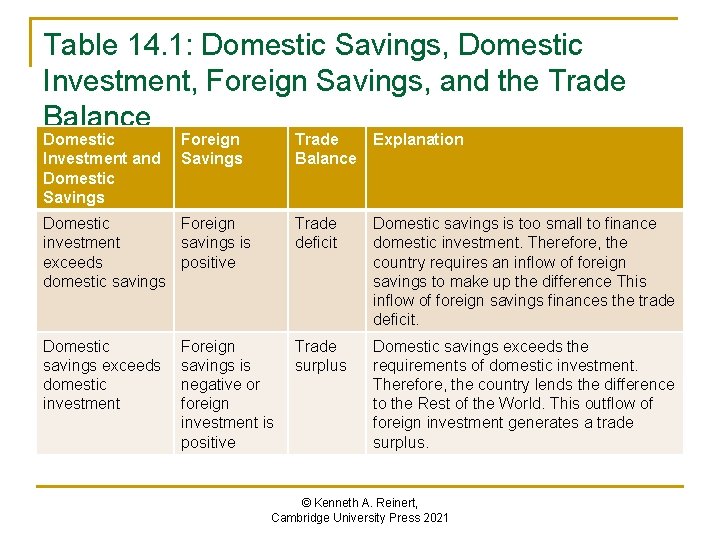
In plain English, a trade deficit means that a country's domestic investment is greater than its total national savings (private savings plus the government's budget balance).
How can a country invest more than it saves? It must import capital from the rest of the world. This capital inflow (borrowing from foreigners or selling assets to them) is what finances the trade deficit and is recorded as a surplus on the financial account, exactly as we discussed in the previous lesson.
A common cause of trade deficits is a large government budget deficit (T-G is very negative). If private savings (S) do not increase enough to offset the government's borrowing, the country as a whole will have a savings shortfall that must be met by capital inflows, resulting in a trade deficit. This is often referred to as the twin deficits problem.
Scenario 2: Trade Surplus (X – M > 0)
Conversely, if a country runs a trade surplus, it exports more than it imports. This implies:
This means the country's total national savings are greater than its domestic investment needs. What does it do with these excess savings? It exports them. This takes the form of lending to other countries or buying foreign assets, which is recorded as a deficit on the financial account (a net capital outflow).
The table below provides a concise summary of this dynamic.
4. Practical Application
This relationship is a common source of exam questions. You will often be asked to solve for one component given the others. This requires you to be comfortable rearranging the core formula.
Let's try a question from the AnalystPrep resource you just read.
Question:
When aggregate expenditure equals aggregate output, the government’s fiscal deficit is most likely equal to:
A. private saving – Investment – Net exports
B. private saving – Investment + Net exports
C. investment – Private saving + Net exports
Think through your answer:
- Start with the identity
(X – M) = (S – I) + (T – G). - The question asks for the fiscal deficit, which is
(G - T). Notice that our formula has(T - G). So,Fiscal Deficit = -(T - G). - Let's isolate
(T - G)first:(T - G) = (X - M) - (S - I). - Now, multiply by -1 to get the fiscal deficit
(G - T):(G - T) = -[(X - M) - (S - I)] - Distribute the negative sign:
(G - T) = -(X - M) + (S - I) - Rearrange the terms:
(G - T) = (S - I) - (X - M). - This translates to:
Fiscal Deficit = Private Saving – Investment – Net Exports.
Solution: The correct answer is A. This exercise demonstrates how manipulating this single identity can answer a variety of questions.
Conclusion
In this lesson, we have established a critical link between a country's international transactions and its domestic economy. You are now equipped to explain the relationship between trade, savings, and investment, a cornerstone of macroeconomics.
Key Takeaways:
- The fundamental macroeconomic identity is (X – M) = (S – I) + (T – G).
- This equation states that a country's trade balance is the sum of its private savings balance and its government fiscal balance.
- A trade deficit implies that a country's domestic investment exceeds its national savings. This gap is filled by net capital inflows from abroad.
- A trade surplus implies that a country's national savings exceed its domestic investment. This excess saving is channeled abroad as net capital outflows.
Preview of the Next Lesson:
We have now seen that a current account imbalance is balanced by a financial account imbalance, and we understand the domestic savings/investment dynamic that this reflects. But how does this balancing occur? The price mechanism that connects these international flows is the exchange rate. In our next lesson, we will begin our study of currency exchange rates, defining nominal and real rates and learning how to perform essential calculations like cross-rates. We will eventually see how movements in exchange rates play a crucial role in influencing the trade and investment flows we've discussed today.