Introduction
Welcome to the twelfth module of our course. In our previous lesson, we connected a country's domestic economy to its international trade, establishing that a trade deficit must be financed by foreign capital, and a trade surplus corresponds to an outflow of domestic capital. We concluded by noting that the exchange rate is the key price that governs these international flows.
This lesson marks the beginning of our deep dive into currency exchange rates. We will address a fundamental learning outcome: to define nominal and real exchange rates and convert between direct and indirect quotes. Mastering these definitions and conventions is the essential first step for all topics in international finance. You'll learn the language of the foreign exchange market, which is crucial for analyzing how currency movements impact investments, trade, and economic policy.
1. Nominal Exchange Rates and Quoting Conventions
Let's start with the basics. A nominal exchange rate is simply the price of one country's currency in terms of another. It's the rate you see quoted by banks or on financial news websites. However, to interpret these quotes correctly, we must understand the market conventions.
Base vs. Price Currency
Every exchange rate quote involves a pair of currencies. The convention is to distinguish between a base currency and a price currency.
- Base Currency: The currency that is the basis for the quote. It is always equal to one unit.
- Price Currency: The currency in which the base currency is valued. The quote tells you how many units of the price currency are needed to buy one unit of the base currency.
For example, in the quote USD/EUR = 1.15, the Euro (EUR) is the base currency, and the US Dollar (USD) is the price currency. This means you need 1.15 US dollars to buy 1 Euro.
Direct vs. Indirect Quotes
The terms 'direct' and 'indirect' depend on your perspective—specifically, on which currency you consider your domestic currency.
- A direct quote is one where the domestic currency is the price currency.
- An indirect quote is one where the domestic currency is the base currency.
Let's continue with our USD/EUR = 1.15 example:
- For an investor in the United States, this is a direct quote. It directly tells them the price of the foreign currency (EUR) in their domestic currency (USD).
- For an investor in the Eurozone, this is an indirect quote. It tells them how many units of the foreign currency (USD) they can get for one unit of their domestic currency (EUR). Their direct quote would be
EUR/USD.
Converting Between Quotes
Converting between direct and indirect quotes is straightforward: you simply take the reciprocal of the exchange rate.
If USD/EUR = 1.15, then the inverse quote, EUR/USD, is:
This means 1 US dollar can buy approximately 0.8696 Euros.
The following reading provides a detailed explanation of these critical quoting conventions.
Foreign Exchange Market Overview
Please read the following section from AnalystPrep to solidify your understanding of how currency pairs are structured and quoted. It clearly explains the concepts of price currency, base currency, and the distinction between direct and indirect quotes.
Please read the section titled 'Exchange Rate Quotations.' Focus on the definitions of price currency and base currency using the A/B convention, and make sure you understand the examples for direct and indirect quotes from the perspective of the French investor.
2. Real Exchange Rates: Adjusting for Purchasing Power
While the nominal exchange rate tells you the rate of currency exchange, it doesn't tell you anything about what those currencies can actually buy. Two countries could have high inflation, which would distort the picture. This is where the real exchange rate comes in.
The real exchange rate adjusts the nominal exchange rate for differences in the price levels between two countries. It measures the relative purchasing power of the currencies, telling you how many "baskets of goods" in one country you could exchange for a basket of goods in another.
The Real Exchange Rate Formula
For the CFA exam, you must know the standard formula for the real exchange rate, which is expressed from the perspective of a domestic consumer.
Where:
d/findicates the quote is in "domestic currency per unit of foreign currency".- is the nominal spot exchange rate (units of domestic currency per one unit of foreign currency).
- is the price level in the foreign country (often a CPI).
- is the price level in the domestic country (often a CPI).
Deconstructing the Formula:
Let's think about what this formula is actually doing. The term converts the price of foreign goods into the domestic currency. Then, by dividing by , we are comparing the price of foreign goods (in our currency) to the price of domestic goods. The result is a ratio of the prices of the two "baskets of goods."
The reading below provides a formal definition of the real exchange rate and walks through a calculation example.
Foreign Exchange Market Overview
Now, let's turn back to the AnalystPrep article to learn the formal definition and formula for the real exchange rate. Pay close attention to the worked example, as it is a typical CFA-style problem.
Read the section titled 'Nominal and Real Exchange Rates.' Focus on the formula for the real exchange rate and how each component (S, P_f, P_d) is defined. Work through the example calculation carefully.
3. Interpreting and Applying Exchange Rates
Understanding the formulas is only half the battle; you also need to interpret what the numbers mean for a country's economy.
A key concept is competitiveness. An increase in the real exchange rate (d/f) means that foreign goods have become more expensive relative to domestic goods. This makes the domestic country's exports more attractive (more competitive) and its imports less attractive.
The following video provides an excellent conceptual overview using a simple example of buying iPhones in different countries. It helps build the intuition behind how exchange rates relate to competitiveness.
Important Note: The video uses a slightly different formula convention (indirect quotation). Do not worry about memorizing their formula. Instead, focus on the logic they present about how changes in prices and exchange rates affect whether a country's goods are seen as "overvalued" or "undervalued," which directly relates to competitiveness.
Real Exchange Rate vs Nominal Exchange Rate
This video from InLecture offers a great way to build intuition about the difference between nominal and real exchange rates and how they relate to the real-world concept of competitiveness.
Watch the video from the beginning until 05:26. Focus on the core idea: the real exchange rate tells you about the relative cost of goods. Pay attention to the examples showing how changes in prices affect whether a currency is considered overvalued or undervalued, making its goods more or less competitive.
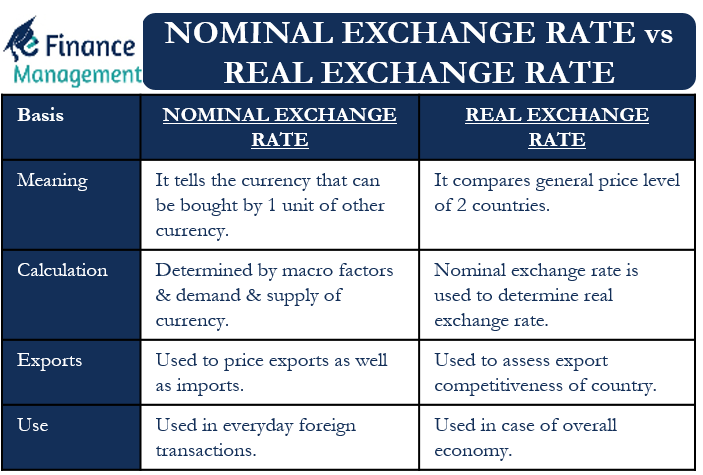
To consolidate these two concepts, here is a helpful summary table.
4. Practice Question
Let's apply what you've learned.
An analyst based in the United Kingdom is reviewing currency data. She observes the following:
- The nominal spot exchange rate (GBP/USD) is 0.80.
- The Consumer Price Index (CPI) in the U.S. is 120.
- The Consumer Price Index (CPI) in the U.K. is 110.
What is the real exchange rate from the perspective of the U.K. analyst?
Thinking process:
- Identify the domestic and foreign currencies. For a U.K. analyst, the domestic currency (d) is GBP and the foreign currency (f) is USD.
- Identify the formula: Real rate (d/f) = .
- Check the spot rate convention. The required spot rate is , which means GBP per USD. The rate given is
GBP/USD = 0.80, which is the correct format. So, . - Identify the price levels. . .
- Calculate:
Answer: The real exchange rate is approximately 0.8727.
Conclusion
In this lesson, we have laid the essential groundwork for understanding foreign exchange markets. You are now familiar with the vocabulary and calculations that will appear throughout the rest of this and subsequent modules.
Key Takeaways:
- Nominal Exchange Rate: The price of one currency in terms of another.
- Quoting Conventions: A quote
A/BmeansAis the price currency andBis the base currency. It states the number of units of A required to buy one unit of B. - Direct vs. Indirect Quotes: A direct quote has the domestic currency as the price currency. An indirect quote has the domestic currency as the base currency. You can convert between them by taking the reciprocal.
- Real Exchange Rate: Adjusts the nominal rate for inflation differentials to measure relative purchasing power. The formula is: Real rate (d/f) = .
- An increase in the real rate (d/f) implies domestic goods are becoming relatively cheaper, enhancing export competitiveness.
Preview of the Next Lesson:
Now that you can interpret a single currency pair quote, what happens when you need to know the exchange rate between two currencies that aren't directly quoted against each other? In our next lesson, we will learn how to calculate a currency cross-rate using two existing exchange rate quotes. For example, if you know the USD/EUR rate and the USD/GBP rate, you will learn how to derive the EUR/GBP rate.