Introduction
Welcome back! In our last lesson, we established the fundamental concepts of nominal and real exchange rates, and crucially, how to interpret currency quotes using the price/base currency convention (e.g., A/B). We saw that converting between a direct and an indirect quote simply involves taking the reciprocal.
This lesson builds directly on that foundation. We will tackle a very practical and common task in finance: calculating a currency cross-rate. Often, you won't find a direct market quote for the currency pair you're interested in (e.g., Polish Zloty to South African Rand). However, you will likely find quotes for both currencies against a major currency like the US Dollar. Your goal for this lesson is to learn how to calculate the implied exchange rate between two currencies using their respective rates against a common third currency. This is an essential mechanical skill for the CFA exam and for any analysis involving multiple currencies.
1. The Core Logic of Cross-Rates
Before diving into the standard financial notation, let's build an intuitive understanding of the concept. At its heart, a cross-rate calculation is a simple algebraic exercise.
If we know that 1 US Dollar buys 19 Mexican Pesos, and 1 US Dollar also buys 70 Indian Rupees, it logically follows that 19 Mexican Pesos must be worth the same as 70 Indian Rupees. From this simple equality, we can figure out the exchange rate between Pesos and Rupees.
The following short video provides a very clear, step-by-step demonstration of this intuitive logic.
Calculate "cross rate": example 1 (easier)
This video from the Teach me finance channel breaks down the cross-rate calculation to its most basic principles, which is a great way to start.
Watch the entire video (it's about 4 minutes long). Notice how it establishes an equality (19 Pesos = 70 Rupees) and then solves for the two possible exchange rates: Pesos per Rupee and Rupees per Peso.
This simple method always works. However, for efficiency and to align with industry practice, we use a more formal technique often called the "chain rule" method, which relies on the A/B notation you learned in the last lesson.
2. The "Chain Rule" Method for Cross-Rate Calculation
The standard method for calculating cross-rates involves treating the currency pairs like fractions and arranging them so that the common, or "intermediate," currency cancels out.
The rule is:
Here, B is the common currency. By multiplying the A/B rate by the B/C rate, the B currency "cancels out," leaving you with the desired A/C cross-rate.
Let's see how this works in practice.
Case 1: The Common Currency Cancels Directly
This is the most straightforward scenario. You are given two exchange rates where the common currency is the base currency in one quote and the price currency in the other.
To see this in action, please watch the following segment from an AnalystPrep video tailored for the CFA exam.
Exchange Rate Calculations (2025 CFA® Level I Exam – Economics – Learning Module 8)
This video demonstrates the standard 'chain rule' method. This first segment covers the ideal case where the common currency is positioned for direct cancellation.
Watch from 03:25 to 05:40. Pay close attention to the example where the goal is to find the RUB/CNY rate from the RUB/ZAR and ZAR/CNY rates. Notice how multiplying them cancels out the ZAR (South African Rand).
As the video showed, given RUB/ZAR and ZAR/CNY, you can find RUB/CNY by setting up the multiplication:
The ZAR units cancel, and you are left with the correct cross-rate.
Case 2: Inversion is Required
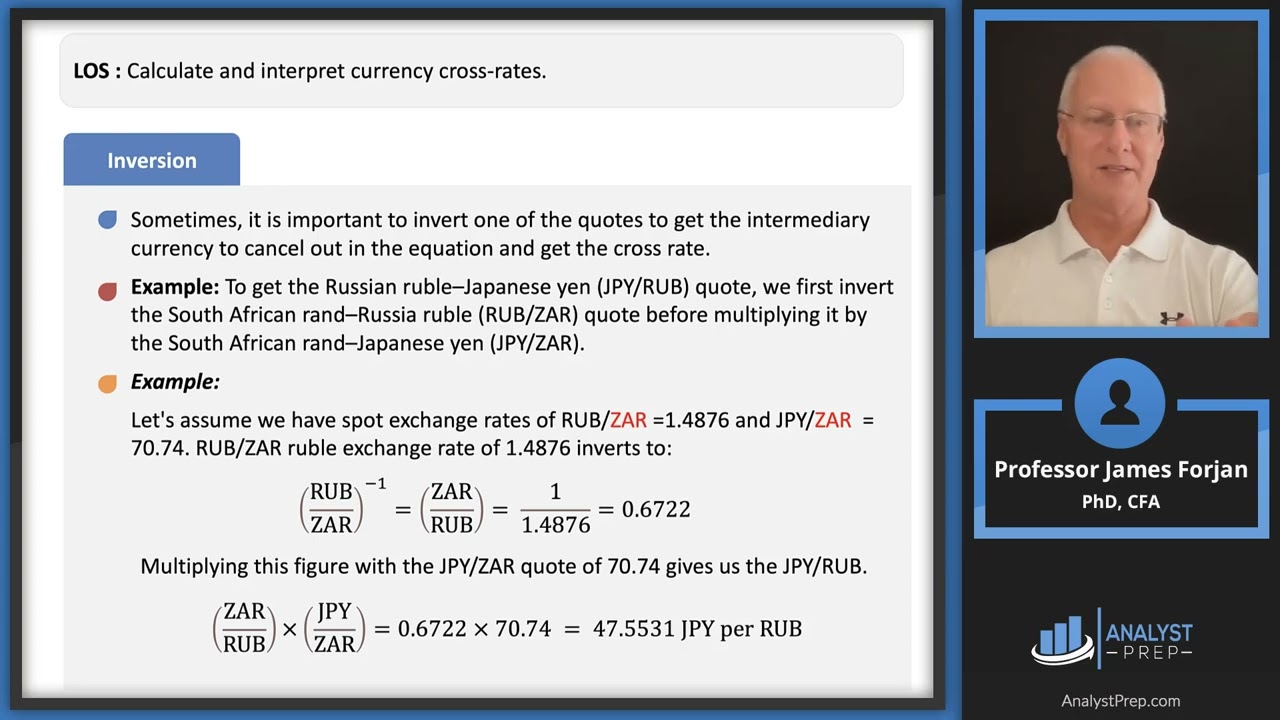
But what if the common currency doesn't line up so nicely? For example, what if you are given RUB/ZAR and JPY/ZAR and need to find the JPY/RUB rate?
The common currency, ZAR, is the base currency in both quotes. If you were to multiply them directly:
This result is nonsensical. This is where the skill you learned in the last lesson—finding the reciprocal—becomes critical. To make the common currency cancel, you must invert one of the quotes.
By inverting the RUB/ZAR rate, you get the ZAR/RUB rate:
Now, you can perform the chain rule calculation:
The next segment of the video explains this exact scenario.
Exchange Rate Calculations (2025 CFA® Level I Exam – Economics – Learning Module 8)
Now watch the next part of the same video, which covers the crucial step of inverting a rate before you can calculate the cross-rate.
Watch from 06:36 to 08:37. Focus on why simple multiplication fails and how inverting one of the rates solves the problem.
This process of inverting a rate to facilitate a cross-rate calculation is a frequent source of error, so it's vital to master. Here is a clear visual summary of the process.
3. Practice and Application
Your preference for practical problem-solving is key to retaining this material. Let's work through a problem together, then you can solve one on your own.
Problem:
An analyst is given the following spot exchange rates from the dealer market:
USD/EUR = 1.3960CHF/USD = 0.9587
Calculate the CHF/EUR spot cross-rate.
Solution Steps:
- Identify the Goal: We want to find
CHF/EUR. This means we needCHFas the price currency andEURas the base currency. - Identify the Given Rates and the Common Currency: We have
USD/EURandCHF/USD. The common currency isUSD. - Arrange the Rates for Cancellation: Our target is
CHF/EUR. Let's write out the chain rule formula:
- Check the Alignment:
- We need
CHF/USD. We are givenCHF/USD = 0.9587. This matches. - We need
USD/EUR. We are givenUSD/EUR = 1.3960. This also matches. - In this case, the common currency (
USD) is already in the denominator of the first term and the numerator of the second. No inversion is needed.
- We need
- Calculate:
The CHF/EUR cross-rate is 1.3383.
Your Turn
Now, use the following information to solve a practice problem. This one requires careful attention to the currency positions.
Practice Question:
Given the following quotes:
USD/GBP = 1.5160(1.5160 US dollars per British pound)USD/EUR = 1.3690(1.3690 US dollars per Euro)
Calculate the GBP/EUR cross-rate.
Think through the steps: What is your target rate? What is the common currency? Do you need to invert one of the given rates to make the chain rule work?
Click here for the solution
- Goal: Find
GBP/EUR. - Given Rates:
USD/GBPandUSD/EUR. The common currency isUSD. - Arrange the Rates: We want
GBP/EUR. The chain rule would be:
- Check Alignment:
- We need
GBP/USD. We are givenUSD/GBP = 1.5160. This is the inverse of what we need. So, we must invert it:
- We need
USD/EUR. We are givenUSD/EUR = 1.3690. This matches.
- We need
- Calculate:
The GBP/EUR cross-rate is 0.9030. This means one Euro costs approximately 0.9030 British pounds.
If you'd like to see more worked examples, the article "Cross Rates Calculation" from AnalystPrep is a good reference, particularly the practice question at the end.
Conclusion
In this lesson, you have mastered a core mechanical skill for the CFA exam. By building from simple intuition to the formal "chain rule" method, you are now equipped to handle cross-rate calculations.
Key Takeaways:
- A cross-rate is an exchange rate between two currencies that is derived from their individual exchange rates with a common third currency.
- The primary calculation method is the chain rule, where you arrange the currency quotes as fractions to cancel out the intermediate currency (e.g.,
A/C = A/B * B/C). - The most critical step is to check the alignment of the common currency. If it does not appear in both the numerator and denominator, you must invert one of the rates by taking its reciprocal before multiplying.
Preview of the Next Lesson:
All the rates we have discussed so far—whether direct, indirect, or cross-rates—have been spot rates, meaning the rate for immediate currency exchange. However, businesses and investors often need to secure an exchange rate for a transaction that will happen in the future. In our next lesson, we will introduce forward exchange rates and learn how to calculate and interpret forward premiums and discounts.