Introduction
Welcome to your next lesson. In our previous discussion, we explored the roles of the key institutions that govern the global economy: the IMF, World Bank, and WTO. We learned that a primary function of the IMF is to provide temporary financing to countries experiencing balance of payments difficulties. This naturally leads to the question: what exactly is the balance of payments?
Today's lesson will answer that question directly. Our learning outcome is to describe the components of the balance of payments (BOP), specifically the current, capital, and financial accounts. We will break down this crucial accounting statement that countries use to track all their economic transactions with the rest of the world. Understanding this framework is fundamental for analyzing a country's economic health and its relationship with other nations, a key skill for any financial analyst.
1. What is the Balance of Payments?
At its core, the Balance of Payments (BOP) is a country's ledger. It's a systematic record of all economic transactions between its residents (individuals, firms, and the government) and the residents of the rest of the world over a specific period, typically a year or a quarter.
A critical concept to grasp from the outset is that the BOP is based on double-entry bookkeeping, similar to what is used in corporate accounting. This means every transaction has two sides—a credit and a debit—and in the end, the entire BOP must sum to zero.
To understand how this works, please read the following brief sections from a CFA-focused guide by IFT World.
International Trade and Capital Flows | IFT World
This reading introduces the formal definition of the Balance of Payments and, most importantly, explains the distinction between credit and debit items. Understanding this is key to deciphering BOP statements.
Read the introductory paragraph under section '9. The Balance of Payments – Accounts and Components' and the short section '9.1 Balance of Payment Accounts', which defines credit and debit items. Don't worry about the table for now; focus on the definitions of credit and debit.
To summarize the key rule:
- Credit (+): A transaction that brings money into a country. This includes exports, income received from abroad, and foreign investment in the domestic country. These transactions create demand for the domestic currency.
- Debit (-): A transaction that sends money out of a country. This includes imports, income paid to foreigners, and domestic investment in foreign countries. These transactions create a supply of the domestic currency on the foreign exchange market.
The BOP is composed of three main accounts:
- The Current Account
- The Capital Account
- The Financial Account
Let's examine each one in detail.
2. The Current Account
The current account is the most frequently discussed component of the BOP. It measures the flow of goods, services, income, and unilateral transfers. Think of it as tracking a country's day-to-day transactions with the world.
To get a clear understanding of its components, we'll watch a video that breaks them down.
Current Account of the Balance of Payments
This video from EconplusDal provides a clear and detailed explanation of the four sub-accounts that make up the current account.
Watch from 01:13 to 03:57. Focus on identifying the four components of the current account and the examples provided for each. Note the important distinction that the account measures the value of transactions, not the volume.
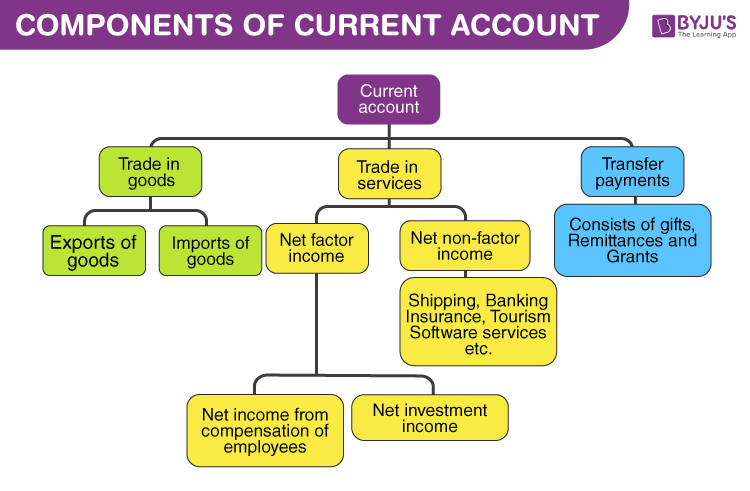
As the video explained, the current account is made up of four parts. The following image provides a useful visual breakdown.
Here's a summary using standard CFA terminology:
- Merchandise Trade: This is the trade in physical goods (e.g., cars, oil, electronics). The difference between the value of a country's exports and imports of goods is called the balance of trade.
- Services: This includes the export and import of services like tourism, transportation (shipping, air travel), insurance, and financial or legal consulting services.
- Income Receipts: This component tracks income paid and received from abroad. It includes:
- Investment Income: Dividends and interest payments earned by domestic residents on their foreign assets, minus dividends and interest paid to foreign residents on their domestic assets.
- Employee Compensation: Wages and salaries earned by residents working abroad, minus payments to foreign workers in the domestic country.
- Unilateral Transfers: These are one-way transfers where nothing is received in return. Examples include foreign aid, official grants, and private remittances (money sent home by workers abroad).
When the sum of credits in the current account is greater than the sum of debits, the country has a current account surplus. When debits exceed credits, it has a current account deficit.
3. The Capital and Financial Accounts
These two accounts track the flow of investments and other capital transfers. They are often discussed together because they both relate to changes in a country's ownership of assets. For the CFA exam, it's important to distinguish between their specific functions.
The following video explains both accounts and highlights the key differences.
Balance of Payments (Current Account, Financial Account and Capital Account)
Let's continue with EconplusDal. This video explains the Capital and Financial accounts, noting that the Capital account is typically much smaller and more specialized.
Watch from 00:50 to 06:18. As you watch, create a simple two-column list and jot down the types of transactions that fall under the Capital Account versus the Financial Account.
Let's solidify those concepts with the precise definitions you'll need for the exam.
The Capital Account
The capital account is the smallest of the three accounts and covers two main types of transactions:
- Capital Transfers: This includes things like debt forgiveness and the transfer of assets by migrants as they enter or leave a country.
- Sales and Purchases of Non-Produced, Non-Financial Assets: This is a technical category that includes the rights to natural resources, and the sale/purchase of intangible assets like patents, copyrights, and trademarks.
It's important to distinguish between payments for the use of a patent (a fee or royalty), which is a service recorded in the current account, and the outright sale of the patent itself, which is recorded in the capital account.
The Financial Account
The financial account is much larger and more significant. It records investment flows—the purchase and sale of foreign assets by domestic residents and of domestic assets by foreign residents. It's best understood by splitting it into two sides:
- Domestic Ownership of Foreign Assets: When a domestic investor buys a foreign stock, bond, or factory, it's a debit (outflow of money) in the financial account. This also includes the country's official reserve assets (foreign currencies and gold held by the central bank).
- Foreign Ownership of Domestic Assets: When a foreign investor buys a domestic stock, bond, or sets up a factory (Foreign Direct Investment - FDI), it's a credit (inflow of money) in the financial account.
These transactions are broadly categorized as Foreign Direct Investment (FDI), which implies a degree of control over the asset, and Portfolio Investment, which is more passive (e.g., buying stocks or bonds).
4. The Balancing Act
Now we bring it all together. The fundamental principle of BOP accounting is:
(Note: In reality, there is a "net errors and omissions" line to account for statistical discrepancies, but for conceptual understanding, we assume they balance to zero).
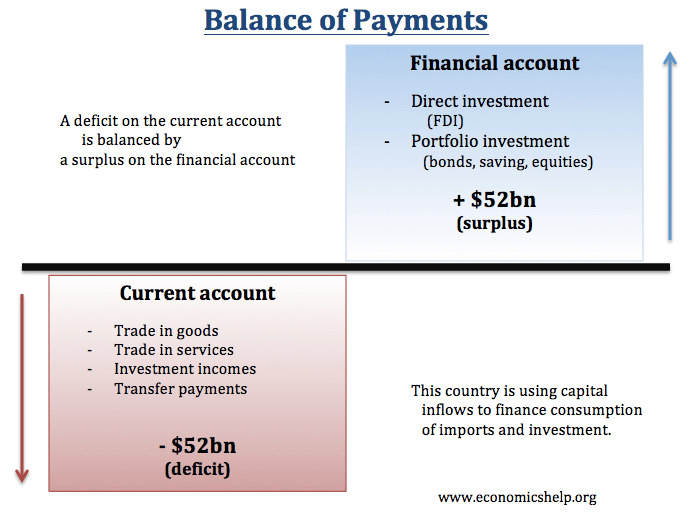
This equation has a powerful real-world implication. If a country has a current account deficit (it buys more goods, services, and pays more income/transfers than it receives), it must be financed by a surplus in the combined capital and financial accounts. In other words, the country must be a net borrower from the rest of the world or be selling off its assets.
This image beautifully illustrates the core relationship, focusing on the two largest accounts.
Putting It into Practice
Let's test your ability to classify transactions. For each item below, decide if it belongs in the current, capital, or financial account. This is a common style of question on the CFA exam.
International Trade and Capital Flows | IFT World
Read the example questions from IFT World. Try to answer each one yourself before looking at the solution. This will help you solidify your understanding of the distinctions between the accounts.
Navigate to the end of section '10. Paired Transactions in the BOP Bookkeeping System' and find the 'Example' section. Work through question 2, which asks you to classify four different transactions.
Here's a quick review of the answers from that exercise:
- Sell gas exploration rights: Sale of a non-produced asset -> Capital Account.
- Sell software-related patents and services: "Services" are a key word -> Current Account.
- Borrow $100 million from a German bank: A change in financial claims (borrowing) -> Financial Account.
- Receive a $5 million dividend: Income from an investment -> Current Account.
Conclusion
In this lesson, we have dissected the Balance of Payments, a comprehensive statement that captures all of a country's international economic dealings. By breaking it down into its three constituent parts, you can now analyze how a country interacts with the global economy, whether it's trading goods, receiving investment income, or financing its consumption by attracting foreign capital.
Key Takeaways:
- The Balance of Payments (BOP) is a double-entry bookkeeping system that records a country's transactions with the rest of the world.
- The Current Account tracks the flow of goods, services, income, and unilateral transfers. A deficit here means a country spends more abroad than it earns.
- The Capital Account records specific capital transfers like debt forgiveness and the sale of non-financial assets like patents.
- The Financial Account records the purchase and sale of financial assets, such as stocks, bonds, and direct investments (FDI).
- The three accounts must sum to zero. A current account deficit must be offset by a surplus in the capital and financial accounts, implying the country is a net borrower or is selling assets to the world.
Preview of the Next Lesson:
The BOP equation has profound implications for a country's domestic economy. In our next lesson, we will explore one of these key connections by examining the relationship between the trade balance, national savings, and domestic investment. We will see how the current account balance is directly linked to whether a country saves more or less than it invests.