Introduction
Welcome back! In our last lesson, we explored how the quantity demanded of a good responds to a change in its own price and how this relationship, measured by price elasticity, affects a firm's total revenue.
Today, we'll expand our analysis by examining how demand is affected by another crucial determinant: consumer income. This lesson directly addresses the learning outcome: to define and calculate income elasticity of demand and distinguish between normal and inferior goods.
Understanding this concept is vital. For businesses and analysts, it helps predict how sales will fare as the economy grows or contracts. For your CFA exam, it's a core concept that allows you to classify goods and interpret demand functions, which are frequently tested skills. We will move from the definition and classification to the practical calculation, ensuring you can confidently solve exam-style problems.
1. Defining Income Elasticity: Normal vs. Inferior Goods
Just as price elasticity measures sensitivity to price changes, income elasticity of demand () measures how sensitive the quantity demanded of a good is to a change in consumer income, assuming all other factors (like price) are held constant.
The formula is:
Unlike with price elasticity, where we often focus on the absolute value, the sign (positive or negative) of the income elasticity is crucial. It tells us what kind of good we are dealing with.
Let's watch a short video that introduces this concept and the fundamental distinction between normal and inferior goods.
Y1 14) Income Elasticity of Demand (YED)
This video from EconplusDal clearly defines income elasticity of demand (YED, where Y represents income) and explains how the sign of the result is used for classification.
Watch the first two minutes of the video (00:00 - 02:06). Focus on the definition, the formula, and how a positive or negative result helps us distinguish between normal and inferior goods.
As the video explained, the sign of gives us our first major classification:
- Normal Goods (): If income elasticity is positive, it means that as consumer income rises, the quantity demanded for the good also rises. This is the case for most goods and services, from restaurant meals to new cars.
- Inferior Goods (): If income elasticity is negative, it means that as consumer income rises, the quantity demanded for the good falls. Consumers substitute away from these goods toward better alternatives as they become wealthier. Classic examples include instant noodles, budget public transportation, or generic-brand items.
2. A Deeper Dive: Necessities and Luxuries
We can further classify normal goods by looking at the magnitude of their income elasticity. This tells us whether the good is a necessity or a luxury.
- Normal Necessity (): Demand for these goods is income inelastic. As income rises, people spend more on them, but the increase in demand is proportionately smaller than the increase in income. Think of goods like toothpaste, milk, or electricity. You'll buy them regardless of your income, and you don't dramatically increase your consumption just because you get a raise.
- Normal Luxury (): Demand for these goods is income elastic. As income rises, the demand for these goods increases by a proportionately larger amount. Examples include fine dining, luxury travel, and high-end sports cars. These are items people tend to buy significantly more of once their basic needs are met and their income grows.
The following image provides an excellent visual summary of these categories.
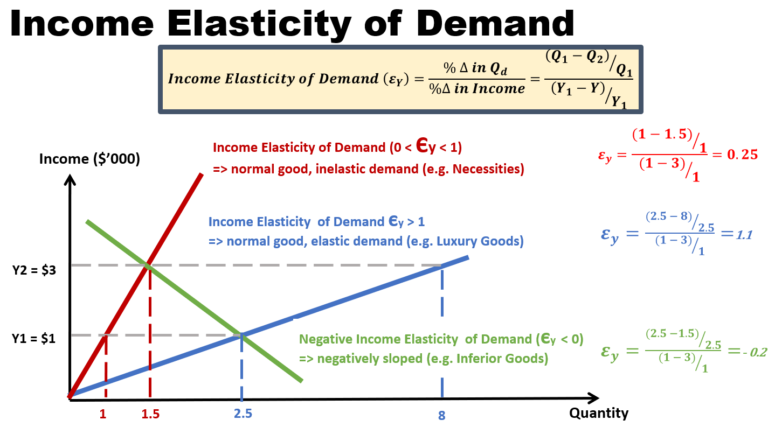
This framework (, , ) is a key classification system you should memorize for the exam.
3. Calculating Income Elasticity of Demand
As a CFA candidate, you'll be expected to calculate income elasticity. The calculation is often based on a given demand function, a common format for exam questions.
The point elasticity formula is:
When you have a linear demand function like Q = a + bP + cI, the term is simply the coefficient of the income variable, c.
Let's see this in action. The following video provides a clear, concise walkthrough of a calculation.
Level 1 CFA Economics: Topics in Demand and Supply Analysis-Lecture 2
This video from IFT demonstrates how to calculate income elasticity using a demand function, which is a key skill for your exam.
Watch the segment from 02:19 to 03:53. Note how the coefficient of the income variable in the demand function is used directly in the elasticity formula.
Practice Problem
Your preference for practical problem-solving is key to mastering this material. Let's work through a typical CFA-style problem from a text-based resource.
Cross Price and Income Elasticity of Demand - PrepNuggets
This article from PrepNuggets presents a demand function and works through the calculation of various elasticities. We will focus on the income elasticity part.
Please read the example under the heading 'EXAMPLE'. Pay close attention to the demand function for E-scooters and the provided values for price and income. Then, follow the step-by-step solution to see how income elasticity is calculated.
Let's break down the logic from the PrepNuggets E-scooter example:
Given:
- Demand function:
- Values: , ,
Step 1: Calculate the quantity demanded (Q).
You must first find the current quantity demanded by plugging the given values into the demand function.
Step 2: Calculate Income Elasticity ().
Now, use the point elasticity formula.
- The coefficient of income () is 0.02.
- Income () is 8,000.
- Quantity () is 11,560.
Step 3: Interpret the result.
- Sign: The result (0.014) is positive, so E-scooters are a normal good.
- Magnitude: The value is between 0 and 1, so they are a normal necessity (income inelastic). This means a 1% increase in income leads to only a 0.014% increase in the quantity of E-scooters demanded.
Conclusion
In this lesson, we added another crucial tool, income elasticity, to our analytical toolkit. We learned how it measures the responsiveness of demand to changes in income and, importantly, how to use its sign and magnitude to classify goods.
Key Takeaways:
- Income Elasticity of Demand () measures how quantity demanded changes in response to a change in consumer income.
- A positive indicates a normal good, where demand rises as income rises.
- A negative indicates an inferior good, where demand falls as income rises.
- For normal goods, if , it's a necessity (income inelastic).
- For normal goods, if , it's a luxury (income elastic).
- You can calculate using the point elasticity formula, , where is the income coefficient from the demand function.
Preview of the Next Lesson:
We have now examined how demand responds to its own price and to consumer income. The final piece of the elasticity puzzle is to understand how the demand for one good is affected by a price change in another good. In the next lesson, we will define and calculate cross-price elasticity of demand, which will allow us to mathematically distinguish between substitutes and complements.