Introduction
Welcome to your next lesson on monetary policy. In our last session, we explored the roles, objectives, and essential qualities of central banks. We established that their primary goal is often price stability, which they pursue with independence, credibility, and transparency. You'll recall that we ended with a key question: how do central banks actually implement their policy decisions?
Today, we will answer that question directly. This lesson addresses the learning outcome: Describe the tools of conventional monetary policy (policy rate, open market operations, reserve requirements). We will dissect the three primary instruments in a central bank's toolkit, examining how each one is used to influence the money supply, interest rates, and ultimately, the broader economy.
This knowledge forms the mechanical foundation of monetary policy and is crucial for your CFA exam preparation.
Let's begin by visualizing the three tools we'll be discussing today.
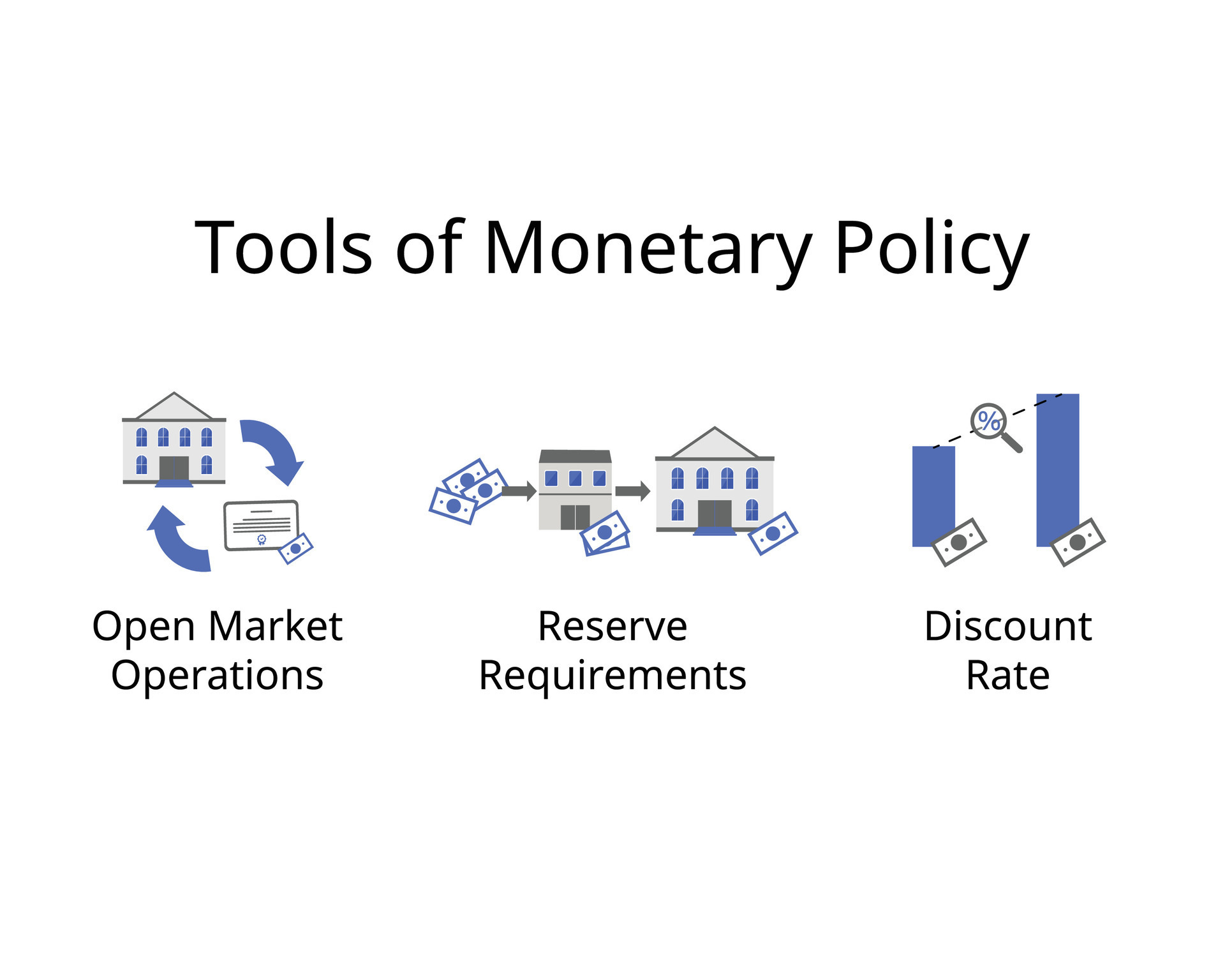
1. Open Market Operations (OMOs)
Open market operations are the most frequently used, flexible, and precise tool of monetary policy, especially in developed economies. They involve the central bank buying or selling government securities (like Treasury bonds) in the open market to or from commercial banks.
To understand the mechanics, it's helpful to first watch a video that illustrates the process and its effect on interest rates.
Monetary policy tools | Financial sector | AP Macroeconomics | Khan Academy
This video from Khan Academy provides an excellent visual explanation of open market operations using the money market model. It clearly shows how buying or selling bonds shifts the money supply curve and changes the equilibrium interest rate.
Watch the segment from 02:02 to 06:22. Pay close attention to how the central bank's action (buying or selling bonds) leads to a change in the quantity of money and the nominal interest rate. Note how it also connects to the money multiplier concept we've discussed previously.
As the video explained, the logic is quite direct:
- Expansionary Policy (to increase money supply): The central bank buys government bonds from commercial banks. It pays for these bonds by crediting the commercial banks' reserve accounts at the central bank. This injection of new money increases bank reserves, allowing them to lend more, which expands the money supply and pushes interest rates down.
- Contractionary Policy (to decrease money supply): The central bank sells government bonds to commercial banks. The banks pay for these bonds by drawing down their reserve accounts. This withdrawal of money drains reserves from the banking system, reducing their capacity to lend, which shrinks the money supply and pushes interest rates up.
To see how this works on a bank's balance sheet, which provides a more technical view, let's turn to a reading.
How a Central Bank Executes Monetary Policy
The following text from OpenEd CUNY explains OMOs with the help of simple balance sheet examples. This will deepen your understanding of the transaction between the central bank and a commercial bank.
Read the sections 'Open Market Operations' and the 'Clear It Up' box that follows it. Focus on how the assets and liabilities on Happy Bank's balance sheet change when the central bank buys or sells bonds. This illustrates the mechanics of how reserves are injected or withdrawn.
In the US, the target of these operations is the federal funds rate—the rate at which banks lend reserves to each other overnight. By buying or selling bonds, the Federal Reserve changes the overall supply of reserves, thereby influencing this key interbank lending rate.
2. The Policy Rate
The second major tool is the central bank's official policy rate. This is the interest rate at which the central bank is willing to lend money to commercial banks. It acts as a powerful signal and a benchmark for other interest rates in the economy.
This rate goes by several names depending on the country, which is important to know for the exam:
- Discount Rate in the United States.
- Refinancing Rate by the European Central Bank (ECB).
- Repo Rate is a common term for short-term collateralized lending.
This reading from PrepNuggets clearly defines the policy rate and explains its role in implementing expansionary and contractionary policy.
Read the section titled 'Policy Rate'. Focus on how changing this rate affects the cost of funds for commercial banks and, in turn, influences their lending behavior.
The mechanism is straightforward:
- Expansionary Policy: The central bank lowers its policy rate. This makes it cheaper for commercial banks to borrow from the central bank if they need liquidity. This lower cost of funds encourages them to lend more freely and at lower rates to consumers and businesses, stimulating economic activity.
- Contractionary Policy: The central bank raises its policy rate. This makes borrowing from the central bank more expensive, signaling a tighter policy stance. Commercial banks tend to become more cautious, increasing their own lending rates and reducing the overall extension of credit, which helps to cool down an overheating economy.
It is worth noting that in many systems, like the U.S. Federal Reserve, borrowing from the central bank at the "discount window" is seen as a backstop or emergency option. The primary tool remains open market operations to guide the interbank rate (the federal funds rate) toward the central bank's target.
3. The Reserve Requirement
The final conventional tool is one we have already encountered: the reserve requirement. This is the percentage of deposits that commercial banks are legally required to hold in reserve and not lend out.
By changing this requirement, a central bank can directly alter the money multiplier (1 / reserve requirement) and thus the banking system's ability to create money.
Let's watch a short video that summarizes this tool's function.
Monetary Policy – Module 4 – Economics – CFA® Level I 2025 (and 2026)
The following clip from the FinQuiz Pro video provides a concise, exam-focused explanation of all three tools, including the reserve requirement.
Watch the segment from 03:09 to 04:21. While it covers all three tools, pay special attention to the explanation of the reserve requirement and how it affects the amount of money banks can lend.
The logic is as follows:
- Expansionary Policy: The central bank lowers the reserve requirement. This frees up reserves, increases the money multiplier, and allows banks to lend out a larger portion of their deposits, expanding the money supply.
- Contractionary Policy: The central bank raises the reserve requirement. This forces banks to hold more money in reserve, reduces the money multiplier, and restricts their ability to create new loans, shrinking the money supply.
Why is it rarely used?
While powerful, changing the reserve requirement is a blunt instrument. It is disruptive to the entire banking system, as all banks must adjust their lending and reserve positions simultaneously. For this reason, most central banks in developed economies rarely use it as an active policy tool, preferring the more nuanced approach of open market operations. However, as the PrepNuggets article mentions, it is sometimes used more actively in developing countries.
Summary: Expansionary vs. Contractionary Policies
Let's consolidate what we've learned into a single table. This is a very useful summary for exam purposes, as it clearly links the policy goal to the specific action for each tool.
| Policy Goal | Tool | Action | Effect on Money Supply | Effect on Interest Rates |
|---|---|---|---|---|
| Expansionary (Stimulate Economy) | Open Market Operations | Central Bank buys securities | Increase | Decrease |
| Policy Rate | Lowers the rate | Increase | Decrease | |
| Reserve Requirement | Lowers the requirement | Increase | Decrease | |
| Contractionary (Slow Economy) | Open Market Operations | Central Bank sells securities | Decrease | Increase |
| Policy Rate | Raises the rate | Decrease | Increase | |
| Reserve Requirement | Raises the requirement | Decrease | Increase |
Conclusion
In this lesson, you have learned the mechanics of how central banks execute conventional monetary policy. You can now describe the three primary tools and how each is used to achieve either an expansionary or a contractionary stance.
Key Takeaways:
- Open Market Operations (OMOs): The buying and selling of government securities to alter bank reserves. Buying bonds increases the money supply and lowers interest rates; selling bonds does the opposite. This is the most common and precise tool.
- The Policy Rate: The rate at which the central bank lends to commercial banks. Lowering the rate is expansionary; raising it is contractionary. It serves as a key benchmark for the financial system.
- The Reserve Requirement: The mandated percentage of deposits banks must hold in reserve. Lowering the requirement is expansionary; raising it is contractionary. It is a powerful but blunt tool that is rarely used for active policy management in developed economies.
Preview of the Next Lesson:
We now understand the tools central banks use to influence money supply and short-term interest rates. But how does a change in, for example, the policy rate actually ripple through the economy to affect consumer spending, business investment, and ultimately, inflation and employment? This chain of events is known as the monetary policy transmission mechanism, and we will explore its various channels in our next lesson.