Introduction
Welcome to our next lesson. In our previous session, we saw how commercial banks create money through the fractional reserve system. We also noted that the reserve requirement, a key parameter in the money multiplier, is set by a higher authority. This authority is the country's central bank.
Today, we will delve into the heart of the monetary system to address the learning outcome: Explain the roles, objectives, and independence of central banks. We will explore what these powerful institutions do, what they aim to achieve, and why their ability to operate without political interference is considered so vital for a healthy economy.
This lesson is structured into three parts:
- The Roles of a Central Bank: What are their fundamental jobs?
- The Objectives of a Central Bank: What are they trying to accomplish?
- The Qualities of an Effective Central Bank: What makes them successful?
1. The Roles of a Central Bank
A central bank is the institution that sits at the apex of a nation's financial system. It performs several critical functions that ensure the system's stability and smooth operation.
The image below provides a great high-level summary of these key responsibilities.
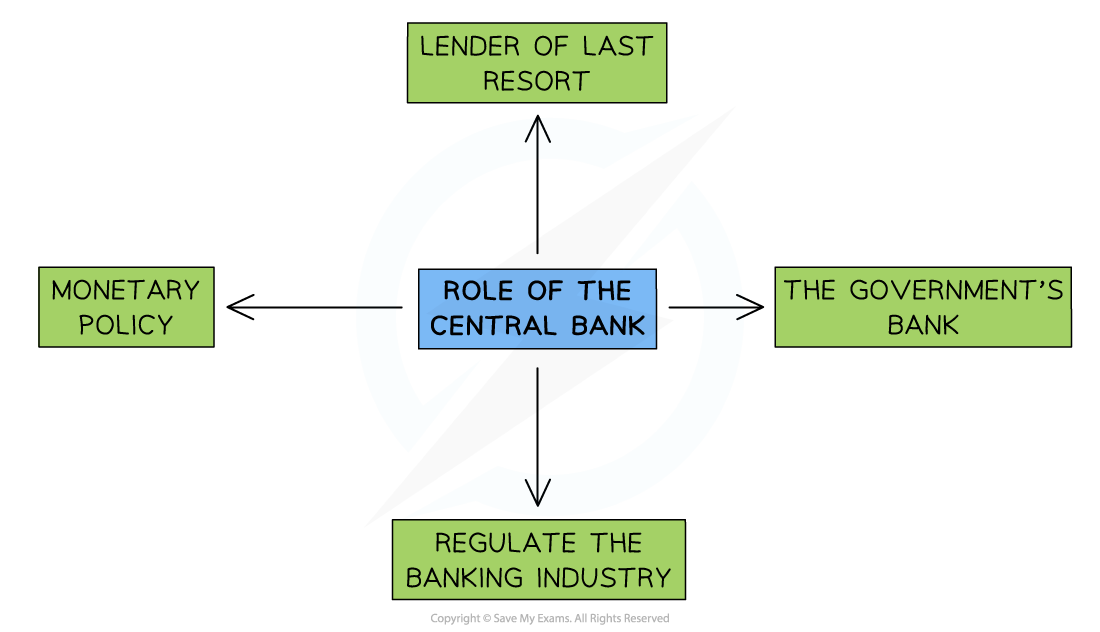
Let's get a more dynamic overview of these roles.
Monetary Policy – Module 4 – Economics – CFA® Level I 2025 (and 2026)
The following short video from FinQuiz Pro provides a quick and clear summary of the various roles a central bank plays in an economy.
Watch the segment from 00:58 to 02:25. As you watch, try to link each role mentioned back to the diagram above.
As the video and diagram show, the main roles are:
- Monopoly Supplier of Currency: The central bank is the only entity with the legal authority to issue currency (notes and coins). The money we use today is fiat money, meaning it isn't backed by a physical commodity like gold but holds value because the government declares it legal tender and people have trust in it.
- Banker to the Government and Commercial Banks: The central bank manages the government's finances and acts as the main bank for the country's commercial banks, processing payments and providing accounts for them to hold their reserves.
- Lender of Last Resort: This is a crucial crisis-management function. If a solvent but temporarily illiquid commercial bank is facing a "bank run" (a surge of withdrawals) and cannot borrow from other banks, the central bank can provide emergency loans to prevent its collapse and stop the panic from spreading through the financial system.
- Regulator of the Payments System & Banking Supervisor: The central bank ensures that the systems used to transfer money (e.g., electronic transfers, checks) are safe and efficient. It often also sets rules for and supervises commercial banks to ensure they operate prudently, although in some countries this supervisory role is handled by a separate agency.
- Conductor of Monetary Policy: This is perhaps their most well-known role. Central banks manage the supply of money and credit to achieve broad economic goals.
This final role leads directly to our next question: what exactly are those goals?
2. The Objectives of a Central Bank
While central banks have several roles, they conduct them in pursuit of specific economic objectives. Although these can vary, for most developed countries, the single most important objective is price stability.
Price stability means maintaining a low and stable rate of inflation. High and unpredictable inflation creates uncertainty, erodes the value of savings, and can distort economic decisions, ultimately hindering long-term growth.
To achieve this, most central banks today use a framework called inflation targeting.
Monetary policy objectives (for the CFA Level 1 exam)
This video from the 'Let me explain' channel provides an excellent, in-depth discussion on monetary policy objectives, focusing on the widely adopted practice of inflation targeting.
Please watch the video twice: First, from the beginning to 03:46 to get an introduction to inflation targeting and its history. Then, watch from 16:00 to 24:31. This section answers crucial questions that you will likely see on the exam: Why is the target typically 2% and not 0%? What are the key exceptions to this rule, such as the US and Japan?
As the video explains, a target of around 2% is common because:
- A 0% target runs the risk of tipping into deflation (falling prices), which can be very damaging as consumers delay spending, causing economic stagnation.
- A significantly higher target can lead to inflation becoming unstable and difficult to control.
It's also crucial to note the exceptions for the CFA exam:
- The U.S. Federal Reserve (The Fed): Does not have a single, explicit inflation target. Instead, it has a "dual mandate" by law to pursue maximum employment and stable prices, along with a third objective of promoting moderate long-term interest rates. It seeks a balance among these goals.
- The Bank of Japan (BoJ): For decades, its primary battle has been against persistent deflation, so its policy focus has been on stimulating the economy to escape this trap, rather than controlling high inflation.
3. The Qualities of an Effective Central Bank
Having a clear objective like inflation targeting isn't enough. For a central bank to be successful, especially in controlling inflation, it must possess three essential qualities: independence, credibility, and transparency. These concepts are highly testable.
Monetary policy objectives (for the CFA Level 1 exam)
Let's return to the 'Let me explain' video, which breaks down these three qualities in detail.
Watch the segment from 03:46 to 16:00. This is a crucial part of the lesson. Pay close attention to: The difference between operational independence and target independence. Why a central bank's credibility can become a self-fulfilling prophecy. How transparency (e.g., through regular inflation reports) helps build that credibility.
To consolidate what you've just learned, please read the following short text, which summarizes these three desirable qualities perfectly.
Desirable Qualities of a Central Bank
This reading from PrepNuggets offers a concise, exam-focused summary of the key qualities of an effective central bank. It's a great way to review and solidify the concepts from the video.
Read the section titled 'Desirable Qualities of a Central Bank'. This will reinforce your understanding of independence, credibility, and transparency.
Let's quickly recap these three pillars:
-
Independence: The central bank must be free from short-term political interference. A government facing an election might be tempted to pressure the central bank to lower interest rates to create a short-term economic boom, even if it leads to higher inflation after the election.
- Operational Independence: The central bank has the authority to decide what level to set its policy rates.
- Target Independence: The central bank also has the authority to define the inflation target itself (e.g., what the target percentage is and how it's measured). This is a higher degree of independence.
-
Credibility: The public and financial markets must believe that the central bank will follow through on its stated intentions. If a central bank is credible, its inflation target becomes an anchor for public expectations. For instance, if everyone believes the bank will keep inflation at 2%, they will factor this into wage negotiations and price-setting, which helps to actually keep inflation at 2%.
-
Transparency: A central bank should be open and clear in its communication. By regularly publishing its economic forecasts, policy decisions, and the reasoning behind them (often in an "Inflation Report" or similar document), it builds public trust and enhances its credibility.
Conclusion
In this lesson, we have established a foundational understanding of the central bank's place in the economy. You now know what they do, what they're aiming for, and what enables them to succeed.
Key Takeaways:
- Roles: Central banks are the sole currency issuers, act as bankers to the government and other banks, serve as the lender of last resort, and conduct monetary policy.
- Objectives: The primary objective for most central banks is price stability, which they commonly pursue through an inflation target of around 2%. Key exceptions include the US Federal Reserve with its dual mandate and the Bank of Japan's focus on fighting deflation.
- Qualities for Effectiveness: To achieve their objectives, central banks must have independence (both operational and ideally target), credibility with the public, and transparency in their communications.
Preview of the Next Lesson:
We've discussed what central banks do and why, but we haven't yet detailed how they conduct monetary policy. In our next lesson, we will examine the specific tools of conventional monetary policy, such as the policy rate, open market operations, and the reserve requirement you learned about previously. We will see exactly how these tools are used to influence the money supply and interest rates to steer the economy.