Introduction
Welcome back! In our previous lesson, we established what money is, its essential functions in an economy, and how it's measured using aggregates like M1 and M2. We noted that a significant component of these measures consists of bank deposits. This sets the stage perfectly for today's topic.
Today, we'll explore a core concept in banking and macroeconomics that directly addresses the learning outcome: Explain money creation through fractional reserve banking and calculate the money multiplier. You will learn that banks are not just passive storehouses for money; they are active creators of it. We will break this process down into simple, digestible steps, see how it works mechanically, and then learn the formula to calculate the total amount of money that can be created from a single new deposit.
1. The Core Idea: Fractional Reserve Banking
At its heart, the modern banking system operates on a simple premise: not all depositors will withdraw all their money at the same time. This allows banks to keep only a fraction of total deposits on hand as reserves and lend out the rest. This system is known as fractional reserve banking. The portion of deposits that a bank must hold in reserve is determined by the reserve requirement, a regulation often set by a country's central bank.
To get a clear, intuitive overview of this concept, let's start with a short video.
Fractional Reserve Banking and the Money Multiplier Made Simple
This video from Marginal Revolution University introduces the fundamental concept of fractional reserve banking and how banks use deposits to make loans.
Please watch from the beginning until 01:54. Focus on how a bank handles a new deposit and the definition of the reserve ratio.
As the video explains, when you deposit money, the bank holds a fraction in reserve and lends the majority out. This act of lending is the first step in the money creation process.
2. The Chain Reaction of Money Creation
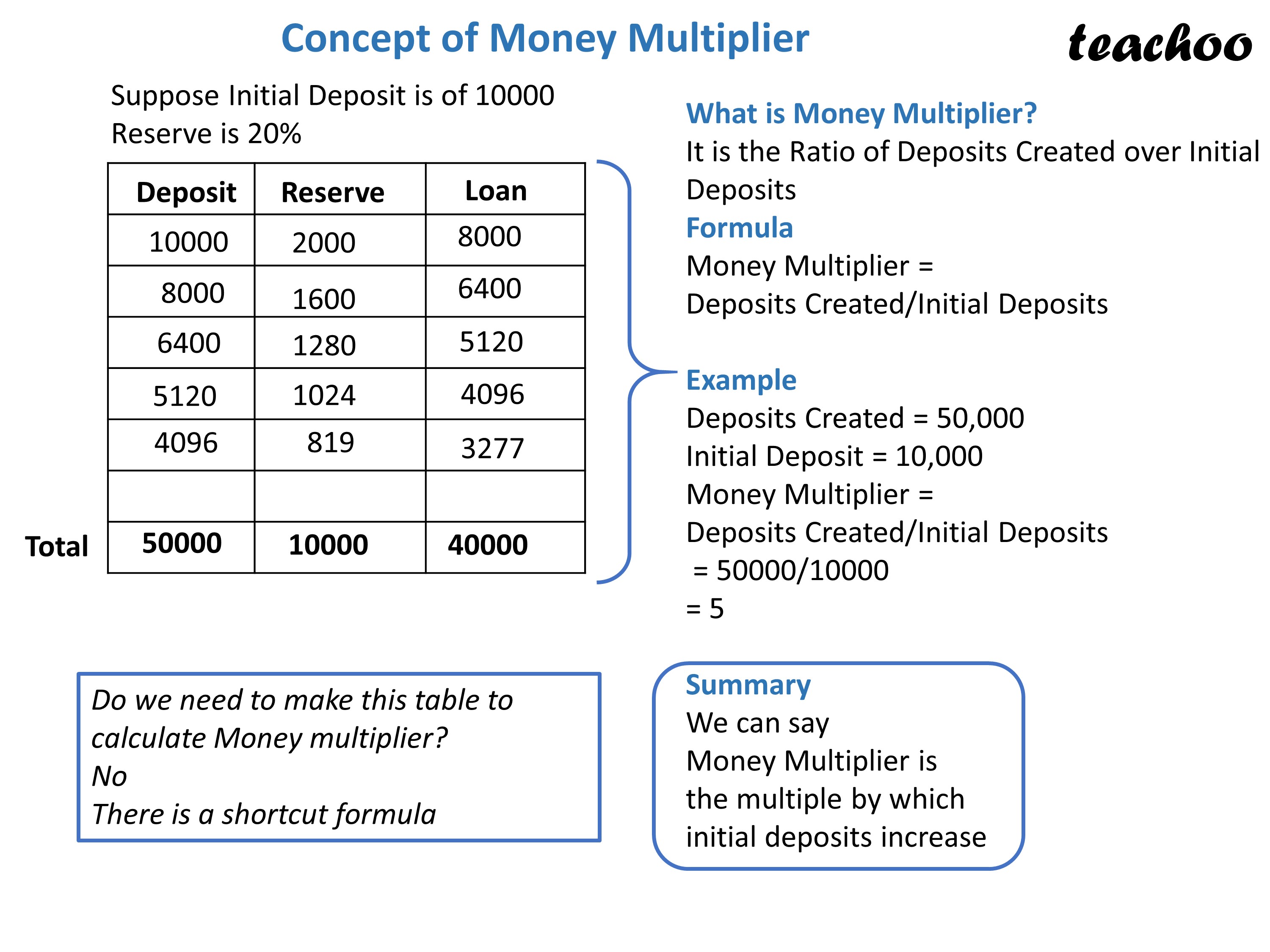
So, how does that initial loan create more money? It happens through a chain reaction of depositing and lending. The money that is lent out is typically spent, and the person who receives that money then deposits it into their own bank. This new deposit becomes the basis for another loan, and the process repeats.
Let's watch a detailed walkthrough that is specific to the CFA curriculum's perspective.
Level I CFA: Economics: Monetary and Fiscal Policy-Lecture 1
The following clip from IFT, a CFA prep provider, gives a concise numerical example of the money creation process, starting with a €100 deposit.
Watch the segment from 04:33 to 08:45. Pay close attention to how the initial deposit flows through multiple banks, creating new, smaller deposits at each step.
This process can be visualized as a series of transactions that expand the money supply.

Given your interest in accountancy, viewing this process through the lens of a bank's balance sheet (assets and liabilities) can be particularly insightful. A deposit is a liability for a bank (it's owed to the depositor), while reserves and loans are assets.
The following reading provides an excellent breakdown of this process using simplified balance sheets.
Money Creation Process Explained | CFA Level 1 - AnalystPrep
This article from AnalystPrep provides a clear, step-by-step example of money creation, illustrating how deposits, reserves, and loans affect the balance sheets of several banks in the chain.
Please read the introduction and the section 'Example of the Money Creation Process.' Notice how the asset side (Reserves + Loans) always balances the liability side (Deposits) for each bank.
As you can see from the examples, an initial deposit of €50, with a 20% reserve requirement, leads to a total amount of money far greater than the original €50. But how much greater? For that, we need the money multiplier.
3. The Money Multiplier
Instead of adding up the infinite series of smaller and smaller deposits, we can use a simple formula to find the total effect. This is where the money multiplier comes in.
The money multiplier is the factor by which an initial deposit is multiplied to find the total amount of money created. Its formula is simply the reciprocal of the reserve requirement.
So, if the reserve requirement is 10% (or 0.10), the money multiplier is . This means that every new dollar of reserves has the potential to create ten dollars of new money in the banking system.
To find the total amount of money created from a new deposit, we use the following formula:
An Important Caveat: Potential vs. Actual Multiplier
The formula for the money multiplier calculates its maximum potential. It operates under two key assumptions:
- Banks lend out all of their excess reserves (the amount above the required reserve).
- All loaned money is redeposited into the banking system (i.e., no one holds the loan proceeds as physical cash).
In reality, neither of these is perfectly true. Banks may choose to hold excess reserves for liquidity reasons, and individuals or businesses might hold some cash. These "leakages" from the banking system reduce the actual money multiplier.
The following video explains this important distinction.
Fractional Reserve Banking and the Money Multiplier Made Simple
This final clip from the Marginal Revolution University video discusses the factors that cause the real-world money multiplier to be lower than the theoretical maximum.
Watch from 04:07 to 06:33. Focus on the two main reasons the actual multiplier is smaller: banks holding excess reserves and individuals holding cash.
For the CFA exam, you will typically work with the potential money multiplier unless otherwise specified, but understanding this real-world nuance provides a more complete picture.
4. Practice Application
Let's put this into practice with a typical CFA-style question. This will help solidify your understanding of the calculation.
Question:
The reserve requirement for banks in a certain economy is 8%. If a customer makes a new cash deposit of $500, what is the maximum potential amount of money that can be created?
A. $40
B. $540
C. $6,250
Solution
The correct answer is C.
-
Identify the inputs:
- New Deposit = $500
- Reserve Requirement = 8% = 0.08
-
Apply the formula for total money created:
-
Calculate the result:
Therefore, the initial $500 deposit can lead to a maximum of $6,250 in total money within the banking system.
Conclusion
In this lesson, we demystified the process of money creation. You've seen that when a bank makes a loan, it's not simply passing along existing money; it is creating a new deposit and thereby expanding the money supply.
Key Takeaways:
- Fractional Reserve Banking is the system where banks keep only a fraction of deposits as reserves and lend out the rest.
- The Money Creation Process is a chain reaction: loans become new deposits at other banks, which in turn become the basis for new loans.
- The Money Multiplier quantifies this effect. Its formula is .
- The total potential money created is calculated as the New Deposit multiplied by the Money Multiplier.
- The actual money multiplier is typically smaller than the potential multiplier due to "leakages" like banks holding excess reserves and individuals holding cash.
Preview of the Next Lesson:
We've mentioned the "reserve requirement" several times today, noting it's often set by a central authority. This leads us to our next topic: the central bank. In the next lesson, we will explore the roles, objectives, and crucial concept of the independence of central banks, the institutions that stand at the center of the monetary system.